
Driveways
Driveways and turnarounds
Gravel-to-concrete conversions, replacements and widenings on a compacted base, with control joints laid out before the pour and thickness stepped up where trucks and trailers turn.
Long rural driveways, aprons onto County roads, garage and shop slabs, footings, walks and steps — poured on a base compacted over Lakeside’s loose river sand or cut into granite, with the County’s road permit handled for you. Owner-run and licensed; free on-site estimate from Alpine.
CSLB #979389 · C-29 Licensed · Bonded $25,000 · Free on-site estimates
Lakeside concrete by the numbers
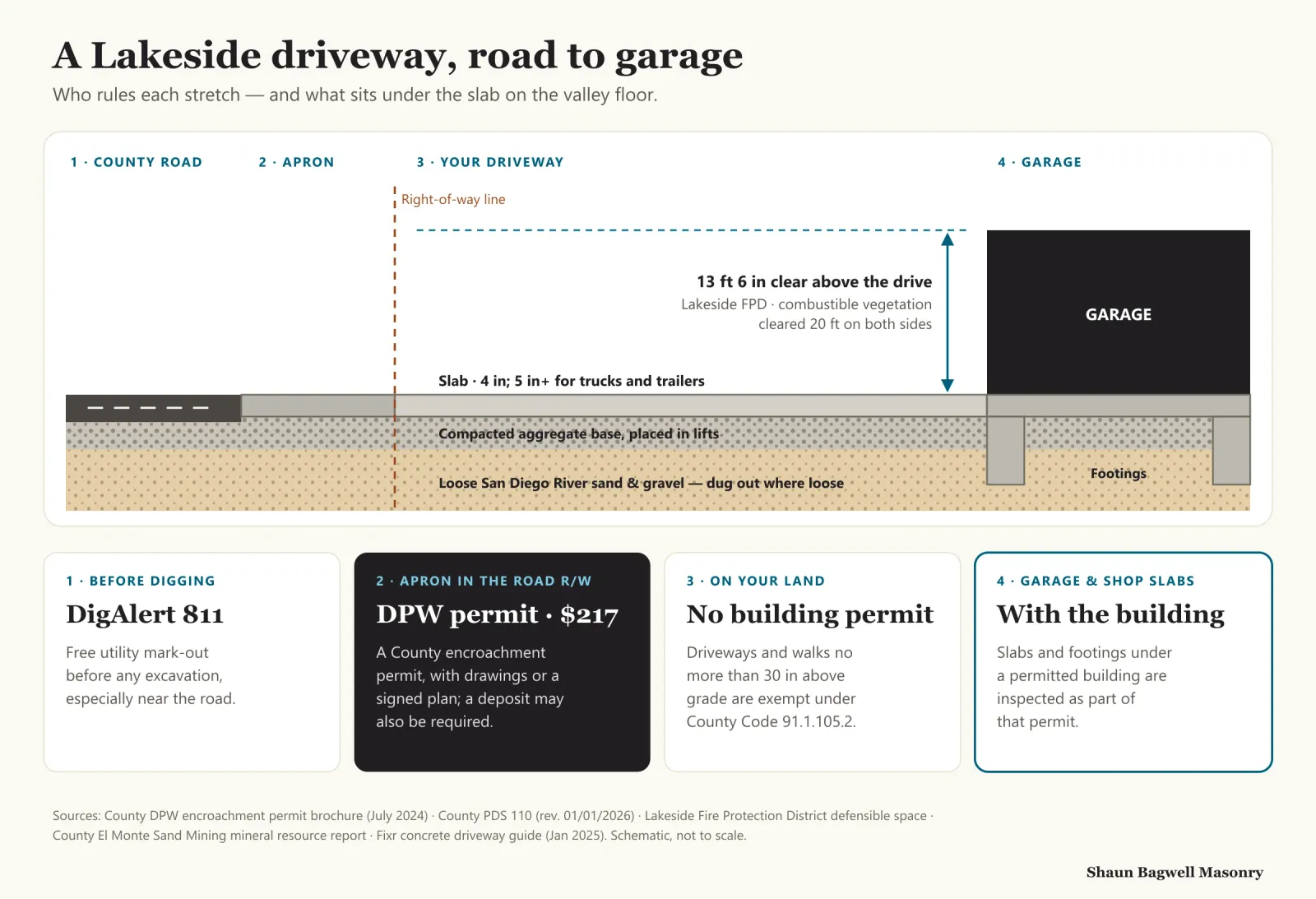
Concrete in Lakeside is mostly about getting from the road to the house. The County notes that many Lakeside homes have small horse corrals, and rural parcels mean long drives, turnarounds for trailers and aprons that tie into County roads, where the first stretch of the drive sits in the County’s right-of-way rather than on your lot. Any work there needs a written encroachment permit ($217 in the July 2024 brochure) and a DigAlert ticket before anyone digs.
Under the slab, the County’s El Monte Valley mineral report describes the valley floor as loose sands and gravels from the San Diego River, with granitic bedrock on the slopes. Loose granular ground is why a Lakeside driveway or slab starts with digging out and compacting a proper base — and why a drive that carries trucks and horse trailers is poured thicker. Lakeside Fire Protection District adds its own driveway rules: a 13-foot-6-inch clear height and combustible vegetation cleared 20 feet either side.
Flatwork, footings and slabs — the same scope as our county-wide concrete services, built for ranch lots and County roads.
Driveways
Gravel-to-concrete conversions, replacements and widenings on a compacted base, with control joints laid out before the pour and thickness stepped up where trucks and trailers turn.
County roads
The section between your driveway and the road edge, built under a County DPW encroachment permit with drawings or a signed plan, and a DigAlert ticket before excavation.
Slabs
Reinforced slabs for garages, workshops, tack rooms and equipment pads — permitted with the building they sit under, on a base built for the ground.
Footings
Wall, pillar and gate footings, and footings for additions — sized to the load and carried to firm bearing through loose valley sand or into rock on the hillsides.
Flatwork
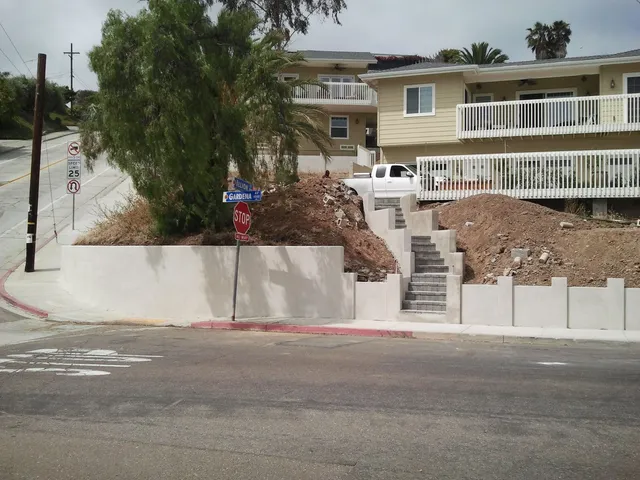
Broom, colored or exposed-aggregate patios, walks and steps sloped away from the house — and, poured against the walls, a non-combustible Zone Zero for the fire district.
Replacement
Removal and replacement of slabs that sank on loose fill or heaved at the joints — fixing the base underneath, not just the surface.
Most failures start below the surface. On the valley floor the loose sand and gravel the County describes is excavated and replaced with aggregate base compacted in lifts; on the hillsides, rock is broken out or worked around and water is directed off the slope. Then reinforcement, a mix specified for its use, joints cut at the right spacing, and curing time before traffic.
Strength is specified at 28 days — that is what concrete is tested and accepted against under ACI 318 — which is why a driveway poured on Monday isn’t carrying a horse trailer by Friday. For the footings under masonry walls, the County’s own Table A calls for 2,500 psi concrete; driveways and slabs are poured to a stronger mix.
Lakeside is unincorporated, so concrete work answers to the County of San Diego. Driveways, walks, patios and decks no more than 30 inches above the adjacent grade are exempt from a building permit (County Code 91.1.105.2). Footings and slabs that carry a building, garage or wall that needs a permit are inspected as part of that permit.
The apron is different. The County Department of Public Works defines a nonstandard driveway or any object in, under or over a County road as an encroachment, and requires a written encroachment permit before it is placed or changed — $217 plus a possible deposit in the July 2024 brochure, with drawings or a signed plan. Large site work — moving more than 200 cubic yards of earth, or a cut or fill more than 8 feet high — also needs a County grading permit.
Lakeside Fire Protection District sets the driveway clearances: 13 feet 6 inches of vertical clearance over roads and driveways, and hazardous or combustible vegetation removed within 20 feet on both sides of the driveways and roads that bound a property.
The finish changes the look, the traction and the price. National cost-guide figures for driveways, for comparison.
| Broom finish | Colored or exposed aggregate | Stamped | |
|---|---|---|---|
| Look | Plain, light texture | Tinted or pebble surface | Patterned like stone or brick |
| Traction | Good — the standard for driveways | Good to very good | Smoother; needs a textured sealer |
| Shows dust and wear | Shows tyre marks | Hides dirt well — suits rural drives | Sealer wears in traffic lanes |
| National cost (per sq ft) | $6–$8 plain · $8–$12 broom | $8–$12 | $12–$18 |
Cost: Fixr concrete driveway guide, January 2025 (national, not our price).
Shaun checks the ground, the drainage, the loads and where the drive meets the County road.
DPW encroachment permit for the apron, grading or building permits where needed, and a DigAlert ticket.
Loose material out, base placed and compacted in lifts, forms set to grade and slope.
Reinforcement placed, concrete poured and finished, joints cut before shrinkage cracks can choose their own line.
Kept moist and off-limits while it gains strength; vehicles wait for the agreed cure time.
County sign-off on the apron where required, and a walk-through on sealing and care.
Planning one? Shaun will walk the site with you and tell you what it needs — free, no obligation.
Call (619) 581-2492National cost-guide figures for comparison. In Lakeside, the length of the drive, base depth over loose sand, rock on hillsides and the County apron permit move the number.
| Project (national) | Typical installed cost |
|---|---|
| Concrete driveway, 24 × 24 ft, 5 in | $5,184 average ($3,460–$6,910) |
| Driveway, broom or colored | $8–$12 per sq ft |
| Concrete patio | $6–$17 per sq ft |
| Stamped concrete | $12–$18 per sq ft |
Fixr national cost guides (driveway Jan 2025, patio 2022) — not our price. The County encroachment fee and any engineering are extra and shown on the proposal.
Ground, access and the road you connect to change from one part of Lakeside to the next.
The Lakeside page covers the ground, permits and neighbourhoods across every kind of job. The county-wide pages go deeper on the build itself.
Straight answers before you hire. Anything else — call, and Shaun answers it himself.
Call (619) 581-2492Not for the driveway on your own land if it is no more than 30 inches above the adjacent grade — County Code 91.1.105.2 exempts it. The apron where the drive meets a County road is an encroachment and needs a Department of Public Works permit ($217 in the July 2024 brochure).
On a County road, that strip is County right-of-way. The DPW requires a written encroachment permit before a driveway is placed or changed there, and may ask for a deposit or removal agreement. We prepare the drawings and pull the permit.
Cost guides put residential driveways at 4 inches and recommend 5 inches or more for heavy trucks and machinery. On loose valley sand the compacted base matters as much as the slab; we size both for the loads you actually run.
Usually the base. Lakeside’s valley floor is loose San Diego River sand and gravel, and a slab poured on poorly compacted fill settles unevenly. Missing or badly spaced control joints let shrinkage cracks run where they like. Replacement fixes the base first.
Yes. Lakeside Fire Protection District asks for 13 feet 6 inches of vertical clearance over roads and driveways and for hazardous or combustible vegetation to be removed within 20 feet on both sides. Concrete against the house also counts as non-combustible Zone Zero.
Concrete’s specified strength is tested at 28 days (ACI 318). Light foot traffic comes much sooner, but heavy vehicles wait for the cure time we agree on for your mix and weather.
Fixr’s national benchmark — 24 × 24 feet, 5 inches, broom finish — averages $5,184. Lakeside jobs vary with length, base work and the County apron permit; you get an itemised written price after a free visit.
Shaun Bagwell Masonry holds California C-29 licence #979389 with a $25,000 bond. Any job of $1,000 or more, or one that needs a permit, must be done by a licensed contractor (AB 2622). Check the licence at cslb.ca.gov.
Call Shaun at (619) 581-2492 or send the form. He’ll look at the ground, the loads and the County road, and put a written, itemised price in your hands.