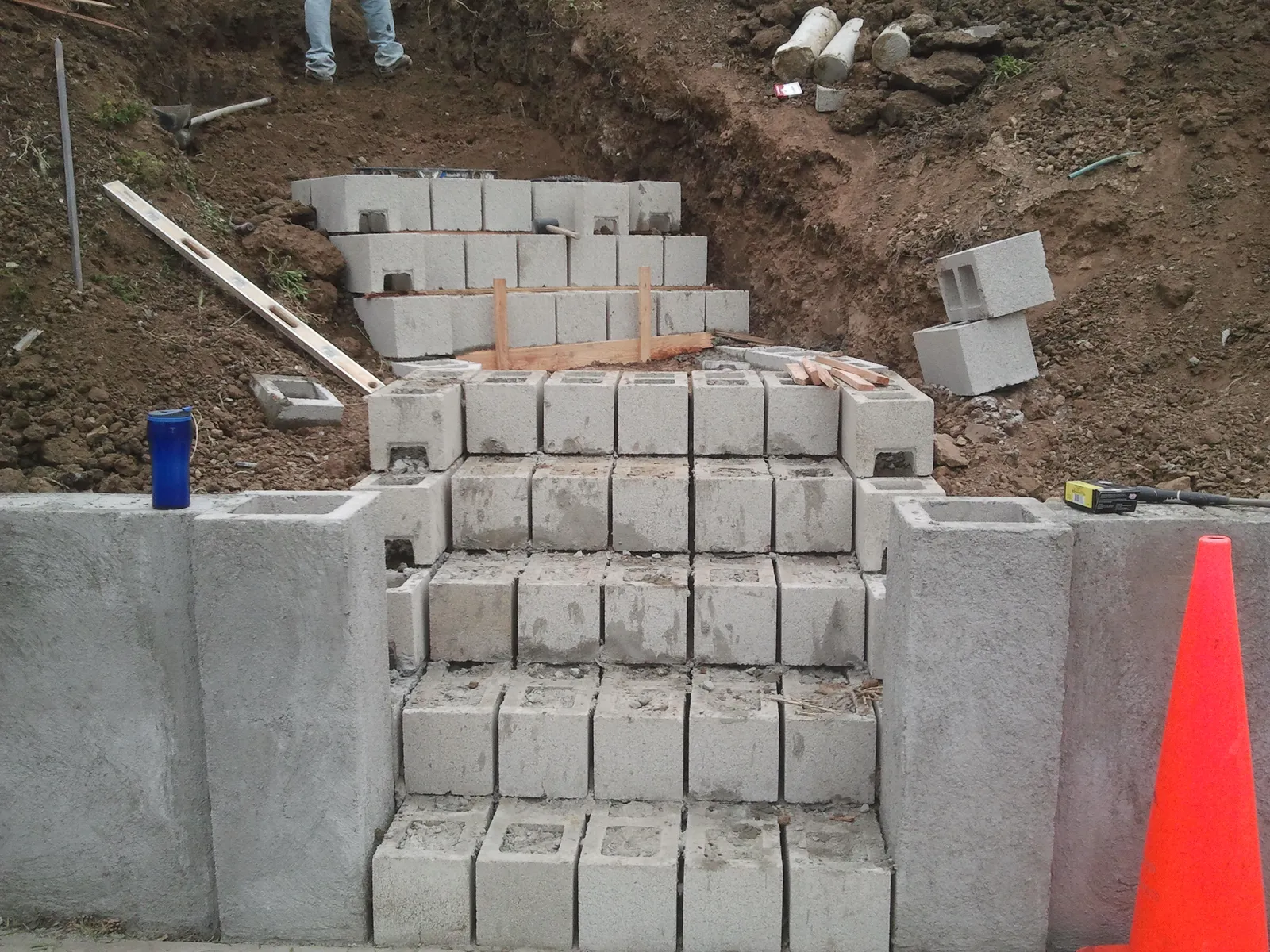
New concrete block stair walls being laid up an excavated slope, cells open for grout, with building materials staged on the bank.

Concrete Contractor in Spring Valley — Driveways, Slabs & Footings

Tearing out a cracked 1970s driveway, pouring a patio or steps, or setting footings for a wall? We dig out what shouldn’t be under it, pour it with the right strength, steel and joints, and handle the County right-of-way permit for the apron. Written price after a free site visit.

CSLB #979389 · C-29 Licensed · Bonded $25,000 · Free on-site estimates

Concrete in Spring Valley, by the numbers

Fifty-Year-Old Flatwork, Two Permit Offices

Most of Spring Valley’s driveways, walks and patio slabs were poured with the houses — and 59.8% of those houses predate 1980. Half a century of wet winters and settling fill is why so much of the concrete work here is tear-out and replacement. Nationally, the median homeowner spent $2,900 on a driveway or walkway project in the two years to 2023; replacing one here has a local wrinkle the national figure doesn’t show.

That wrinkle is jurisdiction. Spring Valley has no city, so the work on your lot answers to County Planning & Development Services, while the apron, sidewalk and curb sit in the County road right-of-way and need a separate encroachment permit — $217, plus a DigAlert ticket two working days before anyone digs. Underneath, a 2020 County study at the Casa de Oro Library site on Conrad Drive found about 3 feet of undocumented fill over clay-bearing soil: the reason we probe before we pour.

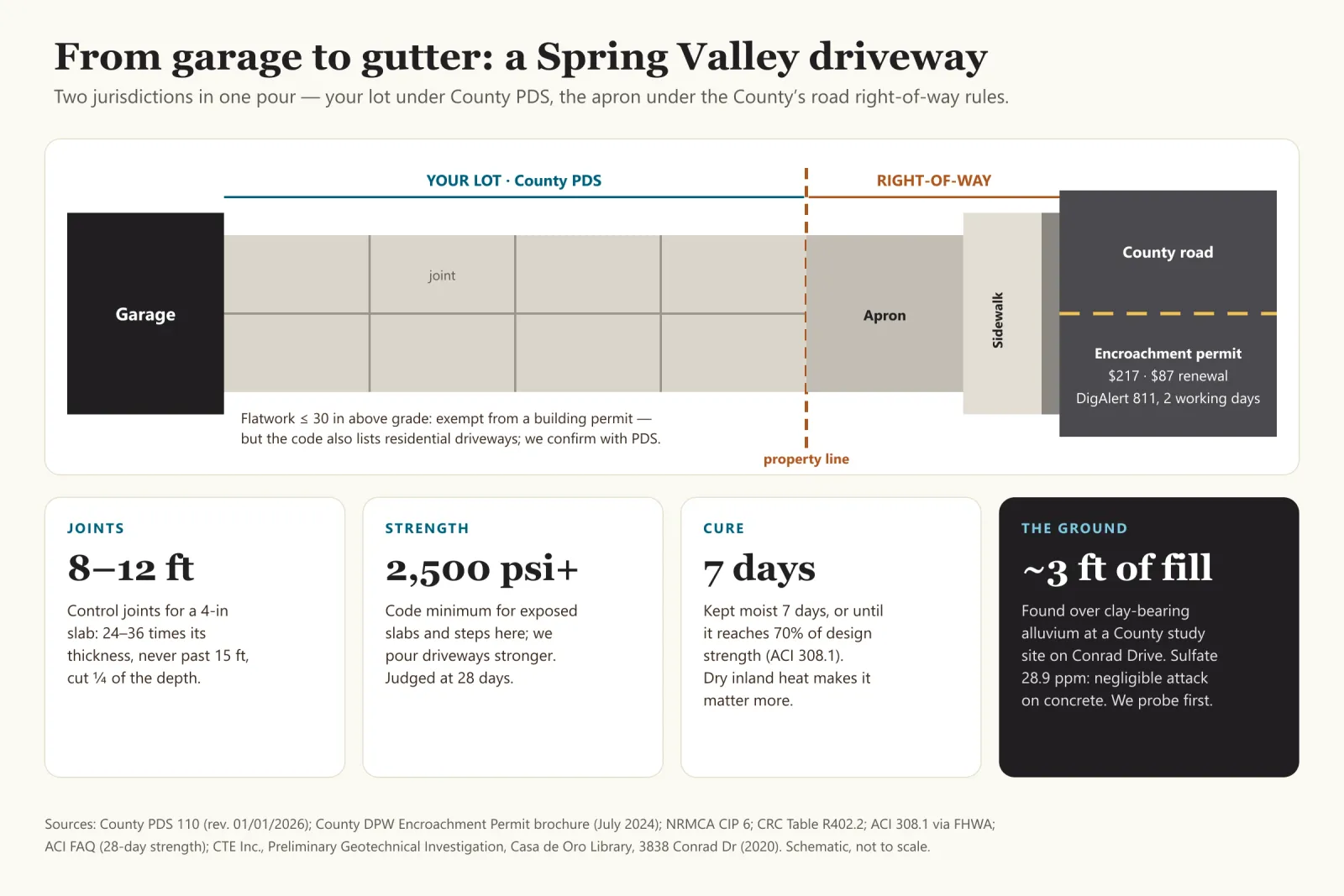
Infographic: from garage to gutter, a Spring Valley driveway. A plan view runs from the garage across the driveway on your lot, governed by County PDS, to the property line, then the apron, sidewalk and curb in the County road right-of-way. On the lot, flatwork no more than 30 inches above grade is exempt from a building permit, but the code also lists residential driveways, so we confirm with PDS. In the right-of-way, a County encroachment permit costs 217 dollars with an 87 dollar renewal, and DigAlert 811 must be called two working days before digging. Four cards: control joints every 8 to 12 feet for a 4-inch slab, 24 to 36 times the thickness and never past 15 feet, cut a quarter of the depth; at least 2,500 psi for exposed slabs and steps, judged at 28 days; kept moist 7 days or until it reaches 70 percent of design strength; and about 3 feet of fill over clay-bearing alluvium at a County study site on Conrad Drive, with sulfate of 28.9 ppm meaning negligible attack on concrete.
One pour, two permit desks. Your side of the property line is County PDS; the apron is the County’s road right-of-way. We pull both — and confirm with PDS where the code is unclear rather than guess.Sources: County PDS 110; County DPW encroachment; NRMCA CIP 6; CTE geotech (2020).

Concrete Work We Do in Spring Valley

Flatwork, footings and structural slabs, poured by the same licensed crew that builds the walls on them. The county-wide detail is on our concrete contractor page.

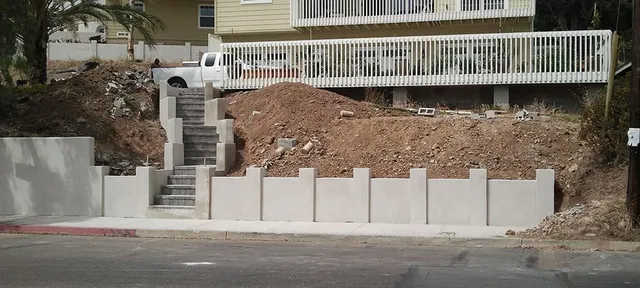
Street-front block wall with pilasters and a stairway above a sidewalk and curb, with the slope behind still being graded.

Driveways

Driveway replacement and widening

Old slab broken out and hauled, soft fill dug out, base compacted, and a thicker, reinforced slab poured with joints laid out before the truck arrives. Aprons and curb cuts go through the County encroachment permit.
Patios & walks

Patios, walkways and side yards

Broom, colored or exposed-aggregate slabs sloped 2% away from the house — including the hardscape band in the first 5 feet that San Miguel Fire & Rescue asks for.

Steps

Steps, landings and ramps

Formed concrete steps with even risers and non-slip finishes, landings at doors, and gentle ramps where a sloped Spring Valley lot meets the driveway.

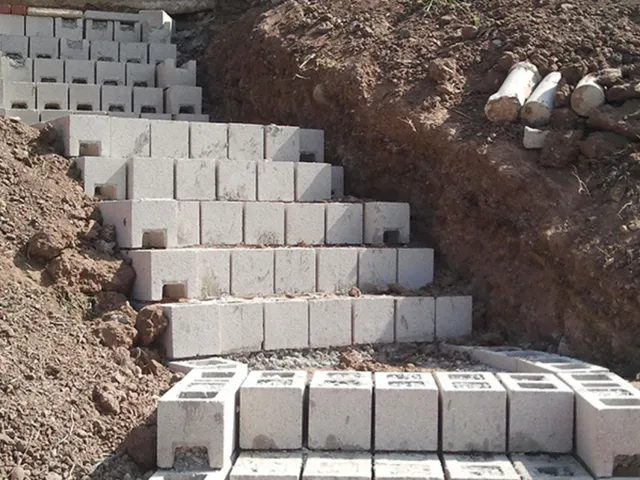
Courses of grey concrete block stepping up a freshly cut earth slope above new footings, cells open for grout.

Footings

Footings for walls, pillars and fireplaces

Footings sized to the load and taken below fill to firm soil — the part of every block wall, pillar and outdoor fireplace you never see and the part that decides how long it lasts.

Slabs

Garage, shed and equipment slabs

Slabs on a compacted base with the thickness, steel and vapour control the use calls for; structural slabs and foundations go through County PDS permits.

Rain-friendly

Pervious concrete

Open-graded concrete that lets rain through to a stone reservoir — one of the surfaces the County’s Rain-Friendly Pavement rebate covers when it replaces old hardscape. On slow-draining soil it gets an underdrain.

How We Pour It

Concrete strength is specified and accepted at 28 days. The residential code’s minimum for porches, steps and garage slabs exposed to the weather in a negligible-weathering region like San Diego’s is 2,500 psi; we pour driveways and garage slabs at 3,000–4,000 psi. Curing matters as much as the mix: the ACI default is to keep it moist for 7 days, or until it reaches 70% of its design strength — and on a dry, warm Spring Valley afternoon an uncured slab loses water from the surface fast.

Cracks are planned, not avoided. Control joints go in every 24 to 36 times the slab’s thickness — 8 to 12 feet on a 4-inch slab, never more than 15 — cut a quarter of the depth. Underneath, the Conrad Drive borings are a useful warning: about 3 feet of undocumented fill, clay-bearing soil, groundwater within 10 feet. The same study found soil sulfate at 28.9 ppm, which the engineers rated a negligible corrosion risk to concrete. We probe before we pour, and remove or recompact what won’t hold a slab.

Exposed slabs and steps
2,500 psi minimum
Negligible-weathering region; we pour driveways at 3,000–4,000 psi.CRC Table R402.2
Control joints
24–36 × thickness
8–12 ft on a 4-in slab; max 15 ft; saw-cut ¼ of the depth.NRMCA CIP 6
Curing
7 days, or 70% of f′c
The ACI 308.1 default above 10 °C.FHWA / ACI 308.1
Next to the house
2% fall away
Hard surfaces within 10 ft of the foundation.CRC R401.3
Concrete pavements
30–50 year service life
Average for concrete pavements — base and joints decide where in that range.American Cement Assoc.

Permits for Concrete Work in Spring Valley

County Code exempts walks and driveways no more than 30 inches above adjacent grade, not over a basement or story and not part of an accessible route, from a building permit (Sec. 91.1.105.2(a)(9)). A separate section, though, says no one shall build a residential driveway without a permit unless it’s part of a new house permit (Sec. 91.1.105(b)). The two read differently, so on driveway jobs we confirm with County PDS before pouring rather than guess. Foundations and structural slabs always need a permit, and any job that needs a grading permit pulls its walls and drainage in with it.

The apron is a separate matter. An encroachment includes any nonstandard driveway or structure “in, under or over any portion of the highway”, and a written County Encroachment Permit is needed before it’s placed or changed: $217, $87 to renew, sometimes a deposit, and a DigAlert ticket before excavation. If you’re hoping for a rebate, note the split: the County’s Rain-Friendly Pavement rebate covers pervious concrete replacing old hardscape, while turf-replacement rebates disqualify concrete surfaces altogether.

Walks and driveways
Exempt to 30 in high
But Sec. 91.1.105(b) lists residential driveways — confirmed with PDS per job.PDS 110
Apron, sidewalk, curb
Encroachment permit
$217 permit, $87 renewal; drawings or signed plan required.County DPW
Before excavation
DigAlert 811
Two working days ahead; the permit isn’t valid without the ticket.County DPW
Pervious concrete
Up to $15/sq ft rebate
Replacing existing hardscape; unincorporated only; funding limited.County DPW
Turf conversions
Concrete disqualified
Surfaces air and water can’t pass through don’t count.SoCal WaterSmart

Choosing a Finish

The finish changes grip, heat underfoot, upkeep and price. Costs are national cost-guide figures for a driveway (Fixr, January 2025), for comparison only.

Choosing a Finish
FinishBest forKeep in mindFixr 2025
Plain / smooth trowelGarage and shed slabsSlick when wet outdoors$6–$8/sq ft
Broom, colored or exposed aggregateDriveways, walks, patiosBest grip for the money; aggregate hides wear$8–$12/sq ft
StampedPatios and entry walksNeeds resealing; can be slippery when wet without grit$12–$18/sq ft
Saw-cut or stainedModern patiosJoints become the pattern$18–$20/sq ft

For a whole patio, Fixr’s 2022 guide puts poured concrete at $6–$17 per sq ft installed and stamped at $15–$30 — national figures; San Diego County jobs usually run higher.

How a Spring Valley Concrete Job Runs

  1. Site visit

    We measure, look at drainage and the property line, and probe the ground where the old slab failed.

  2. Written proposal

    Demolition, base, thickness, strength, steel, finish and any County permits — all itemised.

  3. Permits and DigAlert

    Encroachment permit for aprons, PDS confirmation for driveways and permits for structural work; 811 called two working days ahead.

  4. Tear-out and base

    Old concrete broken out and hauled, soft fill removed, base placed and compacted, forms and steel set.

  5. Pour, finish, joint

    Poured at the specified strength, finished, and jointed the same day or saw-cut at the right time.

  6. Cure and hand-over

    Kept moist through the cure, forms stripped, inspections closed out, and care notes in writing.

Planning one? Shaun will walk the site with you and tell you what it needs — free, no obligation.

(619) 581-2492

What Concrete Work Costs

Published cost-guide figures for comparison — not our price. Tear-out of an old slab, access, thickness and permit fees move a Spring Valley job more than the finish does.

What Concrete Work Costs
ItemNational cost guide
Concrete driveway, 24 × 24 ft, 5 in, broom (Fixr 2025)$5,184 average ($3,460–$6,910)
Driveway, broom / colored / exposed (Fixr 2025)$8–$12 per sq ft
Driveway, stamped (Fixr 2025)$12–$18 per sq ft
Poured concrete patio (Fixr 2022)$6–$17 per sq ft
U.S. median driveway or walkway project (AHS 2023)$2,900

County encroachment permit ($217) and any PDS fees are listed separately on our proposals.

Where Concrete Jobs Differ Across Spring Valley

One set of County rules across 91977 and 91978; the ground and the street decide the details.

  • Casa de OroValley-floor ground like the Conrad Drive study site — fill at the surface and slow drainage, so base prep is most of the job.
  • Central Spring ValleyZIP 91977Original 1960s–’70s driveways and walks: tear-out, widening for a second car, and new aprons through the encroachment permit.
  • La PresaSteeper driveways and stepped walks, where slope, grip and drainage at the garage matter more than the finish.
  • Jamacha Boulevard and Campo Road (SR-94)Homes on busier roads, where apron work in the right-of-way is planned around traffic as part of the encroachment permit.
  • Bancroft Ranch House areaOlder lots near Memory Lane where exposed aggregate or a tinted mix sits better with stone and adobe than bright grey.
  • Sweetwater Springs Boulevard sideNewer neighbourhoods where an HOA may set the driveway colour and finish.

Spring Valley Concrete Questions

Straight answers before you hire. Anything else — call, and Shaun answers it himself.

(619) 581-2492

Do I need a permit to replace my driveway in Spring Valley?

For the apron, sidewalk or curb — yes, a County encroachment permit ($217). For the driveway on your lot, County Code exempts flatwork under 30 inches above grade but also has a section requiring permits for residential driveways, so we confirm with County PDS on each job.

Why did my old driveway crack and sink?

Usually a thin slab on a poor base, with too few control joints and water getting underneath. The County’s 2020 study on Conrad Drive found about 3 feet of undocumented fill at the surface — the kind of material that settles under a slab. A new driveway needs it dug out or recompacted.

How thick should a new driveway be?

At least 4 inches; we usually pour 5 inches or more for driveways, with reinforcement, on a compacted base — thicker where trucks or trailers park. Fixr’s benchmark driveway is 5 inches.

How long before I can drive on new concrete?

It depends on the mix and the weather, so we give you dates on the job. The slab is kept moist through its cure — 7 days by the ACI default — and keeps gaining strength after that; it’s judged at 28 days. Cars come back on before then, heavy trucks last.

Is there a rebate for concrete?

Not for standard concrete — turf rebates disqualify it. The County’s Rain-Friendly Pavement rebate does cover pervious concrete that replaces existing hardscape in unincorporated areas like Spring Valley, up to $15 per square foot, while funding lasts.

Are you licensed for concrete work?

Shaun Bagwell Masonry holds California licence #979389 with a $25,000 contractor bond and pours the footings, slabs and flatwork for its own masonry work as well as standalone concrete jobs. Check the licence at cslb.ca.gov.

Get Your Spring Valley Concrete Priced

Call Shaun at (619) 581-2492 or send the form. He’ll look at the slab and the ground under it, sort out which County permits apply, and give you a written, itemised price.

(619) 581-2492

Call Now(619) 581-2492Estimate