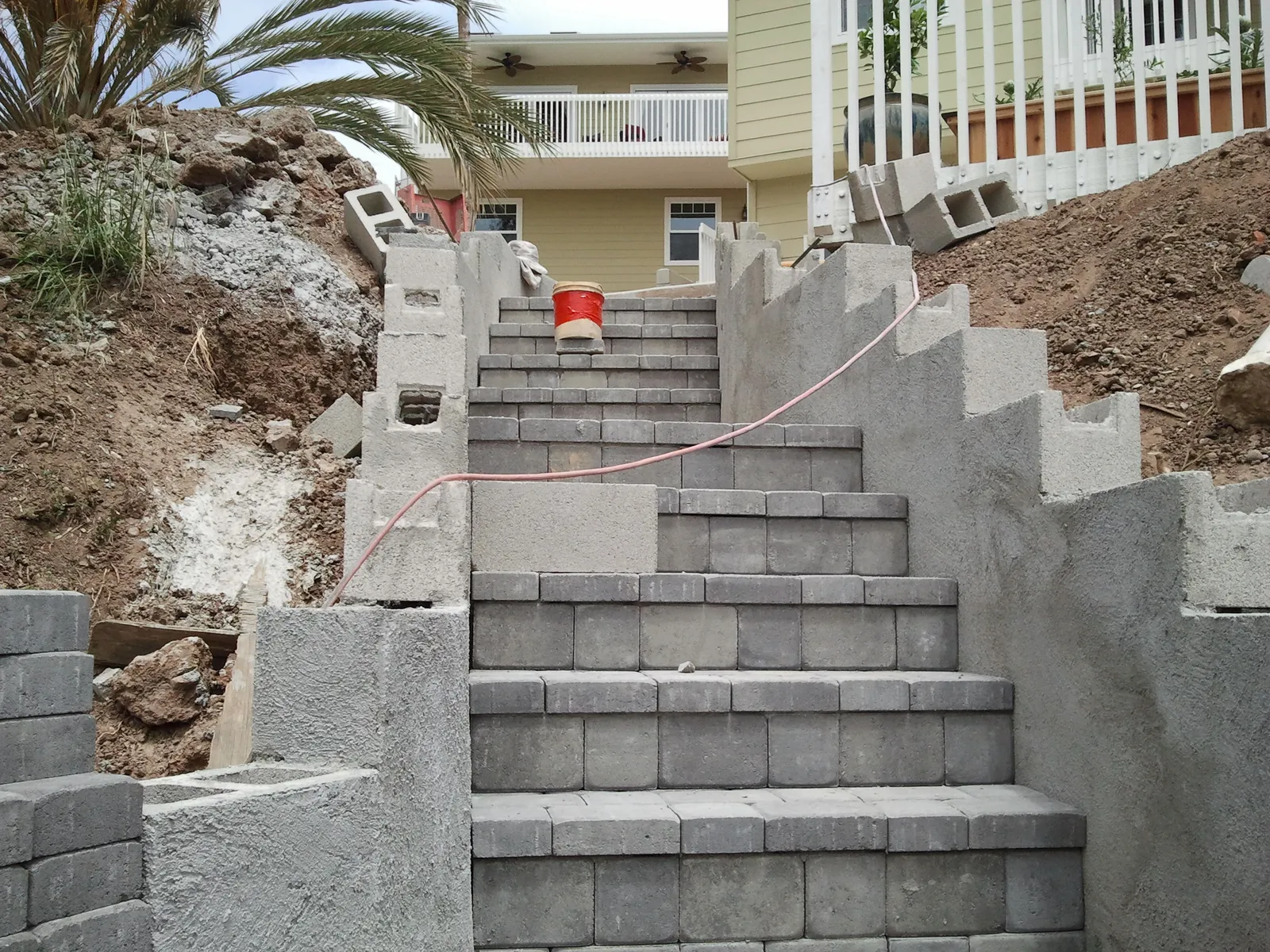
Paver stairway climbing between stepped, plastered block walls on a sloped lot.

Lakeside Masonry Contractor for Block Walls, Retaining Walls and Ranch Driveways

Block walls, retaining walls, stone and driveways for Lakeside’s ranch, horse and hillside properties — built to San Diego County’s own wall rules and ember-safe next to the house. Licensed C-29 from neighbouring Alpine. Call for a free on-site estimate.

CSLB #979389 · C-29 Licensed · Bonded $25,000 · Free on-site estimates

Lakeside by the numbers

A Railroad Town Turned Horse Country, Under County Rules

Lakeside started in 1886, when the El Cajon Valley Land Company bought 6,600 acres around the natural Lindo Lake; the railroad arrived on 30 March 1889. It never incorporated, so there is no City of Lakeside: walls, footings and driveways here are permitted by the County of San Diego. The Census counts 21,152 people in the Lakeside CDP, but the community people call Lakeside is far bigger — Lakeside Water District alone covers 17.6 square miles, from Eucalyptus Hills and Moreno Valley to Muth Valley and Wintergardens.

The County’s own profile notes that many Lakeside homes have small horse corrals, and the PRCA Lakeside Rodeo runs every spring. Housing is mostly from the 1970s and ’80s — the median home dates to 1981 — and one home in five is a mobile home. On the ground, the valley floor is loose San Diego River sand and gravel, and the hills are granite. Both change how a wall is founded.

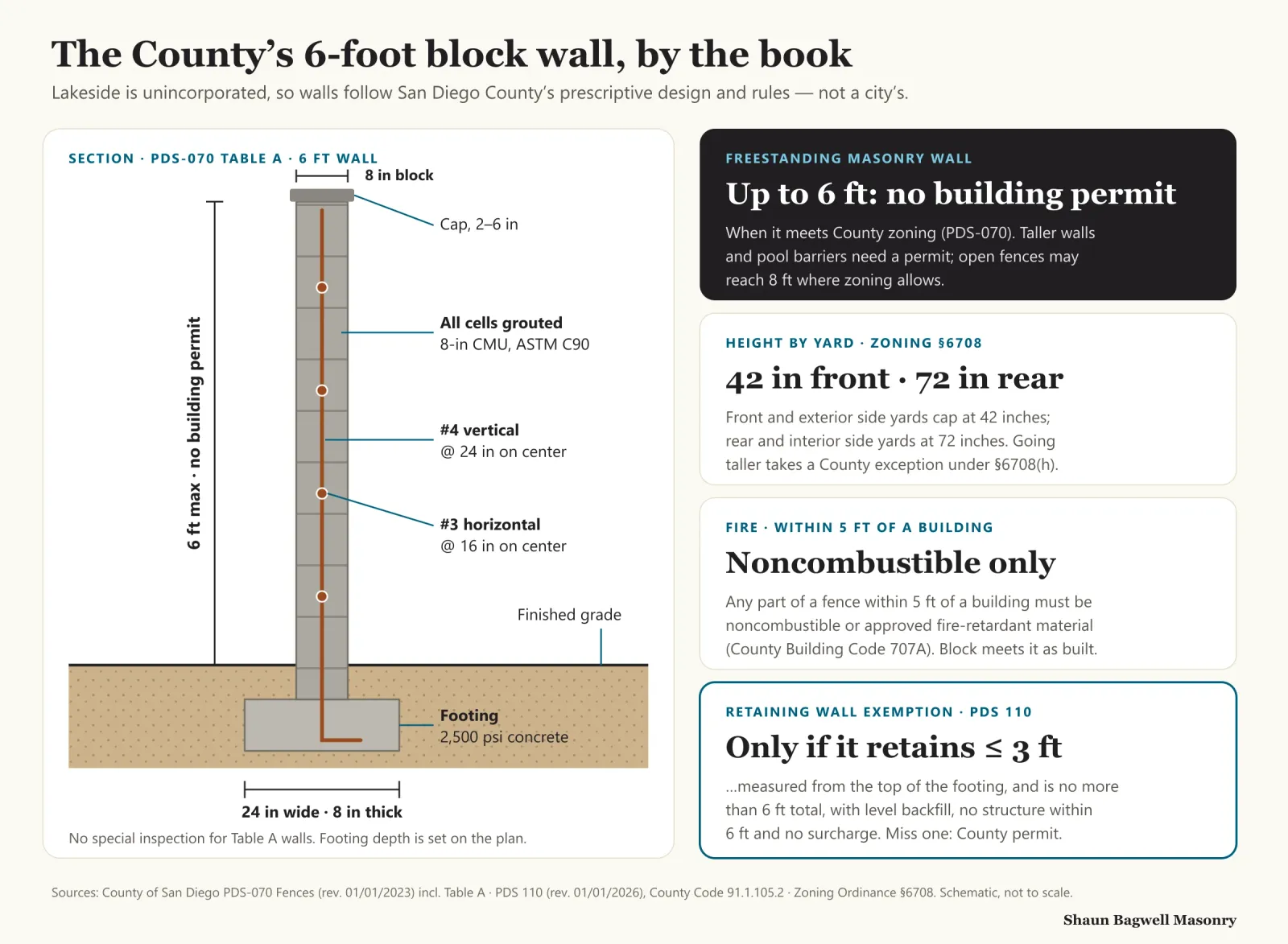
Infographic: section drawing of San Diego County’s prescriptive 6-foot masonry wall from PDS-070 Table A — 8-inch CMU with all cells grouted, a mortar or masonry cap 2 to 6 inches, number 4 vertical bars at 24 inches on center, number 3 horizontal bars at 16 inches on center, and a footing 24 inches wide and 8 inches thick in 2,500 psi concrete, with no special inspection required. Beside it, four County rules: freestanding masonry walls up to 6 feet need no building permit when they meet zoning; walls are capped at 42 inches in front and exterior side yards and 72 inches in rear and interior side yards; any part of a fence within 5 feet of a building must be noncombustible or approved fire-retardant material; and a retaining wall is exempt only if it retains no more than 3 feet measured from the top of the footing, is no more than 6 feet total, has level backfill, no structure within 6 feet and no surcharge.
Lakeside builds to County code. The County publishes a prescriptive design for masonry walls up to 6 feet, and its own limits for height, fire safety and retaining walls. Schematic, not to scale; footing depth is set on the plan.Sources: County PDS-070 Fences; County PDS 110; Zoning §6708 (PDS-308).

River Gravel, Granite Hills and Fire Country

Six conditions shape masonry in Lakeside. They come from the County’s own codes and technical reports, Census housing data and the record of the 2003 Cedar Fire.

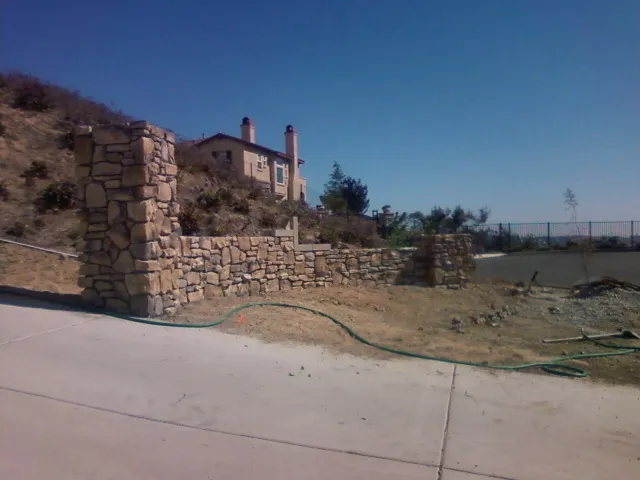
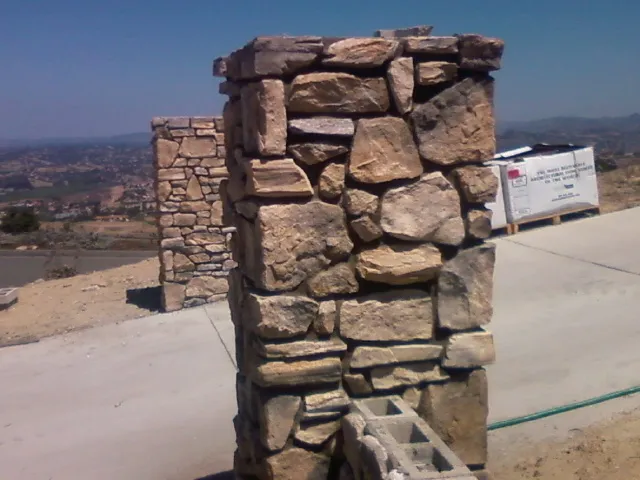
Stone pillar and low stone wall at the edge of a concrete driveway.

Valley floor

Loose river sand and gravel

A County mineral-resource report describes the valley floor as “floodplain deposits that include loose sands and gravels” from the San Diego River — good enough aggregate that at least thirteen sites along the river have been mined. Loose granular ground means footings go down to firm, compacted material and driveways get a properly compacted base, or they settle.

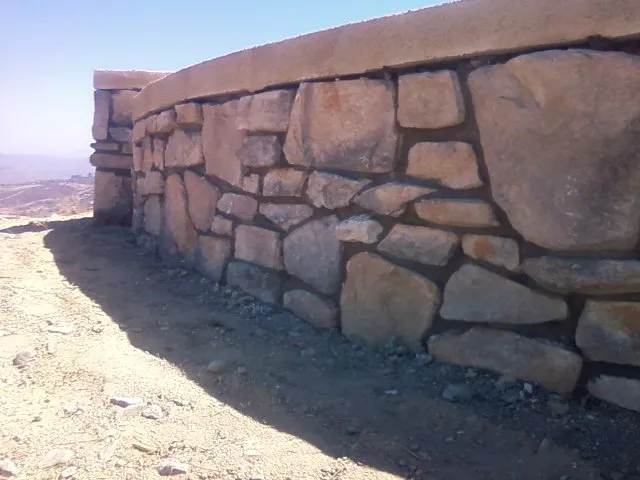
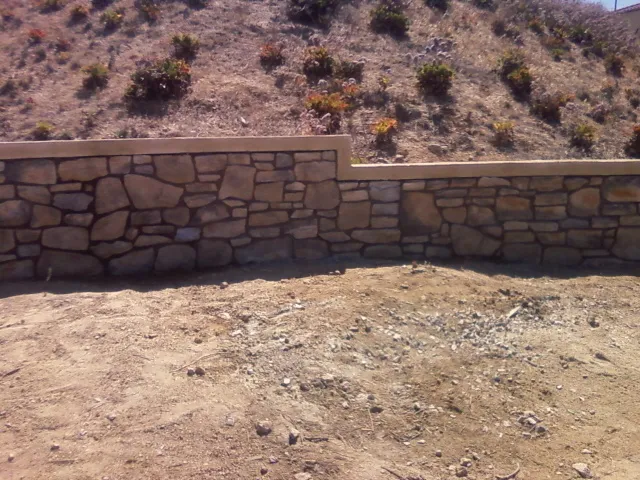
Hand-set natural rock wall with mortared joints along an inland slope.

Hillsides

Granite slopes and boulders

The same report puts the slopes around the valley “primarily” in granitic bedrock. On hillside lots in Eucalyptus Hills, Blossom Valley and Wildcat Canyon, that means rock in the trench, boulders to work around or build with, and retaining walls keyed into firm ground. We price for rock where the ground says to expect it.

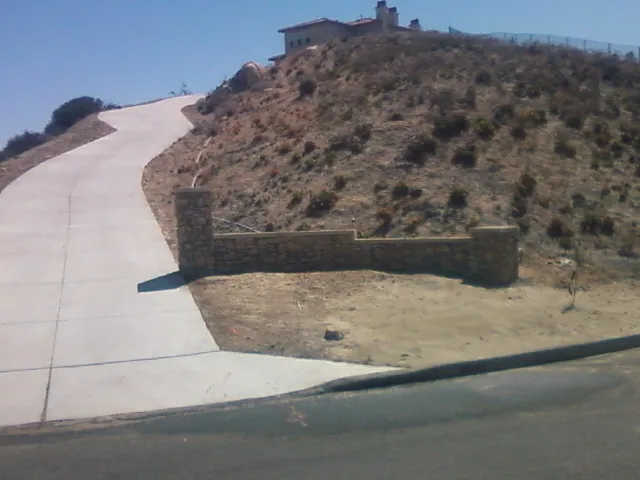
Finished stone wall and pillar at the foot of a long, dry hillside driveway.

Fire

The 2003 Cedar Fire

The Cedar Fire is part of Lakeside’s history. Of the fifteen people it killed, twelve lived in Wildcat Canyon and Muth Valley in northern Lakeside, and the fire destroyed 39 homes on the neighbouring Barona Reservation. The County’s rule today is plain: any part of a fence within 5 feet of a building must be noncombustible or approved fire-retardant material. A block wall meets it as built. The County’s 2026 Wildland-Urban Interface Code took effect on 2 April 2026 for its fire districts, Lakeside’s included.

Close-up of a fieldstone pillar with a flat stone cap.

Ranch & horse lots

Corrals, gates and long driveways

The County notes that many Lakeside homes have small horse corrals, and rural parcels mean long driveways, gate pillars and walls that stand up to livestock. Block and stone pillars, reinforced arena and corral walls, and concrete or paver driveway aprons are typical Lakeside work.

Finished stone-veneer retaining wall with a mortar cap holding back a dry hillside.

County rule

The 3-foot retaining wall test

Under the County building code, a retaining wall needs no permit only if it retains no more than 3 feet of soil measured from the top of the footing, stands no more than 6 feet in total, has level backfill, has no structure within 6 feet and carries no surcharge. On a sloped Lakeside lot, most walls fail at least one of those tests — so they’re engineered and permitted.

Driveways

Aprons onto County roads

Most Lakeside streets are County roads, so a driveway apron or any work in the road right-of-way needs a County encroachment permit from the Department of Public Works — a $217 fee in the County’s July 2024 brochure — and a DigAlert ticket before digging. We build it into the schedule.

There’s No City Hall in Lakeside — It’s County Rules

Because Lakeside is unincorporated, building and zoning rules come from the County of San Diego Planning & Development Services, road-side work from the County Department of Public Works, and defensible-space rules from the Lakeside Fire Protection District. Santee next door is a city with its own code; Lakeside isn’t.

For freestanding walls the County is generous: masonry walls up to 6 feet that meet zoning need no building permit, and the County publishes a prescriptive design for them (8-inch block, grouted solid, a 24-inch footing and #4 bars at 24 inches for a 6-foot wall). Zoning caps walls at 42 inches in front and exterior side yards and 72 inches in rear and interior side yards. Pool barriers and taller walls need a permit.

Retaining walls are stricter: the exemption only covers walls retaining 3 feet or less with level backfill and nothing near them. And since 1 January 2025, any job that needs a permit — or costs $1,000 or more — has to be done by a licensed contractor.

County of San Diego issues

  • Building & zoning — Planning & Development Services
  • Driveway aprons — Department of Public Works
  • Defensible space — Lakeside Fire Protection District

Not a city

  • Lakeside never incorporated
  • Santee’s city code stops at its border
Freestanding masonry wall
Up to 6 ft — no building permit
When it meets County zoning. Pool barriers excluded.PDS-070
Wall height by yard
42 in front · 72 in rear
Front and exterior side yards / rear and interior side yards.Zoning §6708
Fence within 5 ft of a building
Noncombustible
Or approved fire-retardant material (County Building Code 707A).PDS-070
Retaining wall exemption
≤ 3 ft retained, ≤ 6 ft total
Level backfill, nothing within 6 ft, no surcharge — otherwise a permit.PDS 110
Driveway onto a County road
DPW encroachment permit
$217 fee (July 2024); DigAlert 811 before digging.DPW brochure

Masonry Work We Do in Lakeside

Built for ranch lots, granite hillsides and river-bottom ground — every job quoted in writing after a site visit.

Retaining walls

CMU, poured, segmental, stone and boulder walls for granite hillsides and terraced lots, with gravel and a drain behind every one, and County permits where the 3-foot test fails.

Stone walls and gate pillars

Fieldstone and boulder walls, entry and gate pillars, and stone veneer that suit Lakeside’s granite country and ranch character.

Ember-safe hardscape

Block walls, paver bands and stone in the first five feet around the house, where County code already rules out ordinary combustible fencing.

Not sure which of these your property needs? Shaun will look at it with you — free, on site, no obligation.

(619) 581-2492

What Masonry Costs in Lakeside

The 2026 ranges we quote across San Diego County. In Lakeside the swing comes from rock in the trench, long access on rural lots, and whether a retaining wall passes the County’s 3-foot test or needs engineering.

What Masonry Costs in Lakeside
ProjectTypical 2026 range
Retaining wall, CMU block, under 4 ft$35–$55 per sq. face ft.
Retaining wall, engineered, 4–8 ft$45–$120 per sq. face ft.
Natural stone retaining wall$80–$250 per sq. face ft.
Block wall, CMU with stucco or veneer$250–$400 per linear ft.
Patio or pavers$18–$40 per sq. ft.
Masonry chimney repair$1,500–$8,000+ by scope

Ranges are for comparison, not a quote. Engineering, County permit fees and any DPW encroachment permit are priced separately and shown on the proposal.

Lakeside Communities We Work In

Lakeside reaches well past its Census boundary. These are the places that make it up — all under County rules.

  • Lindo Lake & town centreWhere the town began in 1886, along the Western Days parade route on Woodside and Maine Avenue. Brick, block and patio repair.
  • Eucalyptus HillsPart of the Lakeside Water District area. Hillside lots: retaining walls, rock excavation and driveways.
  • Winter Gardens (Wintergardens)Its own Census place since 2000, with 22,380 people in 2020 — so many 92040 addresses aren’t in the Lakeside count above. Part of the Lakeside Water District area. Block walls, patios and driveways.
  • Moreno ValleyPart of the Lakeside Water District area. Rural parcels: corral walls, gate pillars and driveway aprons.
  • Muth Valley & Wildcat CanyonNorthern Lakeside, where twelve of the Cedar Fire’s fifteen victims lived. Noncombustible walls and hardscape near the house.
  • Blossom Valley & Flinn SpringsServed by Padre Dam Municipal Water District. Granite ground and larger lots.
  • El Monte ValleyHome of El Capitan Reservoir (about 1,562 acres). River-bottom sand and gravel on the valley floor.
  • Lake Jennings areaAround the 85-acre reservoir managed by Helix Water District. Hillside walls and patios.

Lakeside Masonry Questions

Straight answers to what Lakeside homeowners ask before they hire. Anything else — call, and Shaun answers it himself.

(619) 581-2492

Do I need a permit for a block wall in Lakeside?

Not if it is a freestanding masonry wall up to 6 feet that meets County zoning (PDS-070). Zoning caps walls at 42 inches in front and exterior side yards and 72 inches in rear and interior side yards. Taller walls and pool barriers need a County permit.

Do I need a permit for a retaining wall in Lakeside?

Usually. The County exempts a retaining wall only if it retains no more than 3 feet of soil measured from the top of the footing, is no more than 6 feet tall in total, has level backfill, no structure within 6 feet and no surcharge (County Code 91.1.105.2, PDS 110). Miss any one and it needs a permit and, typically, an engineered design.

Can I have a wood fence against my house?

Not an ordinary one. County code requires any part of a fence within 5 feet of a building to be noncombustible or approved fire-retardant material (PDS-070, Building Code 707A). Block, stone or a masonry pilaster with metal infill meet it as built.

Do I need a permit to pave my driveway apron onto the road?

Usually. Most Lakeside streets are County roads, and work in the road right-of-way needs a County DPW encroachment permit — $217 in the County’s July 2024 brochure — plus a DigAlert ticket before digging.

Can you build walls for a horse property?

Yes — corral and arena walls, gate pillars, retaining walls for flat paddocks, and driveway aprons. Walls are reinforced and grouted to take livestock and gates, and kept to County height limits unless permitted taller.

How much does a block wall cost in Lakeside?

Most reinforced CMU walls with a stucco or veneer finish run $250–$400 per linear foot in 2026, and retaining walls $35–$120 per square foot of face. Rock in the trench and long access on rural lots move the price. You get an itemised written proposal after a free site visit.

Why are Lakeside footings different from El Cajon’s or the coast’s?

Because the ground is. The valley floor is loose San Diego River sand and gravel that needs compaction and firm bearing, while the hills are granite that brings rock into the trench. Footings are designed for whichever your lot sits on.

How do I check that you’re licensed?

Shaun Bagwell Masonry holds California C-29 Masonry licence #979389, issued 14 December 2012, with a $25,000 contractor bond. Look it up at cslb.ca.gov → “Check a License”. Any permitted job, or any job of $1,000 or more, requires a licensed contractor.

Get Your Lakeside Wall or Driveway Priced

Call Shaun at (619) 581-2492 or send the form. He’ll come over from Alpine, look at the ground and the County rules that apply, and put a written, itemised price in your hands.

(619) 581-2492

Call Now(619) 581-2492Estimate