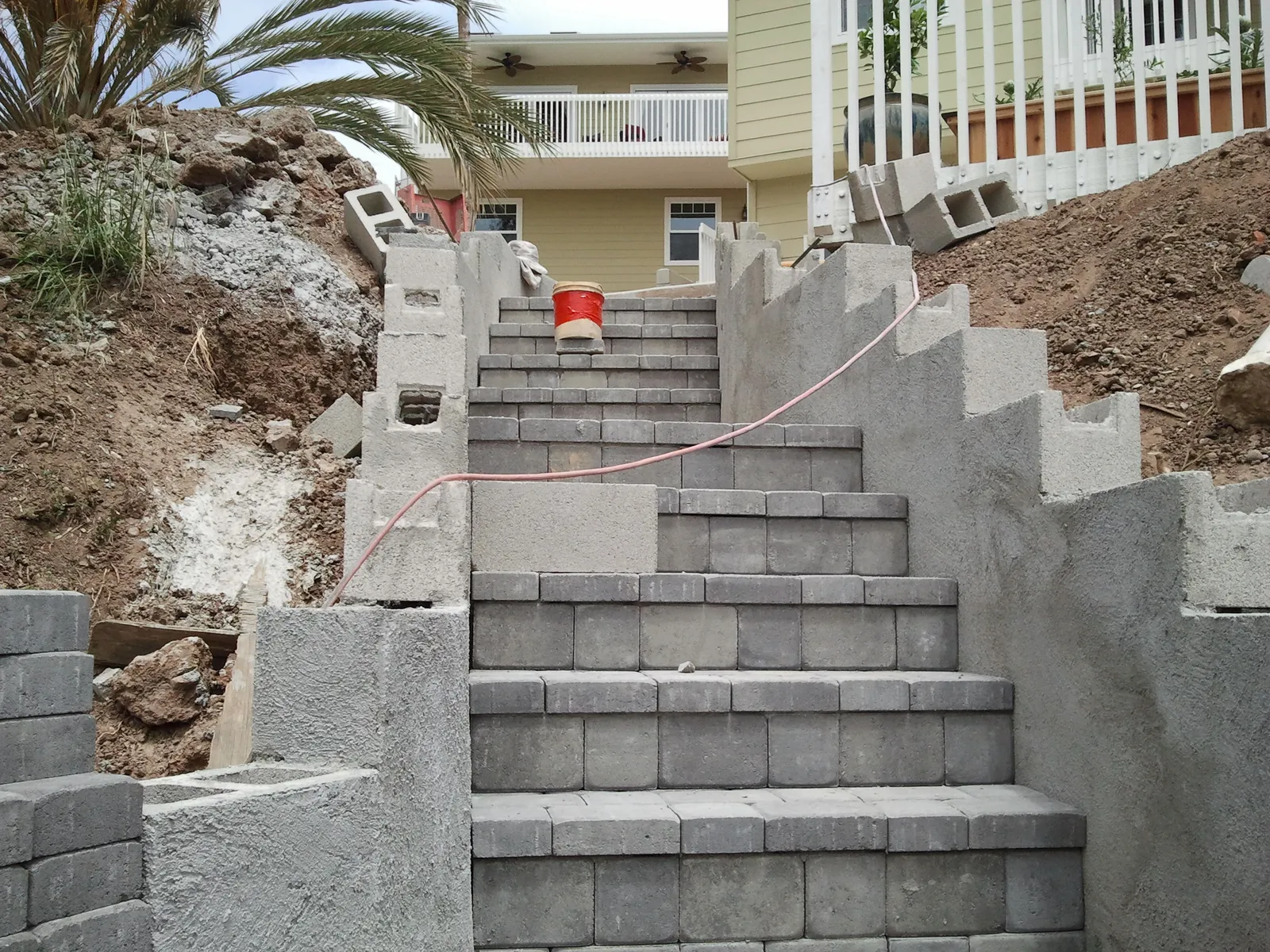
Paver stairway climbing between stepped, plastered concrete block retaining walls on a sloped residential lot.

Spring Valley Masonry Contractor for Retaining Walls, Block Walls and Repairs

Replacing a tired 1970s block wall, holding up a hillside yard or fixing an old chimney? We build it to County of San Diego rules — the ones that apply in Spring Valley, not a city’s — and price it in writing. Licensed C-29 mason, based up the road in Alpine.

CSLB #979389 · C-29 Licensed · Bonded $25,000 · Free on-site estimates

Spring Valley by the numbers

A 1970s Community That’s Due for Its Walls

Spring Valley is an unincorporated community of about 31,000 people on 7.3 square miles south of Casa de Oro–Mount Helix, with La Presa to the south. It’s home to the Bancroft Ranch House, built in 1863 and the oldest adobe in east San Diego County. Most of its homes are much younger and the same age as each other: the median house was built in 1977, the 1970s were the biggest building decade, and 59.8% of homes predate 1980.

That age is what drives the work. Block walls from the 1960s and ’70s that were never fully grouted, chimneys and fireplaces built before today’s reinforcement rules, driveways and patios with half a century of settlement in them. And because Spring Valley isn’t a city, every permit runs through the County of San Diego — including its five-part test for whether a retaining wall needs one, shown below.

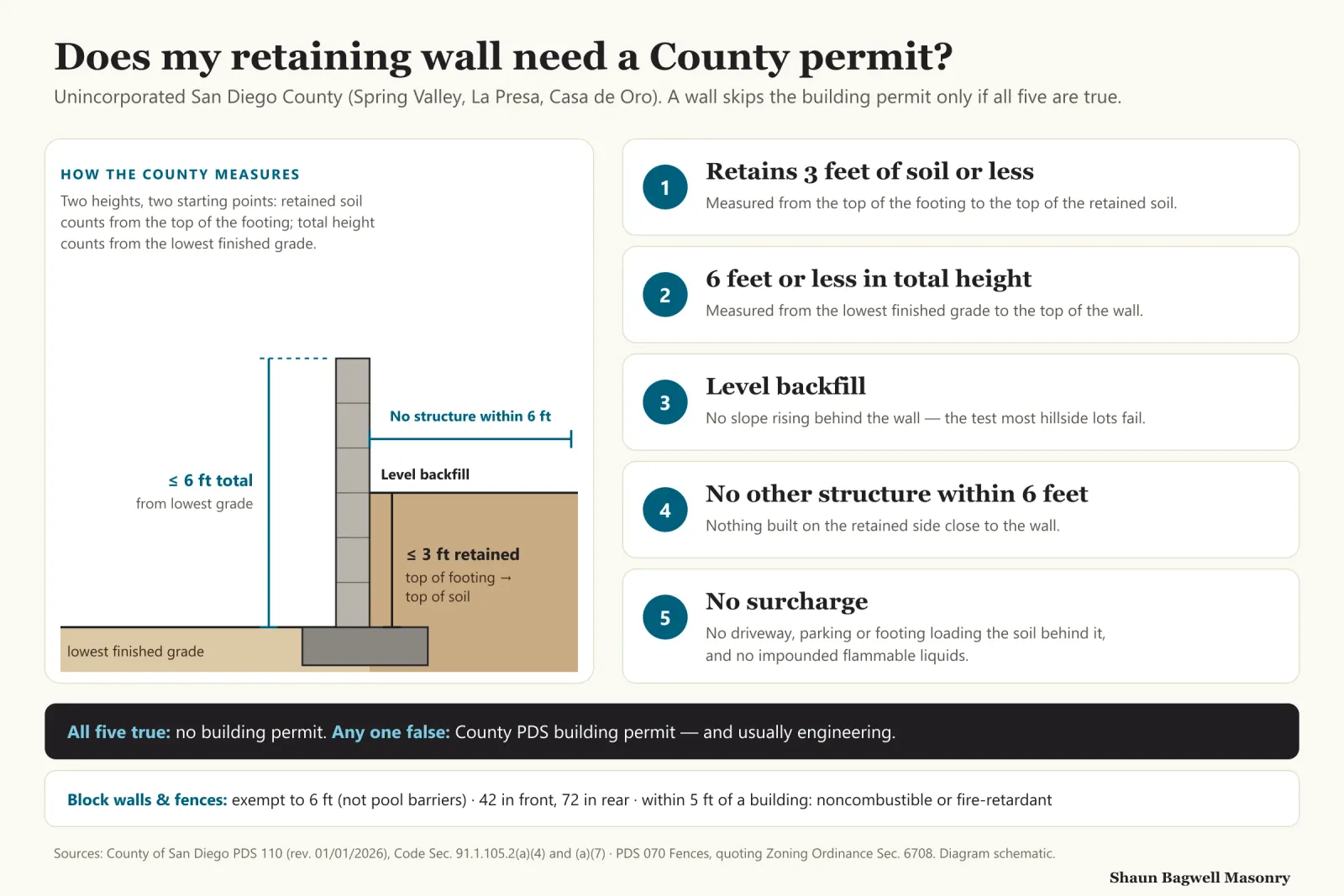
Infographic: does my retaining wall need a County permit? A wall diagram shows retained soil measured from the top of the footing to the top of the soil (3 feet or less) and total height measured from the lowest finished grade (6 feet or less), with level backfill and no structure within 6 feet. Five checks: retains 3 feet of soil or less; 6 feet or less in total height; level backfill; no other structure within 6 feet; no surcharge such as a driveway or footing, and no impounded flammable liquids. All five true means no building permit; any one false means a County PDS building permit and usually engineering. Block walls and fences are exempt to 6 feet except pool barriers, limited to 42 inches in front yards and 72 inches in rear yards, and must be noncombustible or fire-retardant within 5 feet of a building.
The County’s five-part test. A retaining wall in Spring Valley skips the building permit only if all five conditions hold — and on a sloped lot, “level backfill” is usually the one that fails. We check all five on site before we quote.Sources: County PDS 110 (rev. 01/01/2026); County PDS 070 Fences.

What Spring Valley’s Lots and Homes Ask of a Mason

Spring Valley isn’t a city, so its rules come from the County — and its housing is concentrated in one era. Six things shape almost every job here.

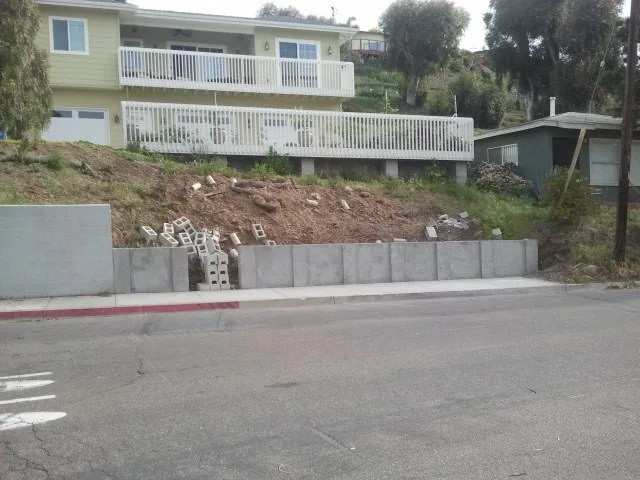
Existing low block walls and an eroding slope along a street before the walls were rebuilt.

Housing age

Six homes in ten are over 45 years old

The 1970s alone account for 28.4% of Spring Valley’s 10,122 homes, and 59.8% were built before 1980. After four or five decades of wet winters and dry summers, walls of that age are the ones that lean, crack along the joints or lose their caps, and much of the block wall work here is replacement rather than a first build. Close to one home in ten (9.5%) is a mobile home, where a low wall, steps or a pad is often the job.
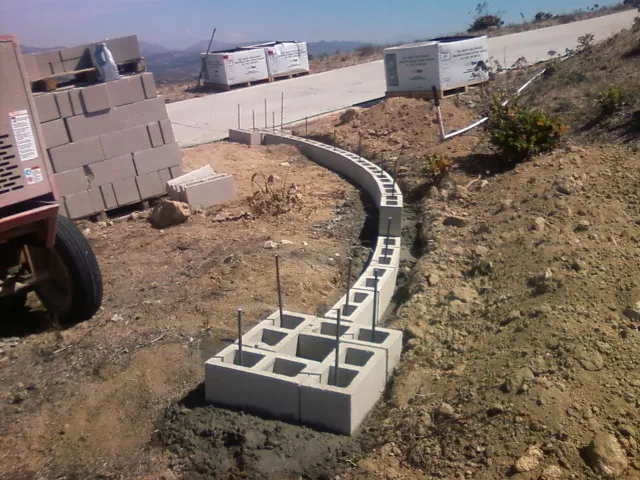
Concrete block wall core laid on a new footing along a hillside driveway, before stone veneer was applied.

Sloped lots

Hillside yards fail the “level backfill” test

The County exempts a retaining wall from a building permit only if it holds back 3 feet of soil or less (measured from the top of the footing), stands no more than 6 feet from the lowest grade, has level backfill, no structure within 6 feet and no surcharge. On a sloped Spring Valley yard the soil behind the wall usually rises, so even a short wall needs a permit — and, sensibly, an engineered design with drain rock and a perforated pipe behind it.

Grading

Grading pulls every wall into the permit

If the job needs a County grading permit — cutting a pad, terracing a slope — the code requires a building permit to cover all retaining walls and drainage structures on it, whatever their height (Sec. 91.1.105(c)). We plan the walls and the grading as one submittal so nothing gets stuck between the two.

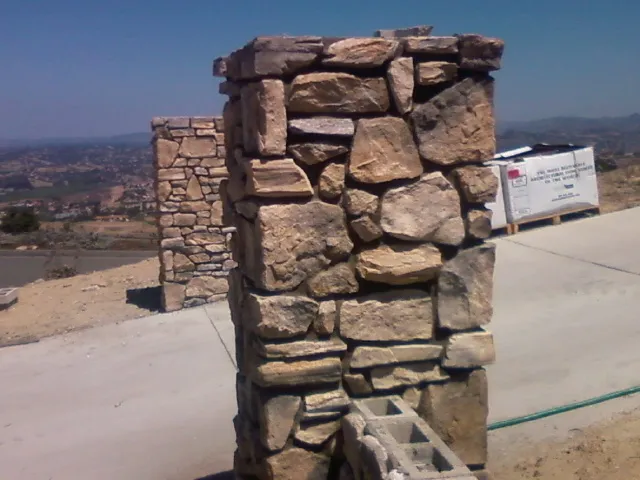
Close-up of a fieldstone pillar with a flat stone cap.

Block walls

The County’s own 6-foot wall recipe

Freestanding masonry walls up to 6 feet need no building permit if they meet zoning — and the County publishes the recipe: for a 6-foot wall, 8-inch block on a footing 24 inches wide and 8 inches thick, #4 bars every 24 inches, horizontal #3 bars every 16 inches, and every cell grouted solid (PDS 070). That’s our minimum, not our target. Pool barriers are not exempt and always need a permit.

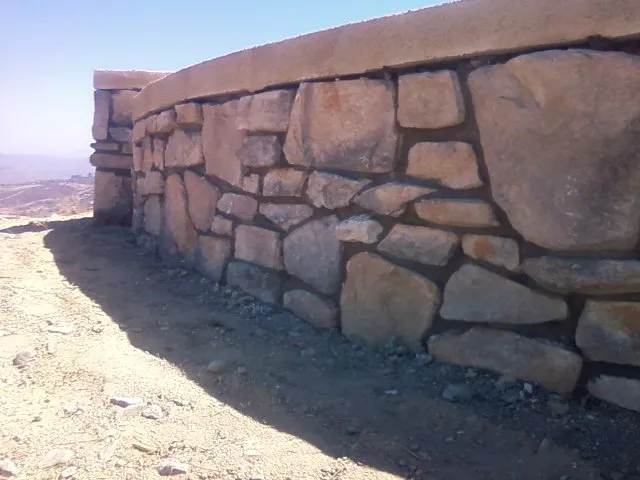
Hand-set natural rock wall with mortared joints along a dry hillside.

Fire

Five feet from the house: no wood

County rules say any part of a fence within 5 feet of a building must be noncombustible or an approved fire-retardant material that meets the exterior-wall standard of Building Code Section 707A (PDS 070). A block or stone wall meets that by nature, and doubles as a privacy wall. Spring Valley is served by San Miguel Fire & Rescue; check your parcel’s fire hazard zone on the state’s map before you plan.

Water

Lawn coming out? Apply before you dig

Otay Water District serves Spring Valley. It points customers to the regional turf-replacement rebate (at least $2 per square foot) and, because Spring Valley is unincorporated, the County’s Waterscape program (up to $5 per square foot). Both require approval before any lawn comes out, and both limit what hardscape can go in the converted area — so ask the program before you plan pavers or a patio there.

County Rules, Not City Rules

Spring Valley has no city hall. Building permits come from the County of San Diego Planning & Development Services, and the County’s numbers differ from the cities around it. Retaining walls are measured from the top of the footing, not the bottom, and must pass all five exemption conditions to skip a permit. Block walls and fences up to 6 feet are exempt from a building permit if they meet zoning — 42 inches tall in a front or exterior side yard, 72 inches in a rear or interior side yard.

Driveway aprons and anything else built in a County road right-of-way need an Encroachment Permit from the County’s right-of-way counter — $217, with an $87 renewal, and a DigAlert ticket (call 811 two working days before digging). Whether a driveway on your own lot also needs a County building permit depends on the job; the code is not consistent on it, so we confirm with PDS rather than guess. Larger projects that need discretionary approval may also be reviewed by the Spring Valley Community Planning Group.

County of San Diego issues

  • Building and grading permits (PDS)
  • Encroachment permits in County roads
  • Zoning height exceptions

Also in the picture

  • San Miguel Fire & Rescue
  • Spring Valley Community Planning Group (discretionary projects)
  • Otay Water District rebates
Retaining wall, permit exemption
All 5 conditions, or permit
≤3 ft retained (top of footing), ≤6 ft total, level backfill, nothing within 6 ft, no surcharge.PDS 110 · Sec. 91.1.105.2(a)(7)
Block wall or fence
Exempt to 6 ft
If it meets zoning. Pool barriers are never exempt.Sec. 91.1.105.2(a)(4)
Wall and fence height
42 in front · 72 in rear
Front and exterior side yards vs rear and interior side yards.PDS 070 · Zoning Sec. 6708
Fence within 5 ft of a building
Noncombustible
Or approved fire-retardant material meeting Building Code 707A.PDS 070
Driveway apron in a County road
Encroachment permit · $217
$87 renewal; DigAlert 811 required before excavation.County DPW

Masonry Work We Do in Spring Valley

Mostly repairs and replacements on 1960s–’80s homes, plus walls for sloped yards — every one quoted in writing after a site visit.

Retaining walls

Walls for sloped yards and driveways, designed to pass the County’s five-part test where possible and engineered and permitted where they don’t — always with gravel backfill and a perforated drain.

Brick and block repair

Eroded mortar repointed in a matched colour, cracked units replaced, planters, steps and garden walls rebuilt so they match what’s already there.

Stone veneer and pillars

Natural and manufactured stone on walls, entry pillars and mailbox columns, set over a drained backing so it stays put.

Not sure which of these your property needs? Shaun will look at it with you — free, on site, no obligation.

(619) 581-2492

What Masonry Costs in Spring Valley

These are the 2026 ranges we quote across San Diego County. In Spring Valley the biggest swings are whether a retaining wall passes the County’s exemption test or needs engineering, and how much old wall has to come out first.

What Masonry Costs in Spring Valley
ProjectTypical 2026 range
Retaining wall, CMU block, under 4 ft$35–$55 per sq. face ft.
Retaining wall, engineered, 4–8 ft$45–$120 per sq. face ft.
Block wall, CMU with stucco or veneer$250–$400 per linear ft.
Patio or pavers$18–$40 per sq. ft.
Masonry chimney repair$1,500–$8,000+ by scope

Ranges are for comparison, not a quote. Demolition of an existing wall, engineering, County permit fees and any encroachment permit are priced separately and shown on the proposal.

Spring Valley Neighbourhoods and Nearby Communities

All of these are unincorporated, so the County’s rules apply across the board. The notes say what usually brings us out.

  • Central Spring Valley · 91977Most of the community’s 1960s–’80s housing. Block wall replacement, chimney repair and driveways.
  • Bancroft Ranch House areaAround Memory Lane and the 1863 adobe — older lots where repointing and stone work need to match what’s there.
  • La PresaSouth of central Spring Valley and popularly considered part of it. Sloped yards and retaining walls.
  • Casa de Oro–Mount HelixUnincorporated hills to the north. Hillside retaining walls and stone work, County permits.
  • Sweetwater Reservoir sideNeighbourhoods toward the reservoir, Bonita and La Presa. Retaining walls and patios.
  • Rancho San Diego & JamulEast along Jamacha Road and SR-94 — covered on our Rancho San Diego and Jamul pages.

Spring Valley Masonry Questions

Straight answers to what Spring Valley homeowners ask before they hire. Anything else — call, and Shaun answers it himself.

(619) 581-2492

Do I need a permit for a retaining wall in Spring Valley?

Usually, yes. Spring Valley is unincorporated, so County rules apply: a retaining wall is exempt only if it retains no more than 3 feet of soil measured from the top of the footing, is no more than 6 feet tall from the lowest finished grade, has level backfill with no other structure within 6 feet, and carries no surcharge. Miss any one and you need a County PDS building permit.

How tall can a block wall be in Spring Valley?

County zoning allows 42 inches in a front or exterior side yard and 72 inches in a rear or interior side yard (Zoning Ordinance Sec. 6708). Freestanding masonry walls up to 6 feet need no building permit if they meet zoning — except pool barriers, which always need one.

Can I keep a wood fence attached to my house?

Not within 5 feet of it, unless it’s an approved fire-retardant material. County rules require any part of a fence within 5 feet of a building to be noncombustible or meet Building Code Section 707A (PDS 070). A block or stone return wall is the simplest way to comply.

Do I need a permit to widen my driveway apron?

If the apron is in a County road right-of-way, yes — a County Encroachment Permit, currently $217 with an $87 renewal, plus a DigAlert ticket before digging. Whether the driveway on your own lot also needs a building permit depends on the job; we confirm it with PDS.

Are there rebates if I replace my lawn?

Otay Water District, which serves Spring Valley, points to the regional turf-replacement rebate (at least $2 per square foot) and the County Waterscape program (up to $5 per square foot in unincorporated areas). Both need approval before work starts and limit hardscape in the converted area, so check before you plan a patio there.

How much does a block wall cost in Spring Valley?

Most reinforced CMU walls with a stucco or veneer finish run $250–$400 per linear foot in 2026. Removing an old wall, access and permits add to it; you get an itemised written proposal after a free site visit.

How do I check that you’re licensed?

Shaun Bagwell Masonry holds California C-29 Masonry licence #979389, issued 14 December 2012, with a $25,000 contractor bond. Look it up at cslb.ca.gov → “Check a License”.

Get Your Spring Valley Wall or Repair Priced

Call Shaun at (619) 581-2492 or send the form. He’ll check the wall against the County’s rules on site and put a written, itemised price in your hands.

(619) 581-2492

Call Now(619) 581-2492Estimate