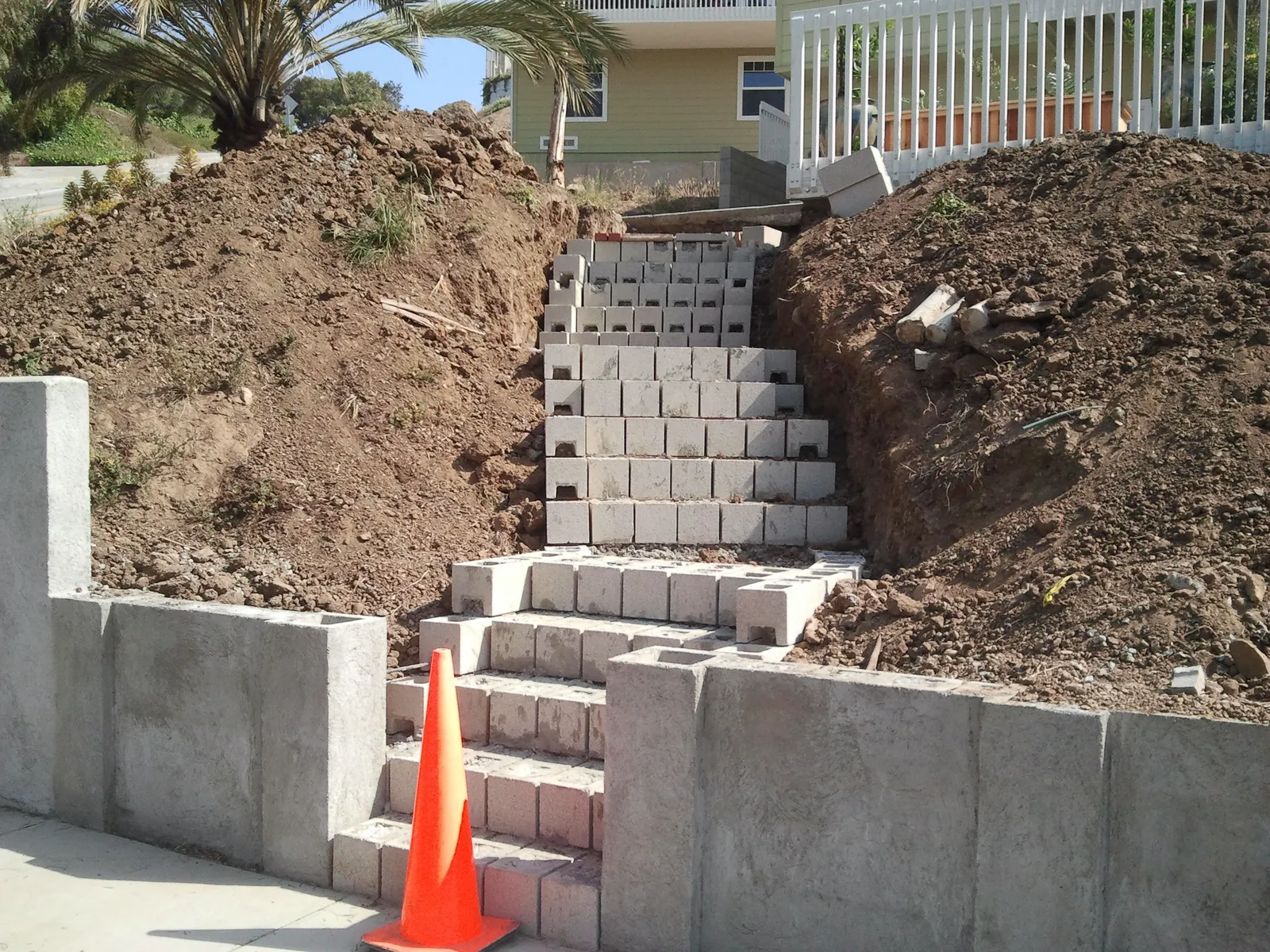
A concrete-block stairway being laid up a cut slope between newly built, plastered block retaining walls, with excavated soil banked on both sides.

Julian Masonry Contractor for Stone Walls, Chimneys and Mountain Concrete

Retaining walls faced in the stone the Historic District asks for, chimneys made sound for a winter of wood fires, and slabs and steps built to survive snow and freezing nights. One licensed C-29 mason, driving up from Alpine, quoting in writing after he has walked your lot.

CSLB #979389 · C-29 Licensed · Bonded $25,000 · Free on-site estimates

Julian by the numbers

Second Homes, Wood Smoke and Sixty-Seven Freezing Nights

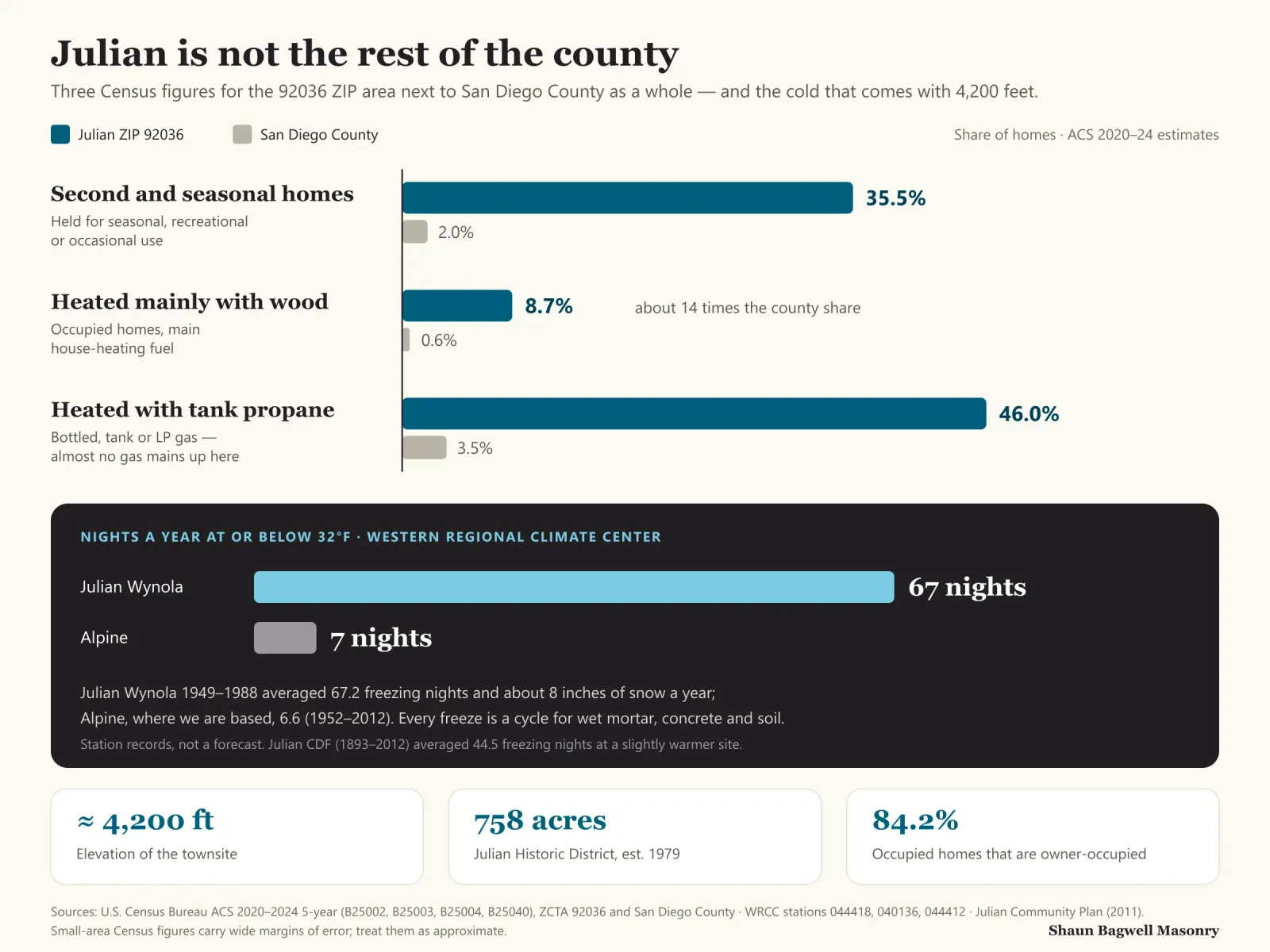
Julian is a gold-rush town at about 4,200 feet, and its housing looks nothing like the coast’s. In the 92036 ZIP area the Census counts roughly 2,300 homes, and about 35.5% of them are held for seasonal or occasional use — against 2.0% across San Diego County. Of the homes lived in year-round, 84.2% are owner-occupied and half of all housing was built before 1980. Almost none of it is on a gas main: 46.0% heats with tank propane and 8.7% mainly with wood, roughly fourteen times the county share.

The weather is the other difference. The Julian Wynola weather station logged an average of 67 nights a year at or below freezing (1949–1988) and about 8 inches of snow; Alpine, where Shaun is based, averaged under seven. Masonry that is fine in the foothills — a crown with no drip edge, a slab without entrained air, a wall with wet backfill — cracks and spalls up here. And inside the 758-acre Julian Historic District, the look of a wall or a walk is reviewed before it is built.

Infographic comparing Julian ZIP 92036 with San Diego County, from Census ACS 2020 to 2024 estimates. Homes held for seasonal, recreational or occasional use: 35.5 percent in Julian, 2.0 percent county-wide. Occupied homes heated mainly with wood: 8.7 percent versus 0.6 percent, about 14 times the county share. Homes heated with bottled, tank or LP gas: 46.0 percent versus 3.5 percent. A dark panel shows nights a year at or below 32 degrees Fahrenheit: 67 at the Julian Wynola station (1949 to 1988, with about 8 inches of snow a year) against 7 at Alpine (6.6, 1952 to 2012). Bottom tiles: about 4,200 feet elevation; the 758-acre Julian Historic District, established 1979; 84.2 percent of occupied homes owner-occupied.
Why a Julian job is specified differently. Seasonal homes, wood heat and freezing nights change what fails and when. Small-area Census figures carry wide margins of error; station data are long-term averages, not a forecast.Sources: Census ACS 92036; Census ACS County; WRCC Julian Wynola; WRCC Alpine; Julian Community Plan.

What Changes When the Job Is in Julian

Six local facts shape how we quote, schedule and build here — each from the County, the Census, a weather record or a federal survey, not a coastal rule of thumb.

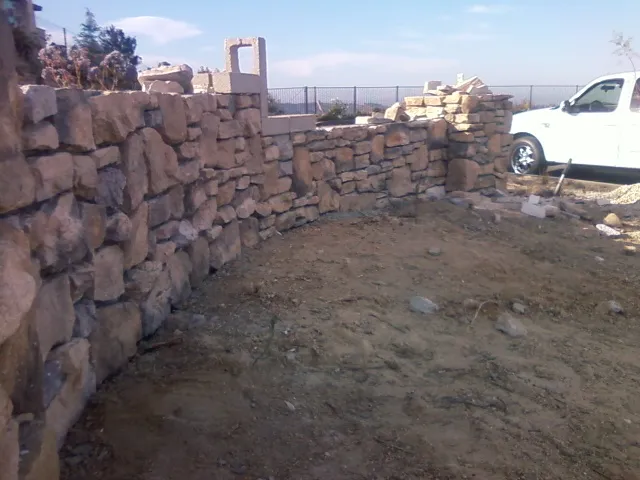
Natural stone veneer going onto a curved block wall, with stone staged on site.

Historic District

Stone that has to look like Julian

The County set up the Julian Historic District in 1979: 758 acres around the 1888 townsite, holding buildings from 1870 to about 1913. The Community Plan says its design standards reach past buildings to “flat work, retaining walls, fences, exterior lighting, and landscaping”, modelled on the 1870–1914 period. In practice the Architectural Review Board has asked for Julian schist — on a house addition in 2019 and on a Main Street building in 2021 — and a guidelines update was on its September 2026 agenda.
Freeze and snow

A winter that tests every joint

January lows at the Julian Wynola station averaged 34.5°F, and the Julian station has averaged about 27.6 inches of precipitation a year since 1893, much of it between December and March. The masonry industry’s cold-weather rules begin below 40°F, because mortar and grout barely gain strength under it. So winter work here is planned around blankets, timing and the forecast, and every top surface — wall caps, chimney crowns, steps — is detailed to shed water before it can freeze in the joints.

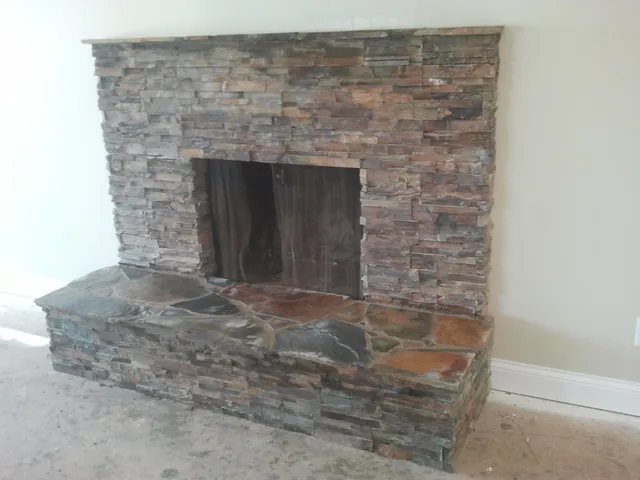
Finished floor-to-ceiling stacked-stone fireplace with a raised hearth.

Wood heat

Chimneys that work for a living

With 8.7% of occupied homes heating mainly with wood, Julian chimneys carry real load all winter, not a few fires at Christmas. The regional air district does not currently prohibit burning in fireplaces, though it calls home wood smoke a growing source of pollution. In a pine forest, state law also requires that no part of a tree sit within 10 feet of a chimney outlet. Crowns, spark arrestors, flashing and rebuilds are the chimney repair a hard-worked mountain chimney ends up needing.

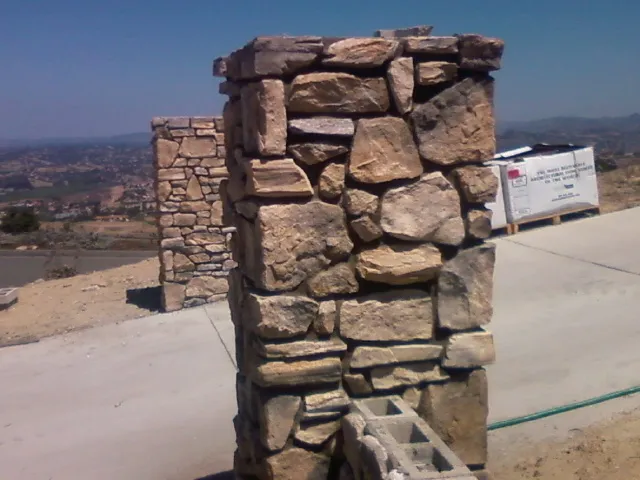
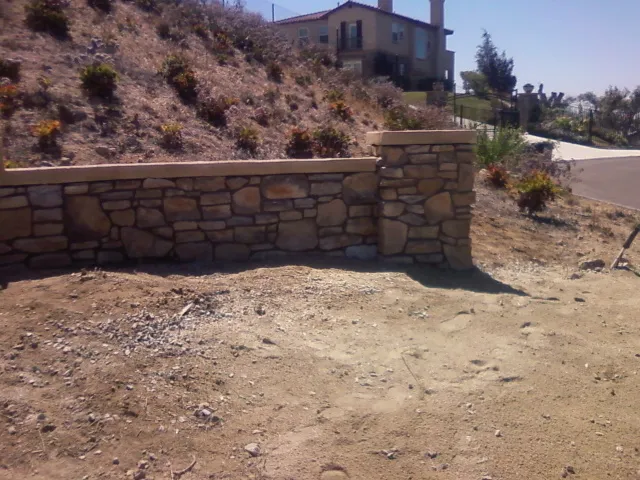
Low stone-veneer wall and capped pillar along a cleared hillside below a house.

Fire

Cedar Fire country

The 2003 Cedar Fire burned 273,246 acres and destroyed 2,820 structures; after the Santa Ana winds eased it turned east, moving into Julian and destroying structures in Cuyamaca. The Community Plan calls the area one of “extremely high fire potential”. Since the volunteer Julian-Cuyamaca district was dissolved in 2019, fire and EMS come from San Diego County Fire, staffed by CAL FIRE, and the County’s 2026 wildfire code keeps the first five feet around a house as hardscape — masonry’s natural ground.

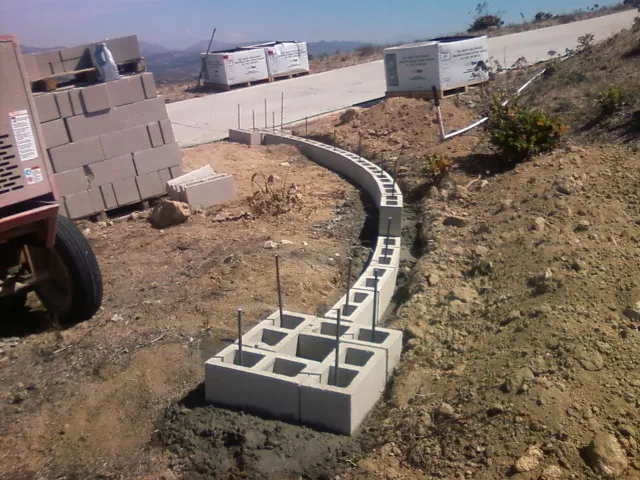
Concrete block wall core laid on a new footing along a hillside driveway, cells open for grout and steel.

Ground and water

Granite, wells and septic fields

The Community Plan describes granitic rock under most of the planning area and says residents rely solely on groundwater; outside the townsite’s sewer, homes use septic systems. Whispering Pines and Kentwood in the Pines draw “100% locally pumped” groundwater through the Majestic Pines district. For a wall or a slab that means two things: excavation that may meet rock, and a site plan that keeps footings, trenches and machines clear of the well, the tank and the leach field.

Close-up of fieldstone masonry with deep, well-tooled mortar joints.

Seismic

On the Elsinore fault’s Julian section

The U.S. Geological Survey maps a “Julian section” of the Elsinore fault zone as a Class A fault, part of the San Andreas system with Holocene activity, and the Community Plan traces it along Banner Canyon at the foot of Volcan Mountain. That is why we build every chimney rebuild and tall wall with vertical steel and solid grout rather than stacking stone on old mortar.

Julian Permits: the County, Plus the Historic District

Julian is unincorporated, so building permits come from County of San Diego Planning & Development Services, not a city. The County exempts a retaining wall only when it retains no more than 3 feet measured from the top of the footing, stands no more than 6 feet, has level backfill, carries no surcharge and has nothing within 6 feet — a short list that most sloped mountain lots fail on at least one point. Freestanding masonry walls up to 6 feet need no building permit, and zoning holds solid walls to 42 inches in front and 72 inches at the side and rear.

Inside the Julian Historic District there is a second step. Exterior work — the Community Plan names retaining walls, fences, paving and flat work — goes to the Architectural Review Board, which meets monthly and has asked applicants for Julian schist and shielded, down-cast lighting. In the Wynola commercial area, the plan calls for new building designs to go before the Julian Community Planning Group. We draw the wall, take samples of the stone, and bring both to the meeting.

County of San Diego issues

  • Building and grading permits (PDS)
  • Fire code and defensible space (San Diego County Fire / CAL FIRE)
  • Encroachment permits for work in County roads (DPW)

Extra review in the Historic District

  • Architectural Review Board approval of exteriors
  • Stone the Board accepts — it has asked for Julian schist
  • Guidelines under update (2026 agenda)
Retaining wall
Over 3 ft = County permit
Exempt only with level backfill, no surcharge, ≤ 6 ft tall and nothing within 6 ft (measured from top of footing).PDS-110 · PDS-308
Freestanding masonry wall
No permit to 6 ft
When it complies with zoning; pool barriers excepted.PDS-110
Solid wall height
42 in front · 72 in rear
Zoning Ordinance §6708; taller with an Administrative Decision.PDS-070
Fence within 5 ft of a building
Noncombustible
Or approved fire-retardant material.PDS-070
Historic District exteriors
ARB review
Retaining walls, fences, paving and flat work, judged against the 1870–1914 period.Julian Community Plan Ch. 3
Around the house
0–5 ft hardscape
Zone 0 of the County’s 2026 wildfire code.2026 County WUI Code

Masonry Work We Do in Julian

For full-time homes, cabins that sit empty half the year, orchards and Main Street buildings — each priced in writing after a site visit.

Schist and natural-stone facing

Stone veneer over a reinforced core, matched to what the Historic District’s review board accepts, with samples and drawings ready for its review.

Not sure which of these your property needs? Shaun will look at it with you — free, on site, no obligation.

(619) 581-2492

Where We Work In and Around Julian

One ZIP code, several kinds of place. The County permits all of it; what differs is the ground, the water source and whether the Historic District applies.

  • Julian townsite & Historic DistrictMain Street, the side streets and the land around the 1888 townsite, inside the 758-acre district: walls, steps and walks reviewed by the ARB, sewered lots in the village core.
  • WynolaThe orchard and commercial strip along Wynola Road west of town, where the Community Plan sends new commercial designs to the Planning Group. Retaining walls for pads and parking, stone for storefronts.
  • Santa YsabelWhere Highways 78 and 79 meet on the way up from Ramona — ranch gates, stone pilasters and long driveways.
  • Whispering PinesWooded hillside lots served by the Majestic Pines water district: chimneys under tall pines, ember screens, and walls on cut slopes.
  • Kentwood-in-the-PinesThe other Majestic Pines community, with many part-time cabins — the place for a pre-winter chimney check before the first visit of the season.
  • Pine Hills & Harrison ParkSouth of town on Pine Hills and Harrison Park roads, toward the Cuyamaca country where the Cedar Fire destroyed structures. Noncombustible walls, hardscape and rebuilt chimneys.

Julian Masonry Questions

Straight answers to what Julian homeowners ask before they hire. Anything else — call, and Shaun answers it himself.

(619) 581-2492

Do you work in Julian?

Yes. Shaun Bagwell Masonry is based at 2351 Eltinge Dr in Alpine and takes jobs up the mountain in Julian, Wynola, Santa Ysabel, Whispering Pines, Kentwood-in-the-Pines and Pine Hills. Call to book a site visit and a written quote.

Does a wall in the Julian Historic District need design approval?

Usually. The Julian Community Plan says the district’s design standards cover new construction and alterations, including retaining walls, fences, paving and flat work. Projects go to the Architectural Review Board of the Julian Historic District, which has asked applicants to use Julian schist for exterior stone. A County building permit may also be needed.

What is Julian schist, and do I have to use it?

It is the local metamorphic rock; the Community Plan notes that usable building materials are scarce in the area but that Julian schist “might be used as a decorative stone.” The Review Board has required it on at least two projects in recent minutes. Outside the Historic District there is no such requirement — you can use any natural or manufactured stone.

Do I need a permit for a retaining wall in Julian?

Above 3 feet, yes. Julian is unincorporated, so County PDS rules apply: a wall is exempt only if it retains 3 feet or less from the top of the footing, is no more than 6 feet tall, has level backfill, no surcharge and nothing within 6 feet. Mountain lots rarely meet every condition, so we check before quoting.

Can you build in winter in Julian?

Often, with care. Cold-weather masonry rules start when temperatures fall below 40°F, and Julian Wynola’s average January low is 34.5°F. We plan pours and grouting for the warmest part of the day, protect fresh work with blankets, and never lay on snow or ice. Some jobs are simply better scheduled for spring.

Is it still legal to burn wood in my fireplace?

Yes. The San Diego County Air Pollution Control District does not currently prohibit burning in fireplaces, fire pits or chimineas, though it notes home wood smoke is a growing source of air pollution. Fire authorities can restrict outdoor fires on high-danger days, and state law requires trees to be kept 10 feet from a chimney outlet.

Who handles fire protection in Julian now?

The volunteer Julian-Cuyamaca Fire Protection District was dissolved in 2019; fire and EMS service passed to San Diego County Fire, staffed by CAL FIRE. The County’s 2026 wildfire code, with its 5-foot hardscape zone around buildings, applies to unincorporated areas including Julian.

How do I check that you’re licensed?

Shaun Bagwell Masonry holds California C-29 Masonry licence #979389, issued 14 December 2012, with a $25,000 contractor bond. Look it up at cslb.ca.gov → “Check a License”.

Sources for the figures on this page

  1. U.S. Census Bureau ACS 2020–2024 5-year, ZCTA 92036 and Julian CDP — tables B25002, B25003, B25004, B25034, B25035, B25040 (via Census Reporter)
  2. U.S. Census Bureau ACS 2020–2024 5-year, San Diego County — tables B25002, B25004, B25040 (via Census Reporter)
  3. County of San Diego — Julian Community Plan (General Plan; adopted 1976, readopted 3 Aug 2011), incl. Ch. 3 Julian Historic District
  4. Architectural Review Board of the Julian Historic District — minutes, 1 Oct 2019
  5. Architectural Review Board of the Julian Historic District — minutes, 2 Feb 2021
  6. Architectural Review Board of the Julian Historic District — agenda, 1 Sep 2026 (Architectural Guidelines Update)
  7. Western Regional Climate Center — Julian Wynola (044418) monthly climate summary, 1949–1988
  8. Western Regional Climate Center — Julian Wynola (044418) monthly snowfall, 1948-49 to 1987-88
  9. Western Regional Climate Center — Julian (044412) monthly precipitation, 1893–2013
  10. Western Regional Climate Center — Alpine (040136) monthly climate summary, 1952–2012
  11. CAL FIRE — Cedar Fire (2003)
  12. NBC 7 San Diego — San Diego’s firestorm: the 2003 wildfires, 20 years later
  13. KPBS — Julian-Cuyamaca fire district dissolution and County Fire takeover (April 2019)
  14. County of San Diego — 2026 Wildland-Urban Interface Code (effective 2 April 2026)
  15. California Public Resources Code §4291 — defensible space and chimney clearance
  16. USGS Quaternary Fault and Fold Database No. 126e — Elsinore fault zone, Julian section
  17. San Diego County Air Pollution Control District — Open burning FAQ (fireplaces, Rule 101)
  18. Majestic Pines Community Services District (Whispering Pines and Kentwood in the Pines water)
  19. CMHA TEK 03-01C — All-Weather Concrete Masonry Construction
  20. County of San Diego PDS-110 — Work exempt from a building permit, County Code §91.1.105.2
  21. County of San Diego PDS-070 — Fences (Rev. 01/01/2023), incl. Zoning Ordinance §6708
  22. County of San Diego PDS-308 — Walls and retaining walls (zoning)
  23. CSLB — Check a License (#979389)

Get Your Julian Project Priced

Call Shaun at (619) 581-2492 or send the form. Tell him whether the property is inside the Historic District and whether it’s on a well or septic — he’ll walk the site, sort out what the County and the Review Board will want, and give you an itemised written price.

(619) 581-2492

Call Now(619) 581-2492Estimate