
Flatwork
Front steps and landings
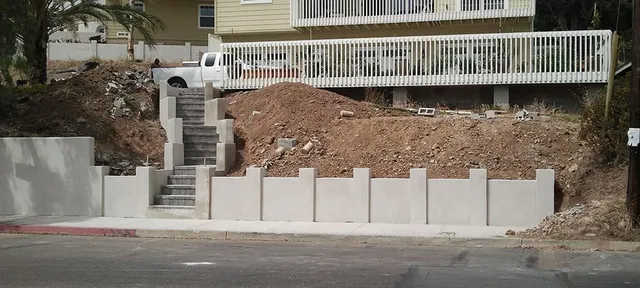
The first thing to scale in a freezing climate, because they collect snowmelt and salt. Air-entrained, properly cured, with a slight fall on each tread so water runs off instead of sitting and freezing.
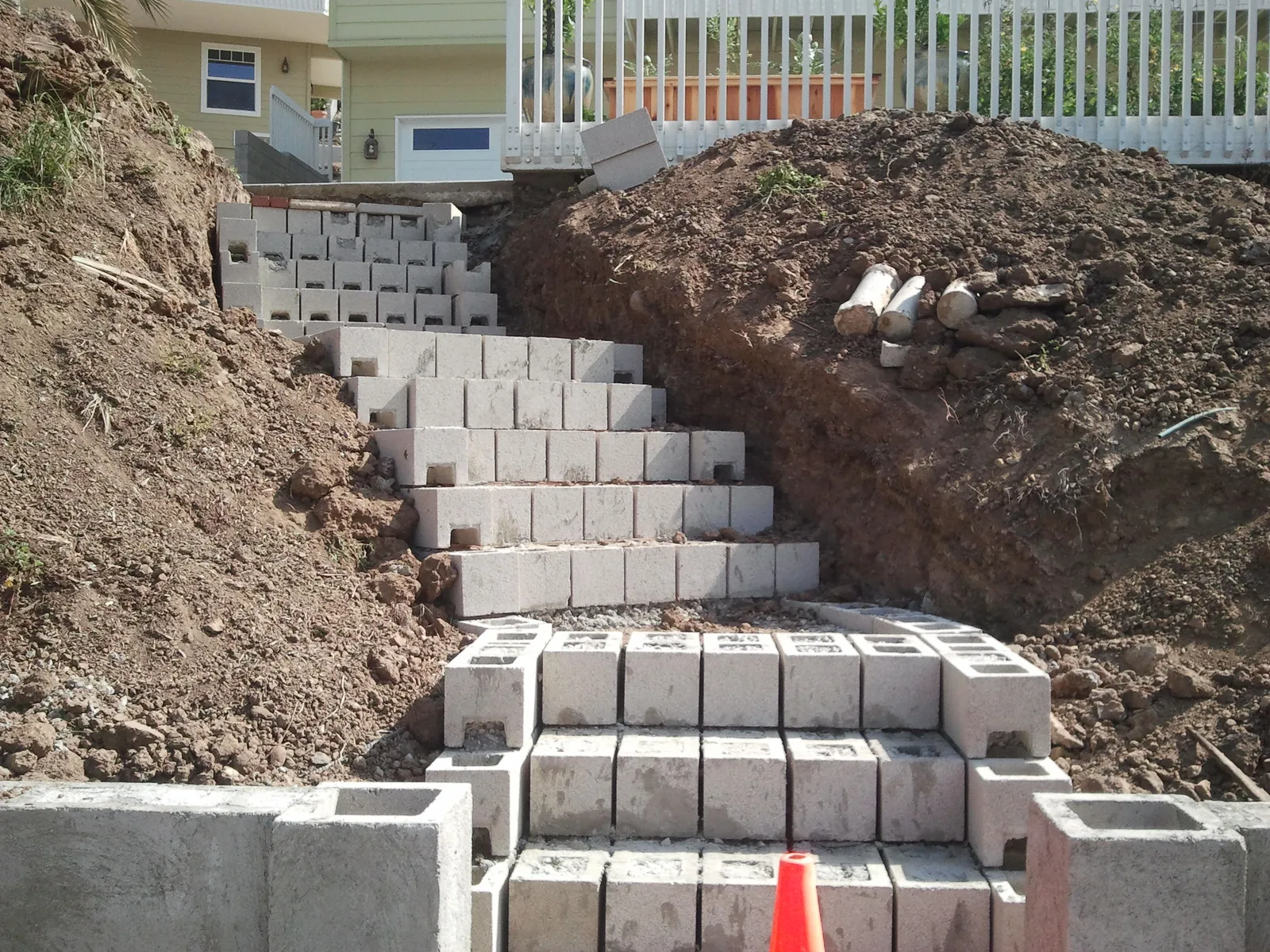
Steps that don’t flake after the first winter, a driveway that takes snow and sand, footings for a wall or a fireplace — mixed, placed and cured for a town that freezes most winter nights. You get the mix, the joints and the curing plan in writing before we pour.
CSLB #979389 · C-29 Licensed · Bonded $25,000 · Free on-site estimates
Julian concrete by the numbers
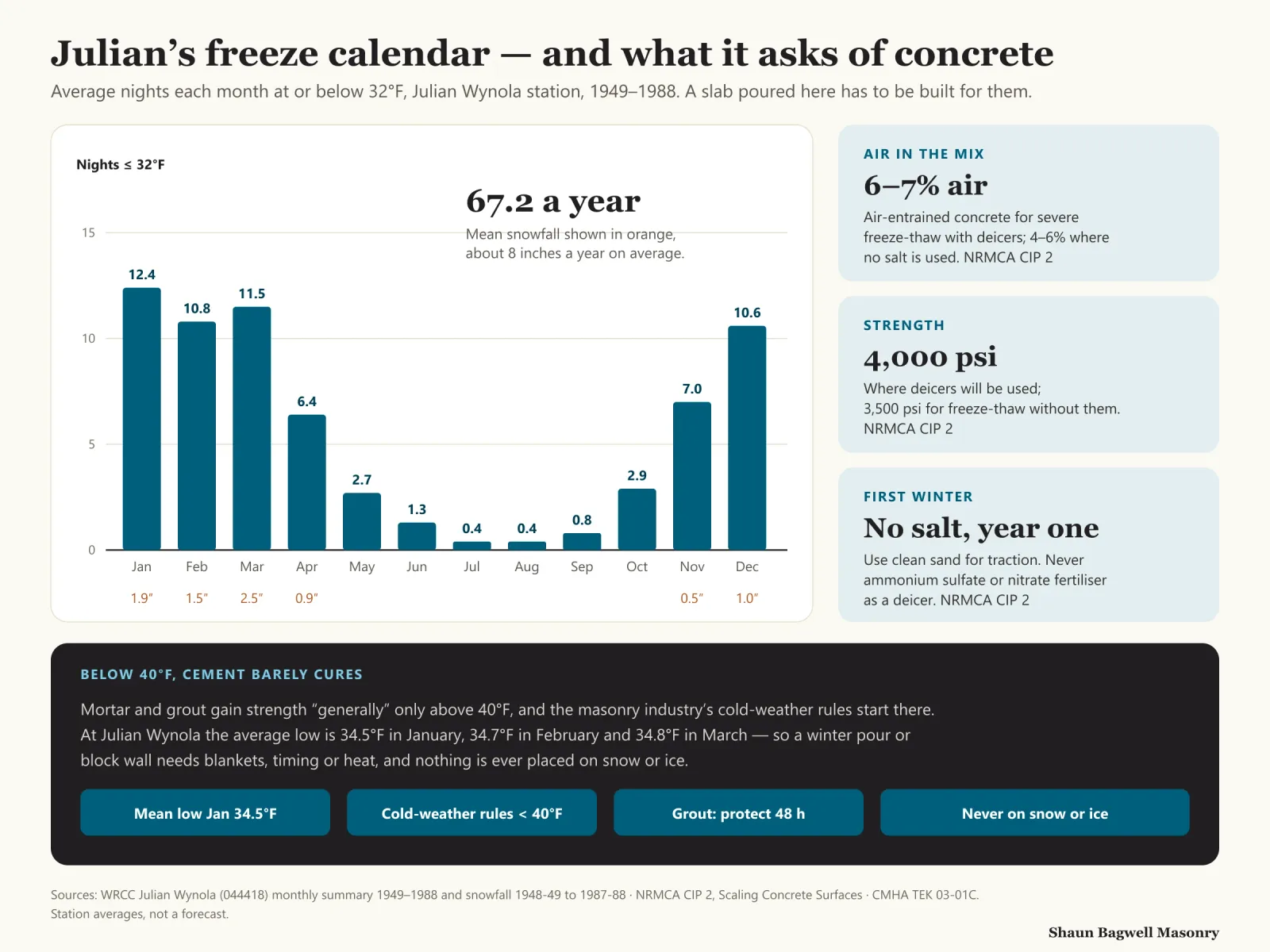
From December through March the Julian Wynola station averaged about 11 freezing nights a month, and 67.2 a year in all, with roughly 8 inches of snow on average and as much as 34 inches recorded at the Julian station in a single March. Concrete that is wet when it freezes loses its surface: the ready-mix industry’s guide to scaling blames non-air-entrained concrete, salt on weak or under-cured slabs, and finishing while bleed water is still on top.
The cure is in the mix and the method. For severe freeze-thaw exposure with deicers the same guide calls for 6–7% entrained air and about 4,000 psi; for freeze-thaw without salt, 4–6% air and 3,500 psi. It also says to keep deicing salt off new concrete for its first year. That matters in a ZIP where about 35.5% of homes are second homes — the drive often sits unattended, and whoever clears it next may reach for salt.
Flatwork and footings that go with masonry — the walls and chimneys we build need them, and so do the steps and walks around a mountain house. The county-wide detail is on our concrete services page; the Julian overview covers the rest of the town.
Flatwork
The first thing to scale in a freezing climate, because they collect snowmelt and salt. Air-entrained, properly cured, with a slight fall on each tread so water runs off instead of sitting and freezing.
Driveways
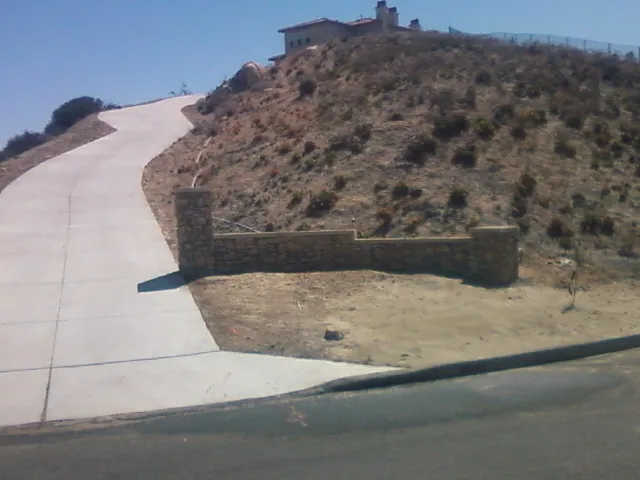
Sloped mountain drives and level pads for the car and the snow you push off it — base compacted, joints cut on time, and a broom finish that keeps traction on a cold morning. Where it meets a County road, the apron goes through DPW.
Hardscape
Concrete walks and pads in the first 5 feet around the house, the zone the County’s 2026 wildfire code keeps as hardscape. They also give you somewhere dry to stack firewood away from the walls.
Structure
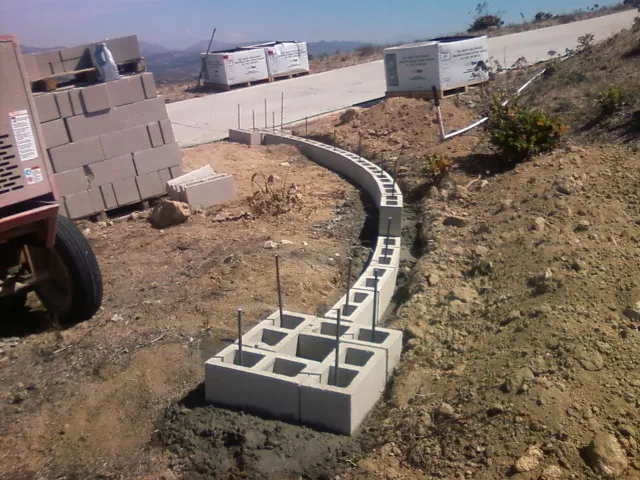
Footings cut to sound ground — in Julian often granitic rock — and poured below the loose, freezing topsoil to the depth the County and the design call for, with steel set before the pour.
Historic District
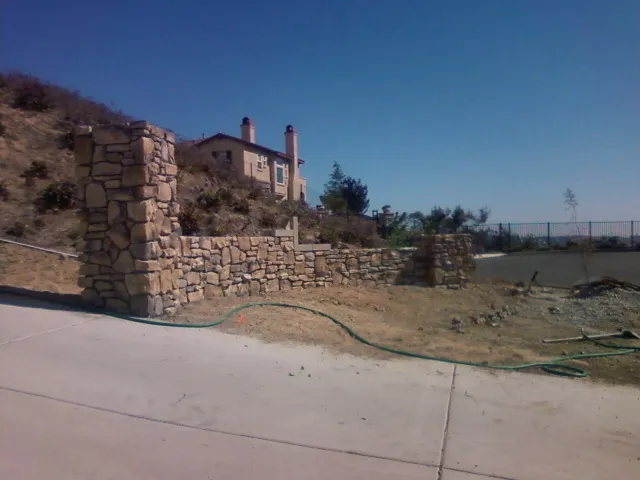
Inside the Historic District, paving and flat work are part of the Architectural Review Board’s design standards. We plan the colour, finish and edges with the Board in mind — and the Community Plan’s preference for no curbs or gutters.
Repair
Flaking steps and slabs that have lifted at the joints. We find the cause — no air, salt, poor drainage under the slab — and replace the section with a mix and base that won’t repeat it.
The ready-mix industry’s scaling guide is blunt: concrete exposed to freezing and thawing “must be air-entrained.” For a Julian driveway or step that may see salt, that means 6–7% air with ¾- to 1-inch aggregate, a moderate slump and about 4,000 psi. Finishing waits for bleed water to leave the surface, because working it back in leaves a weak skin, and the slab is cured, not just left to dry. Joints go in at 24 to 36 times the slab thickness, a quarter of its depth, so the cracks happen where we want them.
Cold limits the calendar. Masonry and concrete guidance treats temperatures below 40°F as cold-weather work, and Julian Wynola’s average lows run in the mid-30s from December to March. Winter pours are timed for the warmest hours, protected with blankets overnight, and never placed on frozen or snow-covered ground. When a cold snap is forecast, we move the pour.
Julian is unincorporated, so concrete work is under County of San Diego PDS. Patios and walks no more than 30 inches above grade are exempt from a building permit; driveways are less clear-cut, so we confirm with PDS on each job. Anything in a County road — an apron, a culvert crossing, a new connection — needs a written DPW encroachment permit before work starts, with drawings, a fee and a DigAlert ticket called in two working days ahead.
The Community Plan adds a local layer. It says snow removal is provided on State Routes and County-maintained roads, and that curbs and gutters “are neither necessary nor desired by residents”; it asks the County to discourage sidewalks, curbs and gutters except under the Julian Community Right of Way Standards. Inside the Historic District, paving and flat work fall under the Architectural Review Board’s design standards. A plain grey apron with a rolled curb may be ordinary in the suburbs and wrong on Main Street.
Both work in a freezing climate when they are built right. The difference is in how they fail and how they are fixed.
| Air-entrained concrete | Concrete pavers | |
|---|---|---|
| How it handles freezing | Resists scaling with 6–7% air and a proper cure | Joints let each unit move slightly |
| First winter | No deicing salt for a year | Salt tolerance depends on the paver |
| Repairs | Cut out and replace a section | Lift and relay the units |
| Snow clearing | Smooth for a shovel or plough | Needs a careful blade on the edges |
| Typical cost (national guide) | $6–$8 per sq. ft. plain | Higher; see our paver page |
Concrete figures: NRMCA CIP 2 and Fixr concrete driveway guide (January 2025, national). Pavers are covered on our paver services page.
Grades, drainage, where the snow goes, where the well and septic are, and whether the Historic District applies.
Air content, strength, thickness, joints and finish on the quote — not left to the day.
PDS where it’s needed, DPW for anything in the County road, and 811 before digging.
Compacted base on undisturbed ground, forms set to fall away from the house.
Scheduled around the forecast; finished after the bleed water clears, joints cut on time.
Curing compound or covers, blankets on cold nights, and written care notes for the first winter.
Planning one? Shaun will walk the site with you and tell you what it needs — free, no obligation.
Call (619) 581-2492National cost-guide figures, not our prices. In Julian, access, haul distance for the ready-mix truck, rock in the excavation and cold-weather protection all move the number — each shown on your written quote.
| Job (national guide) | Typical installed range |
|---|---|
| Plain concrete driveway | $6–$8 per sq. ft. |
| Broom, coloured or exposed-aggregate drive | $8–$12 per sq. ft. |
| Stamped concrete | $12–$18 per sq. ft. |
| Poured concrete patio | $6–$17 per sq. ft. |
Sources: Fixr concrete driveway guide (January 2025) and Fixr patio guide (August 2022). County permit and DPW encroachment fees are extra.
Snow, slope and the Historic District change the job from one part of 92036 to another.
The Julian page covers the ground, permits and neighbourhoods across every kind of job. The county-wide pages go deeper on the build itself.
Straight answers before you hire. Anything else — call, and Shaun answers it himself.
Call (619) 581-2492That is scaling. The ready-mix industry links it to concrete without enough entrained air, deicing salt on weak or under-cured concrete, and finishing while bleed water was on the surface. Replacement steps should be air-entrained (6–7% where salt is likely), properly cured and kept salt-free for the first year.
Not in the first year. Use clean sand for traction, hose off salt carried in on tyres, and use salt sparingly after that. Never use ammonium sulfate or ammonium nitrate — fertilisers — as a deicer; they attack the surface.
On the right day. Below 40°F it is cold-weather work, and Julian Wynola’s average lows are in the mid-30s through the winter months. We pour in the warmest hours, protect the slab overnight, and never place on frozen or snowy ground. Some pours are better left to spring.
Patios and walks up to 30 inches above grade are exempt from a County building permit. Driveways depend on the job, so we confirm with PDS. Any work in a County road — the apron — needs a DPW encroachment permit, and you must call 811 before digging.
Usually not the suburban kind. The Julian Community Plan says curbs and gutters are neither necessary nor desired, and asks the County to discourage sidewalks, curbs and gutters except under the Julian Community Right of Way Standards. In the Historic District, flat work is also reviewed by the Architectural Review Board.
Both work if they are built for freezing. Air-entrained concrete is cheaper and easy to plough; pavers can be lifted and relaid if the base moves. We’ll price both after seeing the slope and the drainage.
It can be if nobody checks first. The Julian Community Plan notes that outside the townsite sewer, homes use on-site septic systems, and that the area relies on wells. We mark the tank, leach field and well line before excavating, keep the ready-mix truck and the slab off the leach field, and route drainage away from the wellhead.
Yes — California C-29 Masonry licence #979389, issued 14 December 2012, bonded and insured. Check it at cslb.ca.gov.
Call Shaun at (619) 581-2492 or send the form. He’ll look at the slope, the drainage and the road, and give you a written price with the mix, joints and curing plan spelled out.