
Driveways
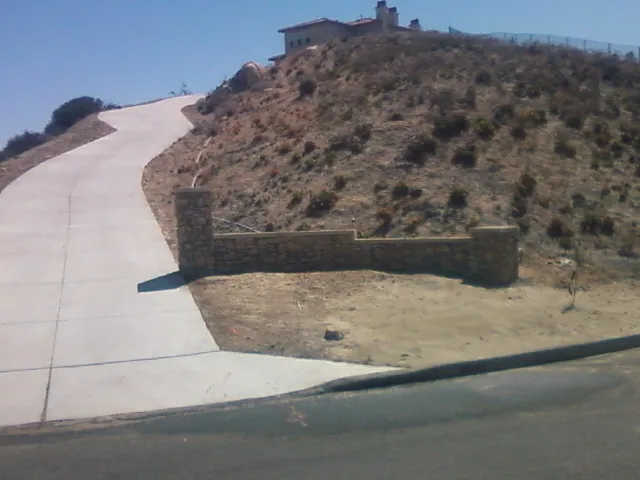
Hillside driveway replacement
Old slab broken out and hauled, base rebuilt and compacted, steel placed, and a broom or exposed-aggregate finish for grip on the grade. Joints are cut to a plan, not wherever the crew ends the day.
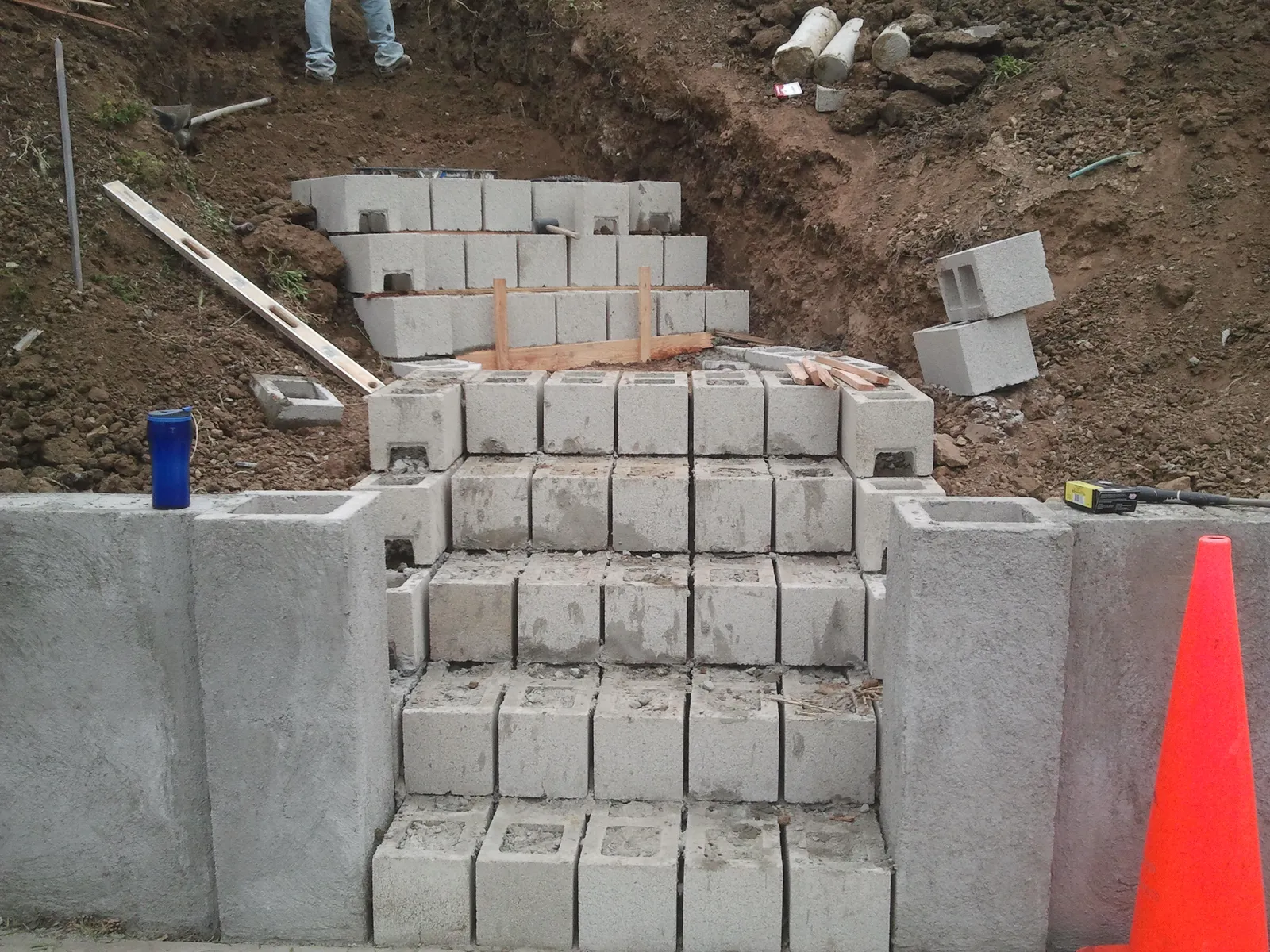
Replacing a cracked driveway that climbs to the house, adding parking on a slope, or pouring steps and a pad for a new wall — we plan the cut, the rock and the run-off before the truck arrives, sort the County permits, and give you a written price first.
CSLB #979389 · C-29 Licensed · Bonded $25,000 · Free on-site estimates
Concrete on Mount Helix, by the numbers
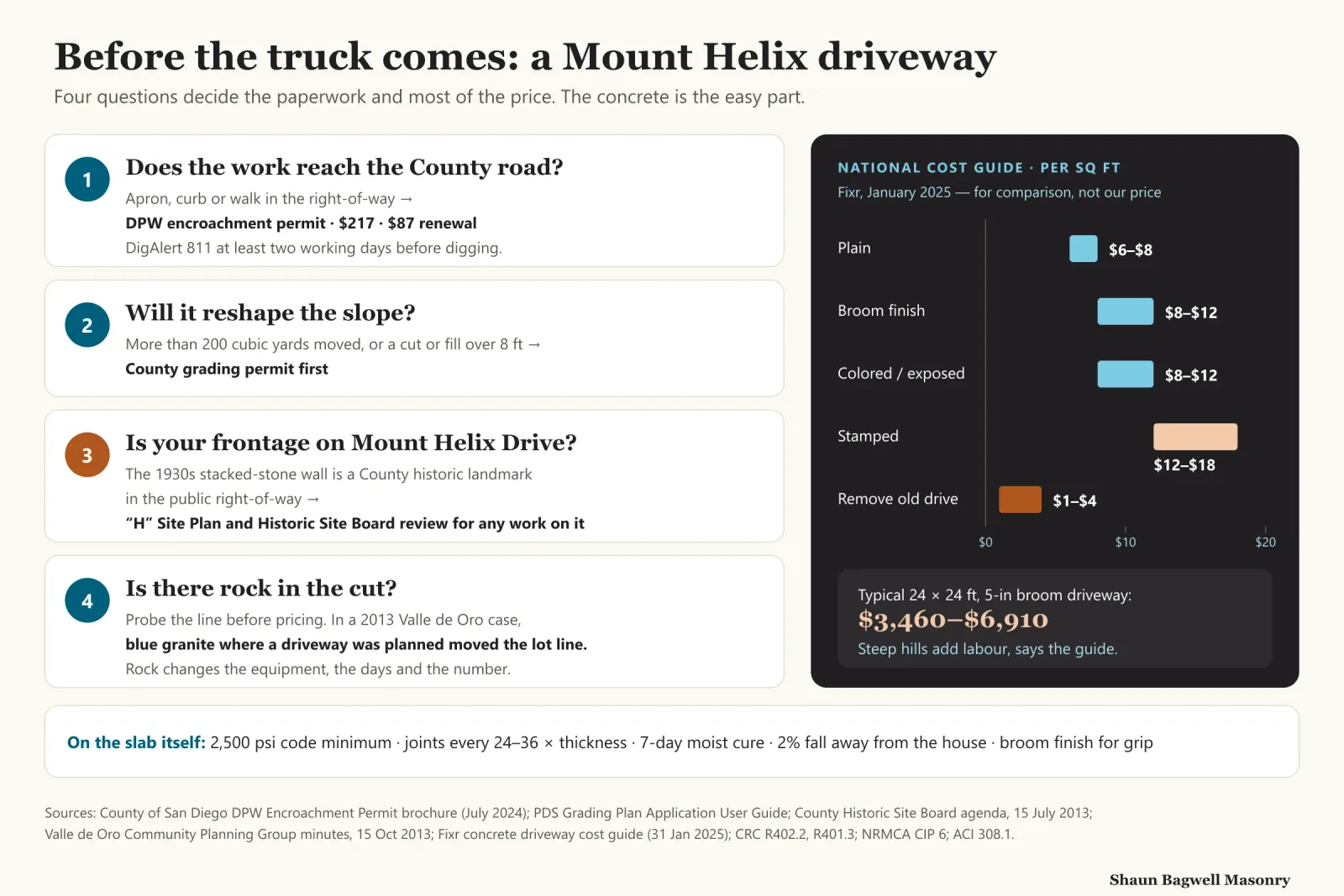
On a mountain of half-acre lots, the driveway is often the longest and steepest slab on the property — and on a house from the 1950s, ’60s or ’70s, which is what seven in ten homes here are, it may be the original pour. Fixr’s national guide puts a typical replacement driveway (24 × 24 feet, 5 inches thick, broom finish) at $3,460–$6,910, and notes that driveways on steep hills cost more in labour than flat ones. Up here the hill is the rule, not the exception.
What sits under the slab matters as much as the slab. When a 2013 subdivision case in Valle de Oro hit blue granite where a driveway was drawn, the County let the owners move the lot line rather than dig through it. Most jobs aren’t that dramatic, but a cut that meets rock changes the equipment and the days. And if the driveway reshapes the slope — more than 200 cubic yards of earth, or a cut or fill over 8 feet — a County grading permit comes first.
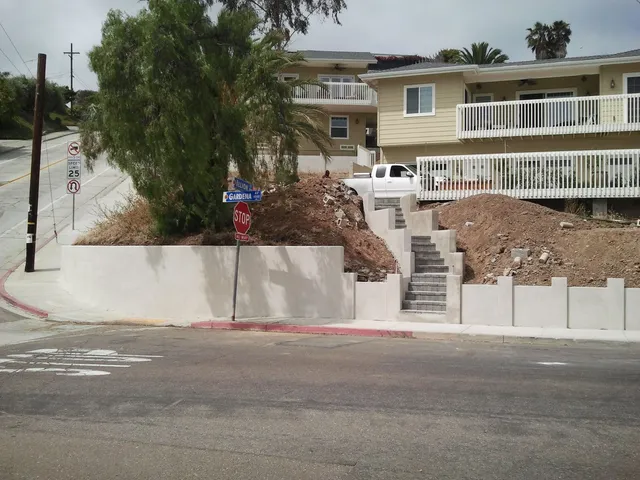
Flatwork, steps and footings, poured with the base, steel and joints a slope needs. Paving alternatives are on our Mount Helix pavers page, and the county-wide detail is on our concrete page.
Driveways
Old slab broken out and hauled, base rebuilt and compacted, steel placed, and a broom or exposed-aggregate finish for grip on the grade. Joints are cut to a plan, not wherever the crew ends the day.
At the road
Where your drive meets a County road, the apron sits in the public right-of-way and goes through a DPW encroachment permit; we pull the DigAlert ticket and build it to the County’s drawing.
Parking pads
A level pad beside the drive, usually with a retaining wall on the uphill side. We size the cut to stay under the grading trigger where we can and permit it where we can’t.
Steps
Formed steps with even risers and landings between the drive, the door and the garden — the everyday route on a sloping lot.
Footings
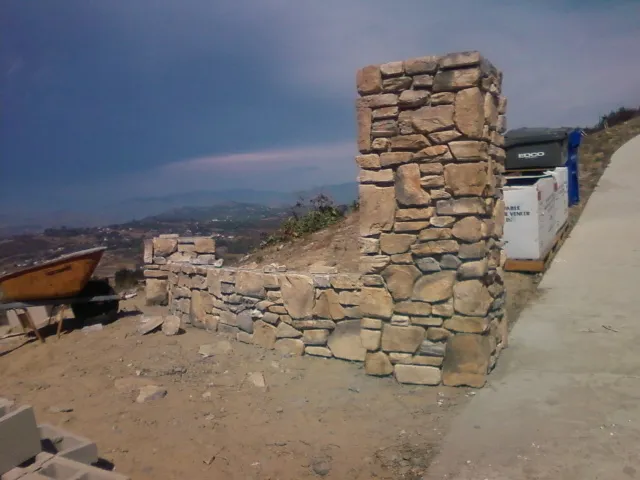
Footings for retaining walls, entry pillars and outdoor fireplaces, dug to firm ground or rock and inspected where a permit applies.
Slabs
Slabs for patios, sheds, spas and equipment, sloped away from the house and jointed so cracks land where we put them.
The residential code’s minimum for exposed slabs in our climate is 2,500 psi; driveways that carry cars up a grade get a stronger mix from us. Joints are where a slab is allowed to crack: the NRMCA rule of thumb is a spacing of 24 to 36 times the slab thickness — roughly 8 to 12 feet on a 4-inch slab — sawn a quarter of the depth. Curing follows ACI 308.1: keep it moist for 7 days, or until it reaches 70% of design strength.
The slope adds two things. Water runs down a driveway as fast as cars do, so the slab is crowned or cross-sloped to a drain or a planted edge rather than straight into the garage or onto a wall below. And near the house the code wants a 2% fall away from the foundation for the first 10 feet. Note that a concrete drive can’t sit inside a lawn-rebate area: the County’s rebate allows only permeable hardscape there.
Mount Helix is unincorporated, so concrete permits run through the County — Planning & Development Services for grading and building, Public Works for anything in the road. A driveway apron, curb or walk in the County right-of-way needs a DPW encroachment permit ($217, renewed at $87), with a DigAlert ticket opened at least two working days before digging. Earthwork above 200 cubic yards or a cut or fill higher than 8 feet adds a grading permit; the excavation for a permitted retaining wall’s footing doesn’t count toward that.
Whether a private residential driveway on your own lot needs a County building permit depends on the job, and the County’s own documents aren’t consistent on it, so we confirm it with PDS for each project rather than guess. On Mount Helix Drive one more rule applies: the 1930s stacked-stone wall at the pavement edge is a County historic landmark in the public right-of-way, and its “H” designator means any work on it needs a Site Plan reviewed by the Historic Site Board. A new driveway opening through that wall is a conversation with the County before it’s a concrete job.
Both work on a slope. The choice usually comes down to grip, repairs, looks and whether the drive falls inside a lawn-conversion area.
| Question | Poured concrete | Pavers |
|---|---|---|
| Grip on a grade | Broom or exposed aggregate | Textured units; joints add grip |
| When the ground moves | Cracks, controlled by joints | Flexes; units lifted and relaid |
| Repairs and utility work | Saw-cut and patch — shows | Lift, fix, relay — mostly invisible |
| National installed cost | $6–$18 per sq ft by finish (Fixr 2025) | Higher per sq ft — see our pavers page |
| Inside a lawn-rebate area | Not allowed | Only if permeable |
Cost figures are national cost-guide numbers for comparison, not our price.
We walk the drive, check the grade, the road edge and the right-of-way, probe for rock and note where water runs.
Demolition, haul-off, base, steel, finish and joints itemised — with encroachment, grading or engineering fees shown where they apply.
Encroachment permit for any road work, grading permit if triggered, and an 811 ticket before excavation.
Old slab broken out and hauled; base excavated, rock dealt with, base rock placed and compacted in lifts.
Forms set to the falls, reinforcement chaired, concrete placed, finished for traction and jointed to plan.
Kept moist through the cure, forms stripped, edges backfilled, County inspections closed out, and care notes given.
Planning one? Shaun will walk the site with you and tell you what it needs — free, no obligation.
Call (619) 581-2492National cost-guide figures (Fixr, January 2025) for comparison — not our price. On Mount Helix, length, grade, rock and access to the top of the drive move the number most.
| Item | National cost guide |
|---|---|
| Typical driveway, 24 × 24 ft, 5 in, broom | $3,460–$6,910 (average $5,184) |
| Plain concrete | $6–$8 per sq ft |
| Broom, colored or exposed aggregate | $8–$12 per sq ft |
| Stamped | $12–$18 per sq ft |
| Removing an old driveway | $1–$4 per sq ft |
Encroachment, grading and any engineering are itemised separately on our proposals. Your number comes from a free site visit.
The County’s rules are the same everywhere here; the length and pitch of the drive are not.
The Mount Helix page covers the ground, permits and neighbourhoods across every kind of job. The county-wide pages go deeper on the build itself.
Straight answers before you hire. Anything else — call, and Shaun answers it himself.
Call (619) 581-2492For the part in the County road — the apron, curb or walk — yes, a DPW encroachment permit ($217) and a DigAlert ticket. For the driveway on your own lot it depends on the job; we confirm with County PDS. If the work moves more than 200 cubic yards of earth or cuts more than 8 feet, a grading permit is needed too.
We probe the line at the site visit and price a rock allowance up front. Shallow rock can usually be broken out or the grade adjusted; a big outcrop may change the layout, as it did on one Valle de Oro lot in 2013.
A broom or exposed-aggregate finish gives the most grip. Smooth trowelled or sealed-glossy finishes get slick when wet. Stamped concrete works on gentler grades with a slip-resistant sealer.
Only with County approval if it affects the historic stone wall. The wall sits in the public right-of-way and carries an “H” designator, so any work on it needs a Site Plan reviewed by the Historic Site Board first.
Fixr’s January 2025 national guide puts a typical 24 × 24 ft broom-finish driveway at $3,460–$6,910, with removal of an old one at $1–$4 per square foot, and notes steep driveways cost more in labour. Those are national figures, not our price; you get an itemised proposal after a free site visit.
We keep it moist for about 7 days, which is the ACI 308.1 default curing period in warm weather, and advise keeping cars off for at least that long. Concrete reaches its specified strength at 28 days.
Give Shaun a call on (619) 581-2492, or send the form. He’ll walk the drive from the road to the garage, check the rock and the permits, and give you a written, itemised price.