Stacked-stone garden wall with a flat stone cap, a path light and planting spilling over the top.

Patio Contractor in San Diego County — Flagstone, Stone, Brick and Outdoor Living

Flagstone, travertine, natural stone and brick patios, with the seat walls, steps and BBQ and fire-pit surrounds that make them a room — laid on the right base, sloped to drain, and finished to stay comfortable in inland heat. Free on-site design visit.

CSLB #979389 · C-29 Licensed · Bonded $25,000 · Free on-site estimates

Patios by the numbers

The Outdoor Project Owners Enjoy Most — If It Drains and Stays Cool

Realtors and landscape professionals priced a new patio at about $10,500 in the 2023 NAR/NALP Remodeling Impact Report, and owners gave it a “Joy Score” of 9.9 out of 10 — one of the highest of any outdoor project. The same report found 97% of Realtors say curb appeal matters in attracting buyers.

What separates a patio you use from one you avoid is mostly invisible: the base under it, the fall away from the house, and how hot the surface gets. The building code wants hard surfaces next to the foundation sloped at least 2% — about a quarter-inch per foot — and the EPA notes conventional paving can reach 120–150°F in summer sun. Inland, where El Cajon averages an August high of 88.6°F, material and colour matter as much as layout.

  • 9.9/10Owner “Joy Score” for a new patioNAR/NALP 2023
  • 2%Minimum slope away from the houseCRC R401.3
  • 120–150°FPeak summer temperature of conventional pavingU.S. EPA
  • 30 inAt-grade patios up to this height need no building permitSDMC §129.0203
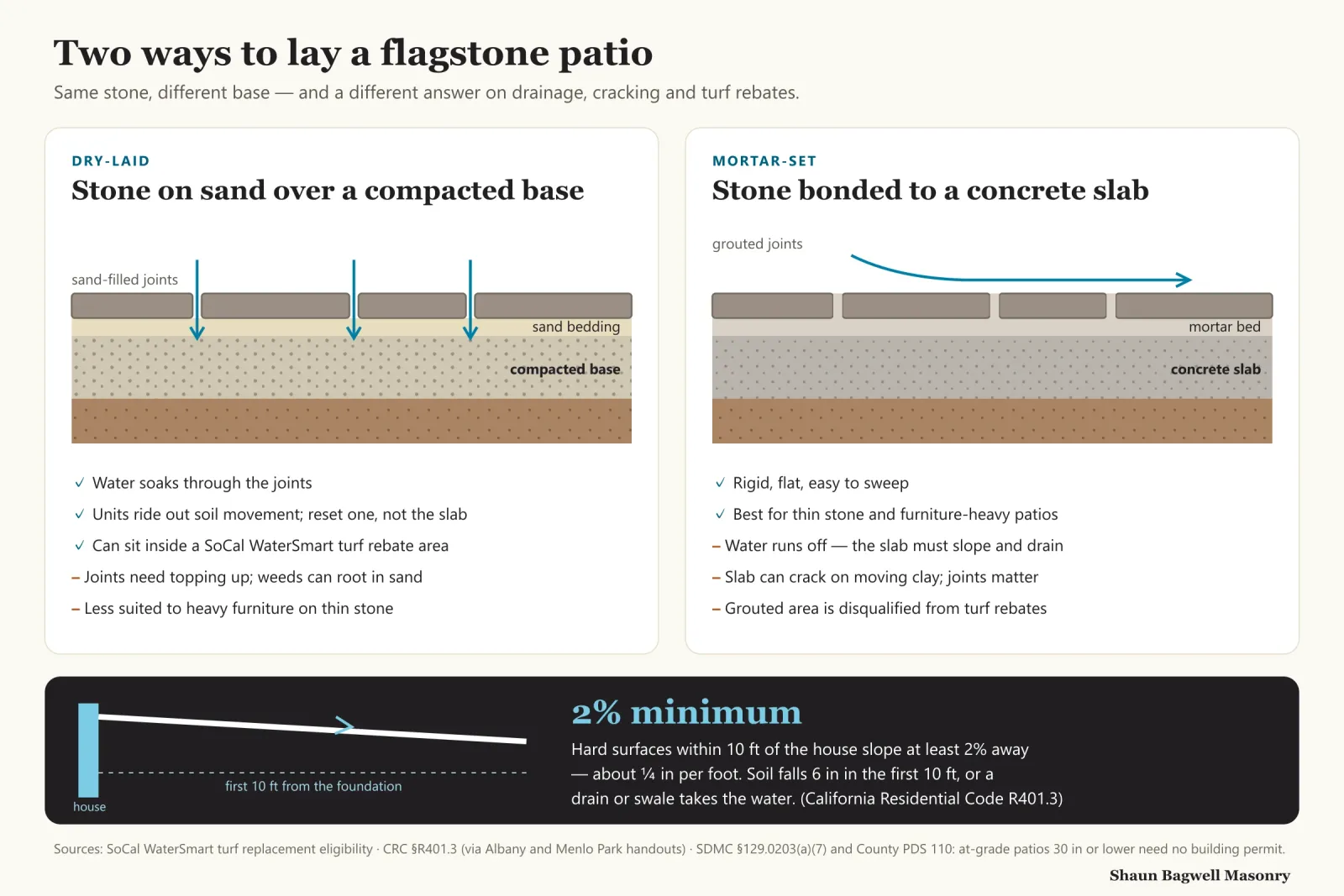
Infographic comparing two ways to lay a flagstone patio. Dry-laid: stone on sand bedding over a compacted base with sand-filled joints; water soaks through, units ride out soil movement, and it can sit inside a SoCal WaterSmart turf rebate area, but joints need topping up. Mortar-set: stone bonded to a concrete slab with grouted joints; rigid and flat, but water runs off so the slab must slope and drain, it can crack on moving clay, and the grouted area is disqualified from turf rebates. Below: hard surfaces within 10 feet of the house must slope at least 2% away, about a quarter inch per foot, per California Residential Code R401.3.
Same stone, two very different patios. Dry-laid flagstone drains through its joints and can be part of a turf-rebate project; mortar-set flagstone is flatter and firmer but sheds water and has to be sloped and drained like a slab.Sources: SoCal WaterSmart eligibility; CRC R401.3; SDMC §129.0203.

Patios and the Masonry Around Them

A patio is rarely just the floor. We build the walls, steps and surrounds that go with it, in matching stone. Looking for paver patios or a poured concrete slab? Those have their own pages.

Flagstone

Flagstone patios, dry-laid or mortared

Dry-laid on sand over a compacted base where you want drainage and flexibility; mortar-set on a slab where you want a flat, firm floor for furniture. We’ll show you both and tell you which suits your ground.
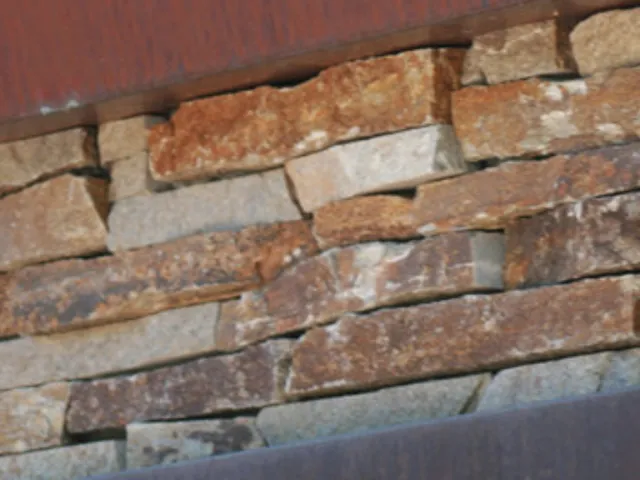
Close-up of a stacked natural-stone wall in warm rust and grey tones.

Travertine & stone

Travertine and natural stone

Tumbled and honed travertine, slate, quartzite and other natural stone — textured finishes for grip, lighter tones for cooler feet, laid to a pattern that works with the house.

Brick

Brick patios and borders

Clay brick in running bond, herringbone or basketweave, alone or as a border around stone or concrete — a natural match for older San Diego homes with brick chimneys and planters.

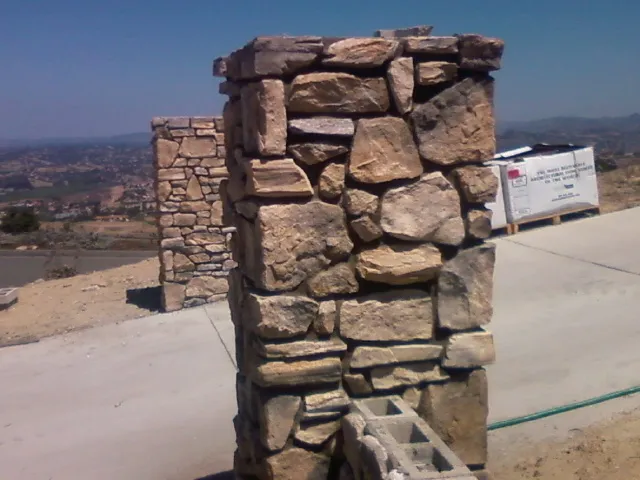
Fieldstone pillar with a flat stone cap, showing the stone and mortar joints.

Seat walls

Seat walls and planters

Reinforced block walls at seating height, faced in stone or stucco and capped to sit on — they edge the patio, hold back a slope and add seating without adding furniture.

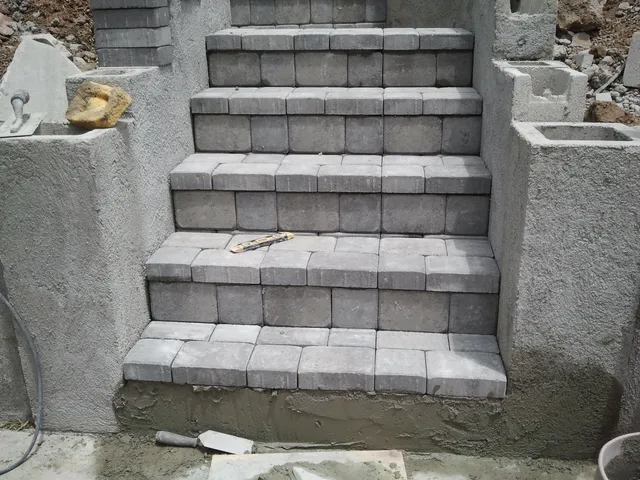
Paver stair treads set between plastered block walls.

Steps

Steps and level changes

Stone, brick and paver steps between patio levels, with consistent riser heights and treads that shed water — the detail that makes a sloped yard usable.

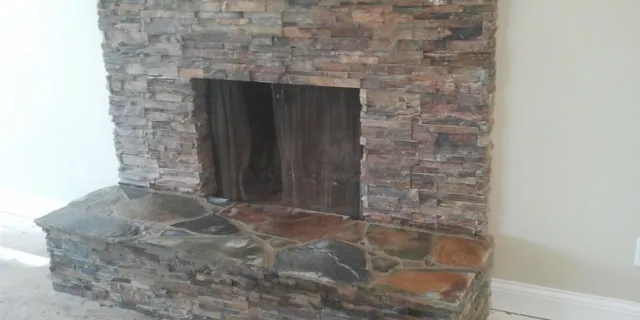
Stacked-stone fireplace wall with a raised stone hearth.

BBQ & fire

BBQ island and fire-pit surrounds

Block cores with stone or stucco faces and stone or concrete tops, built to take an appliance or a burner. Gas lines and wiring need their own trade permits, and we plan around them. See fireplaces and fire pits.

Built to Drain, Built to Last

Most patio failures start under the surface: a thin or uncompacted base that settles, or a surface that slopes back toward the house. The California Residential Code requires impervious surfaces within 10 feet of the foundation to slope at least 2% away from the building, and the ground to fall at least 6 inches in that first 10 feet — or a drain or swale to carry the water instead.

So every patio we build starts with excavation to firm ground, a compacted base, and a laid-out fall before any stone goes down. On clay ground we keep water out from under the patio; on a slope we let the steps and seat walls do the retaining. Mortared work gets joints placed where a slab wants to crack.

Next to the house
2% minimum slope away
Hard surfaces within 10 ft of the foundation — about ¼ in per foot.CRC R401.3
The ground
6 in of fall in 10 ft
Or drains and swales where lot lines or walls prevent it.CRC R401.3
Seat or retaining wall
Permit over 3 ft
City of San Diego: measured from the top of the footing, or any surcharge.SDMC §129.0203
Gas or power to a BBQ
Trade permits
Plumbing and electrical permits still apply when the patio itself is exempt.SDMC §129.0203(b)

Permits, Heat and Turf Rebates

An at-grade patio — 30 inches or less above the ground next to it — needs no building permit in the City of San Diego or in unincorporated County areas. Patio covers are a separate structure: exempt up to 300 square feet in both, with exceptions in the City for coastal, historic and environmentally sensitive sites, and a 3-foot property-line clearance in the County. Covers are carpentry work; we coordinate with the builder so the footings and patio line up.

Heat is the other San Diego reality. Conventional paving can reach 120–150°F in full sun, so inland we steer toward lighter, textured stone and offer to set samples out in your own yard and check them with an infrared thermometer before you choose. And if you’re pulling up lawn for a SoCal WaterSmart turf rebate, know the rule: concrete and grouted surfaces disqualify that area, while flagstone laid without cement grout can stay in it. Get pre-approval before the turf comes out.

At-grade patio
No building permit
30 in or less above adjacent grade — City and County.SDMC · PDS 110
Patio cover
Exempt up to 300 sq ft
City exceptions: coastal, historic, ESL, setbacks. County: 3 ft from property lines.IB 206
Inland summer
88.6°F average August high
El Cajon — lighter, textured surfaces matter.NOAA 1991–2020
Turf rebate
Grouted = disqualified
Dry-laid flagstone without cement grout can remain in the rebated area.SoCal WaterSmart

Choosing a Patio Surface

No surface wins on everything. Here’s how the common choices trade off — we’ll bring samples so you can see and feel them on your own patio site.

Choosing a Patio Surface
SurfaceHow it’s laidWaterIn summer sunUpkeep
Dry-laid flagstoneOn sand over a compacted baseSoaks through jointsLighter stone stays coolerTop up joint sand; occasional reset
Mortared flagstoneBonded to a concrete slabRuns off — slab must slopeSame stone, same heatRepoint joints if they crack
TravertineDry-laid or mortaredDepends on how it’s laidLight tones; tumbled or honed for gripPenetrating sealer on schedule
BrickSand-set or mortaredDepends on how it’s laidDarker; holds heatLow; reset or repoint as needed
PaversSand-set with edge restraintJoints drain; permeable pavers more soWide colour choiceSee our paver page

Surface temperature depends on colour, finish and shade; we don’t quote degree figures because no reliable measured comparison exists for these materials — the in-yard sample test is the honest way to compare.

How a Patio Gets Built

  1. Design visit

    We look at how you’ll use the space, the sun, the slope and the soil, and bring material samples to set out on site.

  2. Layout and drainage plan

    Patio edges, levels, steps and the 2% fall away from the house set out on the ground before anything is dug.

  3. Excavation and base

    Dug to firm ground and built up with compacted base — the part you never see and the part that decides how long the patio stays flat.

  4. Walls and steps

    Seat walls, planters, steps and surrounds go in first, so the patio floor finishes cleanly against them.

  5. Stone, brick or flagstone

    Laid dry on sand or set in mortar on a slab, with joints filled, edges restrained and the surface checked for fall.

  6. Seal and walk-through

    Stone sealed where it needs it, the site cleaned up, and a walk-through on care — including what to top up and when.

Planning one? Shaun will walk the site with you and tell you what it needs — free, no obligation.

(619) 581-2492

Patio Questions

Straight answers before you hire. Anything else — call, and Shaun answers it himself.

(619) 581-2492

Do I need a permit for a patio in San Diego?

Usually not for the patio itself. Flatwork 30 inches or less above the adjacent ground is exempt from a building permit in the City of San Diego (SDMC §129.0203) and in unincorporated County areas (PDS 110). Seat or retaining walls over 3 feet, patio covers over 300 square feet, and gas or electrical work for a BBQ island do need permits.

Which patio material stays coolest?

Lighter, textured surfaces in partial shade stay coolest; dark brick and dark stone hold the most heat. The EPA notes conventional paving can reach 120–150°F in summer sun. We don’t quote degree differences between materials because there’s no reliable measured comparison — instead we’ll set samples out in your yard and check them with an infrared thermometer.

Should flagstone be dry-laid or mortared?

Dry-laid flagstone sits on sand over a compacted base, drains through its joints and rides out ground movement; it suits informal patios, paths and clay soils. Mortar-set flagstone is bonded to a concrete slab, giving a flat, firm, easy-to-sweep floor, but it sheds water and must be sloped and drained. Thin stone and heavy furniture usually call for mortar.

Will a new patio affect my turf-replacement rebate?

It can. Under SoCal WaterSmart rules, areas with concrete or other surfaces water can’t pass through are disqualified, and flagstone or spaced stone may be used only if it isn’t grouted with cement. A mortared patio comes out of the rebated area; dry-laid flagstone can stay in. Always get pre-approval before removing turf.

Can you build seat walls, steps and a BBQ island with the patio?

Yes — that’s the masonry we do best. Seat walls and BBQ islands are built on reinforced block cores with stone or stucco faces and matching caps. Any gas line or electrical circuit needs its own trade permit, which we plan for.

How should a patio drain?

Away from the house. The California Residential Code requires impervious surfaces within 10 feet of the foundation to slope at least 2% away — about a quarter-inch per foot — with the ground falling 6 inches in that first 10 feet or a drain or swale taking the water.

Do you do paver patios too?

Yes — interlocking concrete, clay and stone pavers have their own page with base, edge-restraint and permeable-paver details: see our paver installation page.

Do you build patio covers?

Patio covers are carpentry, not masonry, so we coordinate with the builder rather than build them ourselves. In the City and County, covers up to 300 square feet are generally exempt from a building permit, with exceptions — we’ll make sure footings, posts and the patio surface line up.

How do I check that you’re licensed?

Shaun Bagwell Masonry holds California C-29 Masonry licence #979389, issued 14 December 2012, with a $25,000 contractor bond. Look it up at cslb.ca.gov → “Check a License”.

Design Your Patio With a Mason

Call Shaun at (619) 581-2492 or send the form. He’ll walk the space with you, bring samples, and put a written, itemised price in your hands.

(619) 581-2492

Call Now(619) 581-2492Estimate