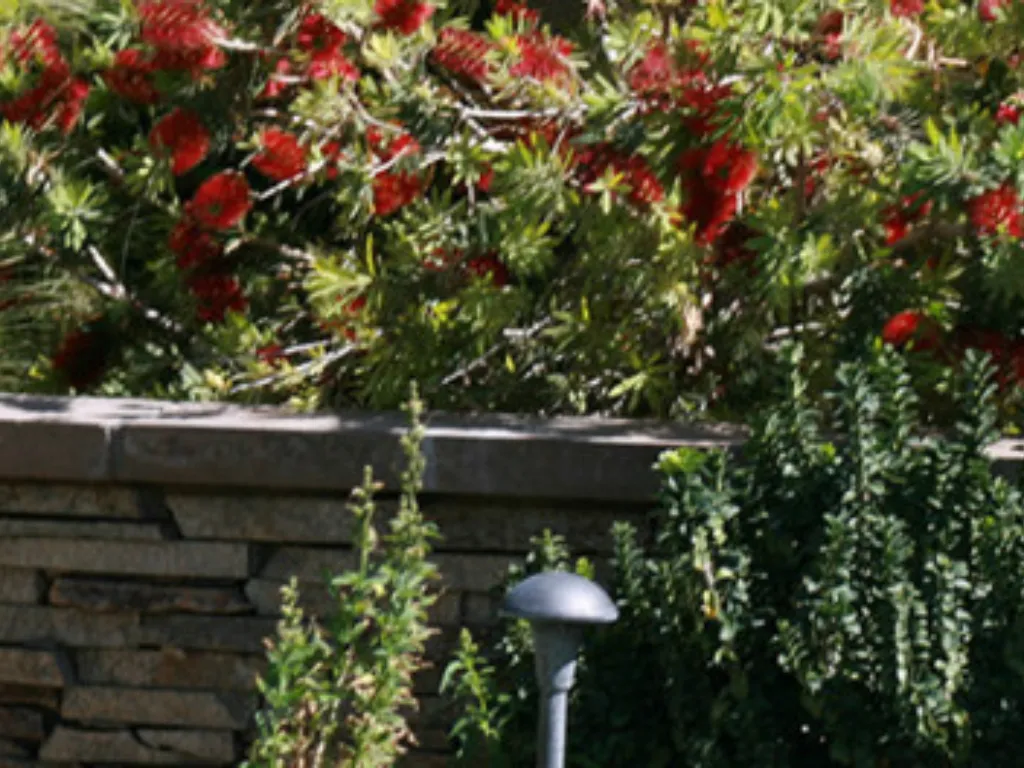
A low stacked-stone garden wall with a flat stone cap, edged by flowering shrubs and a path light.

Mount Helix & Casa de Oro Masonry Contractor

A terrace that has started to slump, a stone wall that needs mending by someone who won’t smear mortar over the face, or a chimney on a 1950s house that has never been looked at — we work the slopes of Mount Helix and Grossmont to County rules, and you get a written price after Shaun has walked the site. Licensed C-29 mason, based in Alpine.

CSLB #979389 · C-29 Licensed · Bonded $25,000 · Free on-site estimates

Casa de Oro–Mount Helix by the numbers

Custom Homes on Granite, Mostly From the ’50s to the ’70s

The Census Bureau counts about 19,800 people in Casa de Oro–Mount Helix, an unincorporated place of roughly 6.9 square miles between La Mesa, El Cajon and Spring Valley. It is a homeowners’ hill: 78.5% of households own, 82% of homes are detached houses, and the median owner-occupied home is valued at $952,400. The County’s community plan describes it plainly — a commercial and denser core along Campo Road, then custom homes on half-acre-plus lots climbing the slopes of the mountain.

Those homes went up in a thirty-year burst. The median one was built in 1969; seven in ten date from the 1950s, ’60s or ’70s, and fewer than 3% are newer than 2000. That age, the slope and the rock under it decide most masonry work here. Underneath the lots is the plutonic bedrock of the Peninsular Ranges, and above them, along Mount Helix Drive, run 1.5 miles of 1930s stone walls the County protects as a historic landmark.

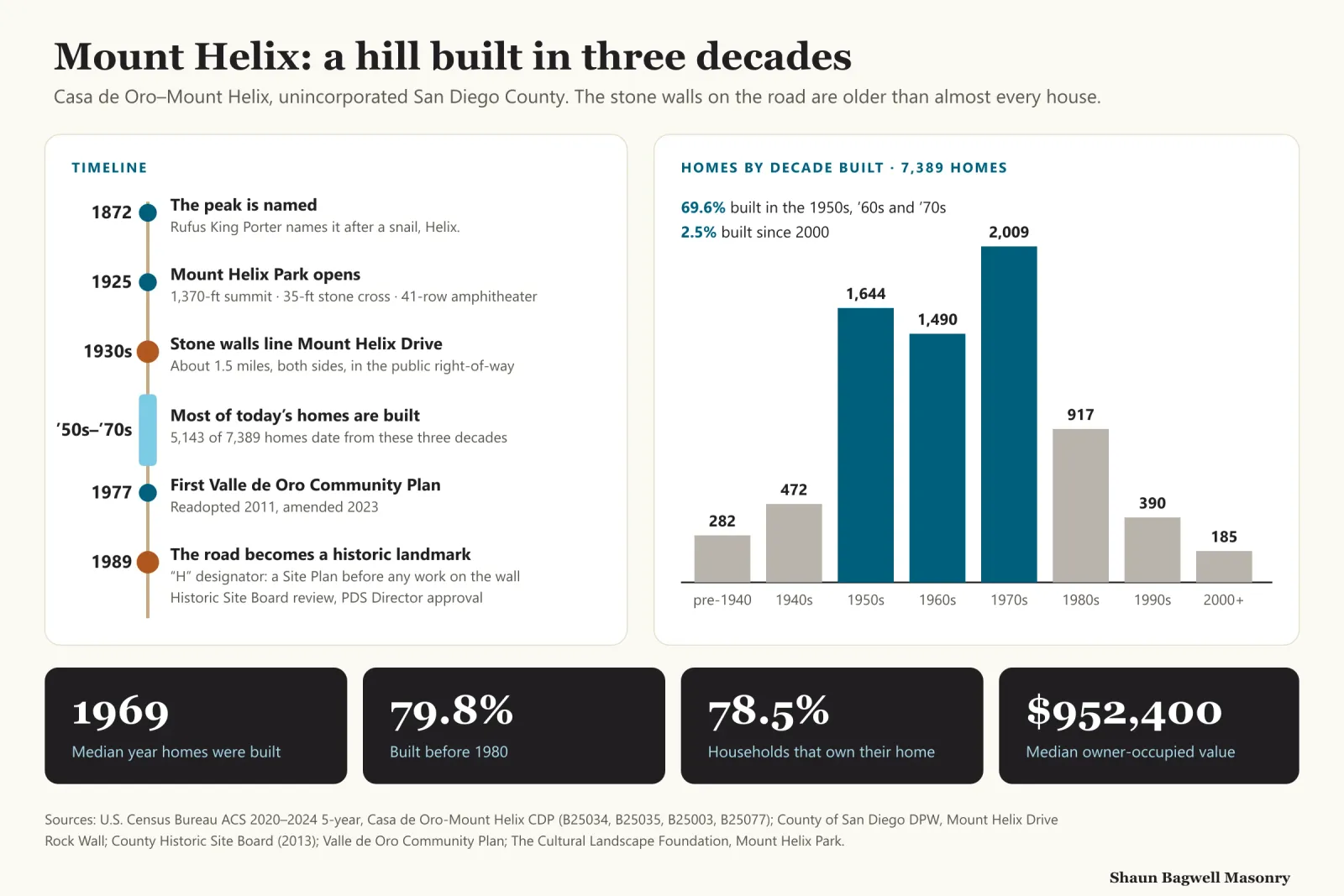
Infographic: Mount Helix, built in three decades. A timeline runs from 1872, when Rufus King Porter named the peak; 1925, Mount Helix Park opens with its amphitheater and 35-foot stone cross; early 1930s, about 1.5 miles of stacked-stone walls built along Mount Helix Drive; the 1950s to 1970s, when 5,143 of today’s 7,389 homes were built; 1977, the first Valle de Oro Community Plan; 1989, the Board of Supervisors rezones Mount Helix Drive as a historic landmark, with an H designator requiring a site plan for any work on the wall; the plan was readopted in 2011 and amended in 2023. A bar chart shows the 7,389 homes in Casa de Oro–Mount Helix by decade built: 282 before 1940, 472 in the 1940s, 1,644 in the 1950s, 1,490 in the 1960s, 2,009 in the 1970s, 917 in the 1980s, 390 in the 1990s and 185 since 2000. Callouts: median year built 1969, 79.8 percent built before 1980, 78.5 percent owner-occupied, median home value 952,400 dollars.
A hill built in three decades, with walls older than its houses. Most homes here are 45 to 75 years old — the age when chimneys, block walls and terraces come due — and the public stone walls on Mount Helix Drive predate nearly all of them.Sources: Census ACS 2020–24; County DPW rock wall; Valle de Oro Community Plan; TCLF — Mount Helix Park.

What the Mountain Asks of a Mason

Mount Helix isn’t a city, so the County writes its rules — and the hill writes the rest. Six conditions come up on almost every visit.

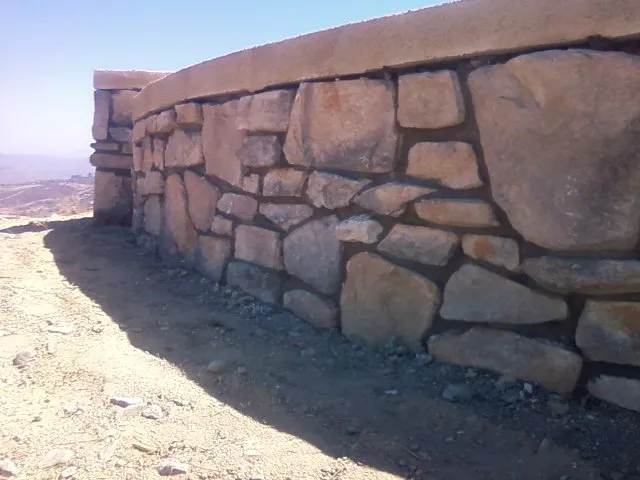
A mortared wall of large, irregular natural stones with a concrete cap, on bare, dry ground.

Rock

Granite where the footing wants to go

The USGS maps this side of the Elsinore fault as Jurassic and Cretaceous plutonic rock of the Peninsular Ranges batholith, and the mountain shows it in its outcrops. It isn’t theoretical: on one Valle de Oro lot reviewed by the planning group in 2013, blue granite turned up exactly where a driveway was meant to go, and the lot lines were redrawn around it. We probe before we price, because a footing trench that hits rock changes the tools, the days and the number.
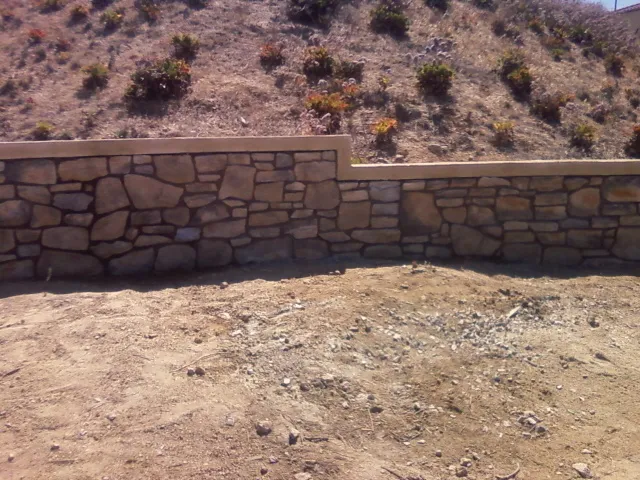
A long stone-faced wall with a smooth concrete cap at the foot of a dry, planted slope.

Slopes

Half-acre lots that fall away from the house

The community plan steers development on Mount Helix to one or two homes per acre and asks that grading answer the land — daylight and contour grading, hillside-adaptive foundations, crib walls or contoured cuts rather than one big scar. In practice that means terraces: two or three shorter retaining walls with planting between them, built so they don’t block a neighbour’s view.

Historic walls

The 1930s stone walls belong to the public

The stacked-stone walls along both loops of Mount Helix Drive sit at the edge of the pavement, inside the County right-of-way, with private lines usually a few feet behind them. The County rezoned the road as a historic landmark in 1989, and its “H” designator means any work on the wall needs a Site Plan reviewed by the Historic Site Board first. In 2013 the planning group objected to a fence bolted on top and concrete “placed between and over the stones.” If your frontage touches the wall, we’ll build your own wall behind it — and leave the landmark alone.

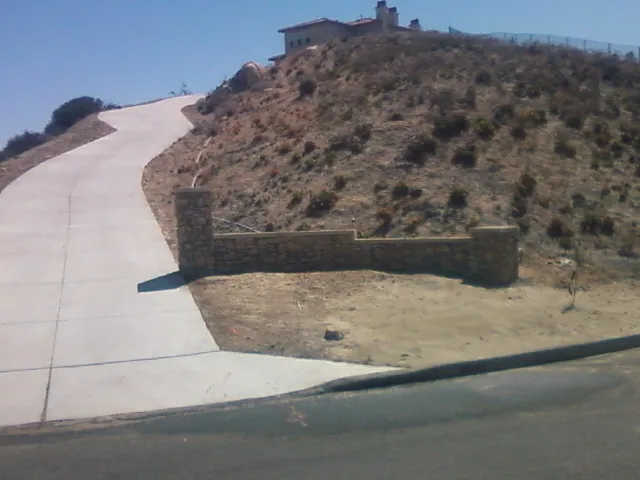
A low stone wall with stone pillars beside a new concrete driveway that climbs a dry hillside to a house.

Drainage

Fuerte Drive shows what water does to a cut

In 2013 two slopes on the south side of Fuerte Drive gave way in the rain — one beside a private block wall, one close enough to a house corner that the County designed a 14-foot soldier-pile wall with a concrete gutter above it specifically to keep water from building pressure behind it. In 2025 the planning group still kept a standing subcommittee on Fuerte slope instability. Every wall we build on the hill gets gravel backfill, a drain and somewhere for the water to go.

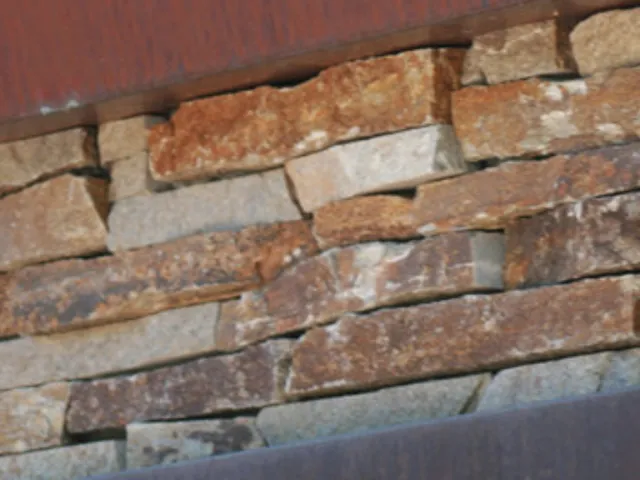
Close-up of dry-stacked natural stone in rust, tan and grey, set in level courses.

Fire

San Miguel’s first five feet

San Miguel Fire & Rescue covers Casa de Oro and Grossmont/Mt. Helix. Its defensible-space rules call for continuous hardscape or approved plantings only within 5 feet of the house, no mulch, and firewood stacked at least 30 feet away. A stone band, a paver walk or a masonry planter does that job and looks deliberate. The state’s 2025 maps now show moderate and high zones as well as very high — check your own address before you plan.

Water

Two water districts, one County rebate

Helix Water District serves the north-western part of the Valle de Oro planning area and Otay serves the rest. Either way, because the land is unincorporated, the County’s Waterscape program adds to the regional SoCal WaterSmart rebate: $3–$4 per square foot of lawn removed, up to 5,000 square feet, approved before anything is dug. Only permeable hardscape may go in the converted area, so dry-laid stone and open-jointed pavers fit; a mortared patio doesn’t.

County Rules, Even With a La Mesa Address

Mail here goes to La Mesa (91941), Spring Valley (91977) or El Cajon (92020), but those post-office names don’t decide who issues your permit. Unless your parcel has been annexed — one on Carmichael Drive was going through that process with LAFCO and La Mesa in 2025 — the County of San Diego Planning & Development Services is the building department. A retaining wall skips a County building permit only when it holds back 3 feet of soil or less (measured from the top of the footing), stands no more than 6 feet above the lowest grade, has level backfill, no structure within 6 feet and no surcharge. On a Mount Helix lot that last pair — level ground and nothing above — is usually what rules the exemption out.

Moving more than 200 cubic yards of earth, or cutting or filling more than 8 feet vertically, needs a County grading permit. Fences and freestanding masonry walls to 6 feet are exempt from a building permit if they meet zoning: 42 inches in front and street-side yards, 72 inches in rear and interior side yards. Work in the road right-of-way, including a driveway apron, needs a County encroachment permit — and on Mount Helix Drive, anything touching the historic wall needs the “H” Site Plan. Variances and other discretionary requests also go to the volunteer Valle de Oro Community Planning Group for a recommendation.

County of San Diego decides

  • Building and grading permits (PDS)
  • Encroachment permits in County roads (DPW)
  • Historic Site Board review on Mount Helix Drive

Also part of the picture

  • San Miguel Fire & Rescue
  • Valle de Oro Community Planning Group (advisory)
  • Helix or Otay Water District rebates
Retaining wall exemption
All 5 tests, or a permit
≤3 ft retained from top of footing, ≤6 ft overall, level backfill, nothing within 6 ft, no surcharge.PDS 110 · Sec. 91.1.105.2(a)(7)
Grading permit
>200 cu yd or >8 ft
Excavation for a permitted wall’s footing is exempt from grading.County grading guide
Fence or masonry wall height
42 in front · 72 in rear
Exempt to 6 ft if zoning is met; pool barriers always need a permit.PDS 070 · Zoning 6708
Historic rock wall, Mount Helix Dr
“H” Site Plan first
Reviewed by the Historic Site Board, approved by the PDS Director.Historic Site Board, 2013
Driveway apron or work in a County road
Encroachment · $217
Renewal is $87; open a DigAlert 811 ticket two working days ahead.County DPW

Masonry Work We Do on Mount Helix and in Casa de Oro

Mostly hillside walls, stone and repair work on homes built between the 1950s and ’70s — each priced in writing after a site visit.

Natural stone walls and repair

Dry-stacked and mortared stone set to match what’s there, with the joints kept back from the face — never mortar smeared over the stones.

Not sure which of these your property needs? Shaun will look at it with you — free, on site, no obligation.

(619) 581-2492

What Masonry Costs on Mount Helix

These are our 2026 ranges across San Diego County. On the mountain the swing factors are rock in the trench, access for equipment on a steep lot, and whether a wall needs an engineer and a County permit.

What Masonry Costs on Mount Helix
ProjectTypical 2026 range
Retaining wall, CMU, engineered or not$35–$120 per sq. face ft.
Block wall with stucco or stone finish$250–$400 per linear ft.
Paver or stone patio$18–$40 per sq. ft.
Pool deck$15–$30 per sq. ft.
Masonry chimney repair$1,500–$8,000+ by scope

For comparison, not a quote. Rock excavation, engineering, County permit and encroachment fees, and any Historic Site Board work are priced separately on your proposal.

Around Mount Helix, Grossmont and Casa de Oro

All of it is unincorporated Valle de Oro, so County rules apply throughout. What changes is the slope, the age of the house and what’s next door.

  • Mount Helix summit and Mount Helix DriveThe two road loops lined with the 1930s rock walls, up to the park, amphitheater and cross at about 1,370 feet. Private walls behind the historic one; Site Plan for anything that touches it.
  • GrossmontThe Grossmont side of the hill, where the plan lists the artist-colony houses on El Granito, Sierra Vista and Summit Circle and the Grossmont Inn as historic sites. Repairs here are matched to old stone and brick.
  • Fuerte Drive corridorA scenic corridor in the community plan that meets Mount Helix Drive, and the site of the slope failures of 2013. Walls below the road and up-slope drainage are the usual brief.
  • Casa de OroThe Campo Road and SR-94 core, with the new Casa de Oro Library and the denser housing. Block walls, driveways and pavers. Valley-floor ground is covered on our Spring Valley page.
  • East toward Jamacha RoadWhere the plan says the land turns more rural, with larger lots. Long retaining runs, entry pillars, gates and driveway walls.
  • NeighboursThe city side is on our La Mesa and El Cajon pages; Rancho San Diego is to the east, and Lemon Grove is to the west.

Mount Helix Masonry Questions

Straight answers to what Mount Helix homeowners ask before they hire. Anything else — call, and Shaun answers it himself.

(619) 581-2492

I have a La Mesa address. Do City of La Mesa permit rules apply?

Usually not. Most of Mount Helix and Grossmont is unincorporated, so the County of San Diego issues building and grading permits even when the mailing address says La Mesa, Spring Valley or El Cajon. Your property tax bill or the County’s parcel lookup shows the jurisdiction; we check it before quoting.

Can I repair or build on the old rock wall along Mount Helix Drive?

Not without County approval. The walls sit in the public right-of-way, the road was rezoned as a historic landmark in 1989, and the “H” designator requires a Site Plan reviewed by the Historic Site Board before any work. We build private walls behind it, on your side of the line.

Does a retaining wall on my sloped lot need a permit?

Most do. The County exemption needs level backfill and no surcharge, and a Mount Helix terrace with a slope, patio or driveway above it fails one or both. Expect an engineered design and a PDS building permit, plus a grading permit if the earthwork tops 200 cubic yards or 8 feet of cut or fill.

What happens if you hit granite digging the footing?

We plan for it. We probe the line at the site visit, and the proposal says how rock will be handled — breaking, coring or pinning the footing to it as the engineer directs — so a find doesn’t become a surprise change order.

Is there a rebate if I replace my lawn with stone or pavers?

Yes, with limits. Because Mount Helix is unincorporated, Helix and Otay customers can get $3–$4 per square foot through SoCal WaterSmart and the County’s Waterscape program, up to 5,000 square feet — but only permeable hardscape counts, and approval must come before any work. The County paused its $1 supplement for July–August 2026 approvals, so check the current rate.

How much does a retaining wall cost on Mount Helix?

Our 2026 range is $35–$120 per square foot of wall face; the low end is a short block wall on easy ground, the high end an engineered wall on a steep, rocky lot. Engineering, permits and rock excavation are itemised on the written proposal.

Is Shaun Bagwell Masonry licensed for this work?

Yes — California C-29 Masonry licence #979389, backed by a $25,000 contractor bond. Enter that number at cslb.ca.gov under “Check a License” to see it yourself.

Get Your Mount Helix Project Priced

Ring Shaun on (619) 581-2492, or use the form. He’ll walk the slope, check for rock, the right-of-way and the County’s permit tests, and put a written, itemised price in your hands.

(619) 581-2492

Call Now(619) 581-2492Estimate