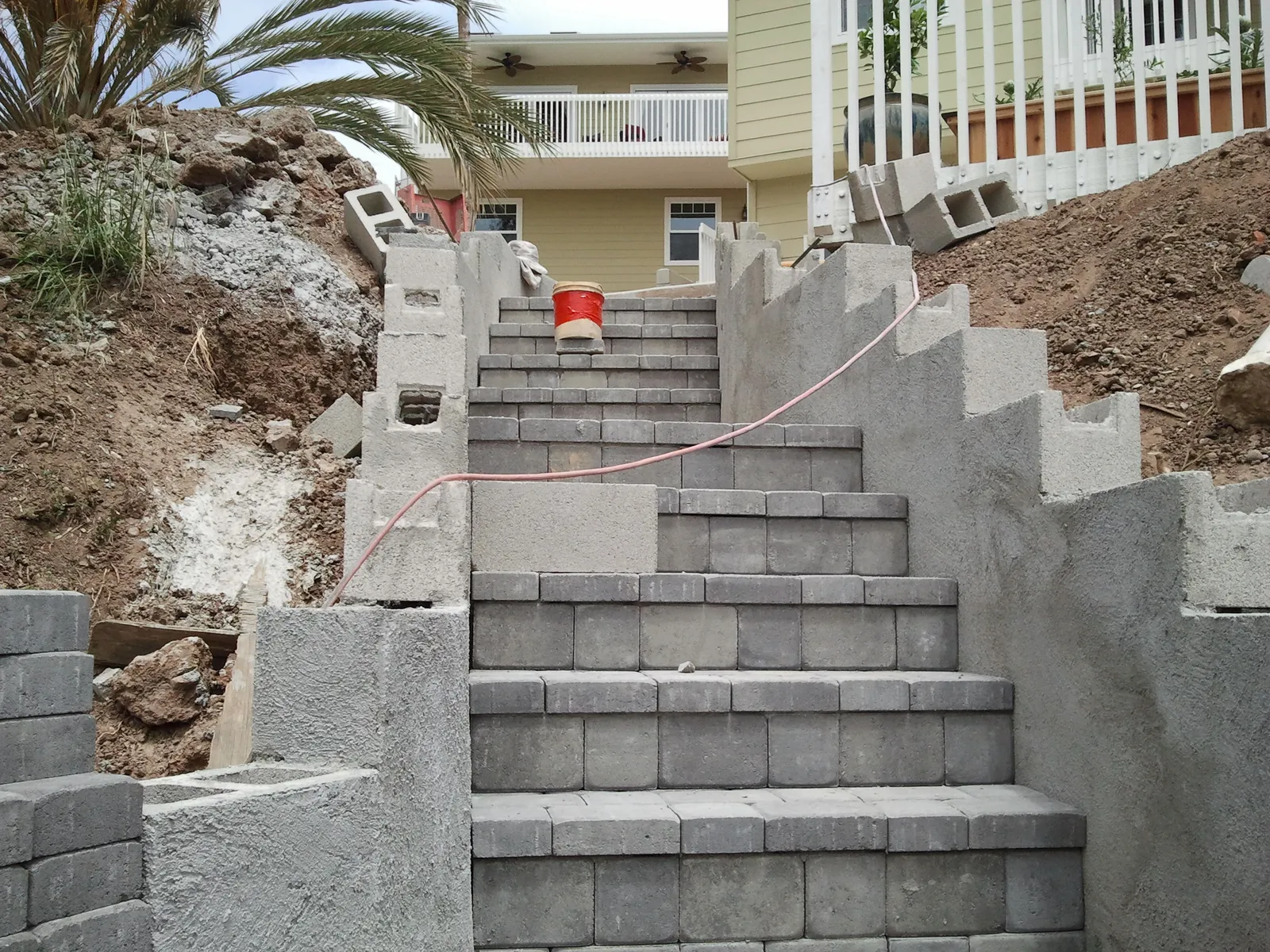
A paver stairway climbing between stepped, plastered concrete block walls toward a house on a sloping lot.

Rancho San Diego Masonry Contractor for Block Walls, Retaining Walls and Hardscape

Is your original tract wall leaning, the driveway lifting at the joints, or the slope behind the yard creeping down? We repair or rebuild it to County of San Diego rules — not El Cajon’s, whatever your address says — for the granite and clay underneath. Licensed C-29 mason from nearby Alpine; call for a free on-site estimate.

CSLB #979389 · C-29 Licensed · Bonded $25,000 · Free on-site estimates

Rancho San Diego by the numbers

A Planned Community That Turned Forty All at Once

Rancho San Diego did not grow street by street. The County’s Valle de Oro Community Plan records that development began in 1970 with Sweetwater Village West — 1,022 homes on 260 acres — followed by Sweetwater Village East, Avocado Village and Cottonwood Village, where 1,972 homes went onto 789 acres under their own specific plan. The whole area runs to about 4,500 acres on both sides of the Sweetwater River, and the plan calls it a “new-town”. The 2020 Census counted 21,858 residents across 8.7 square miles.

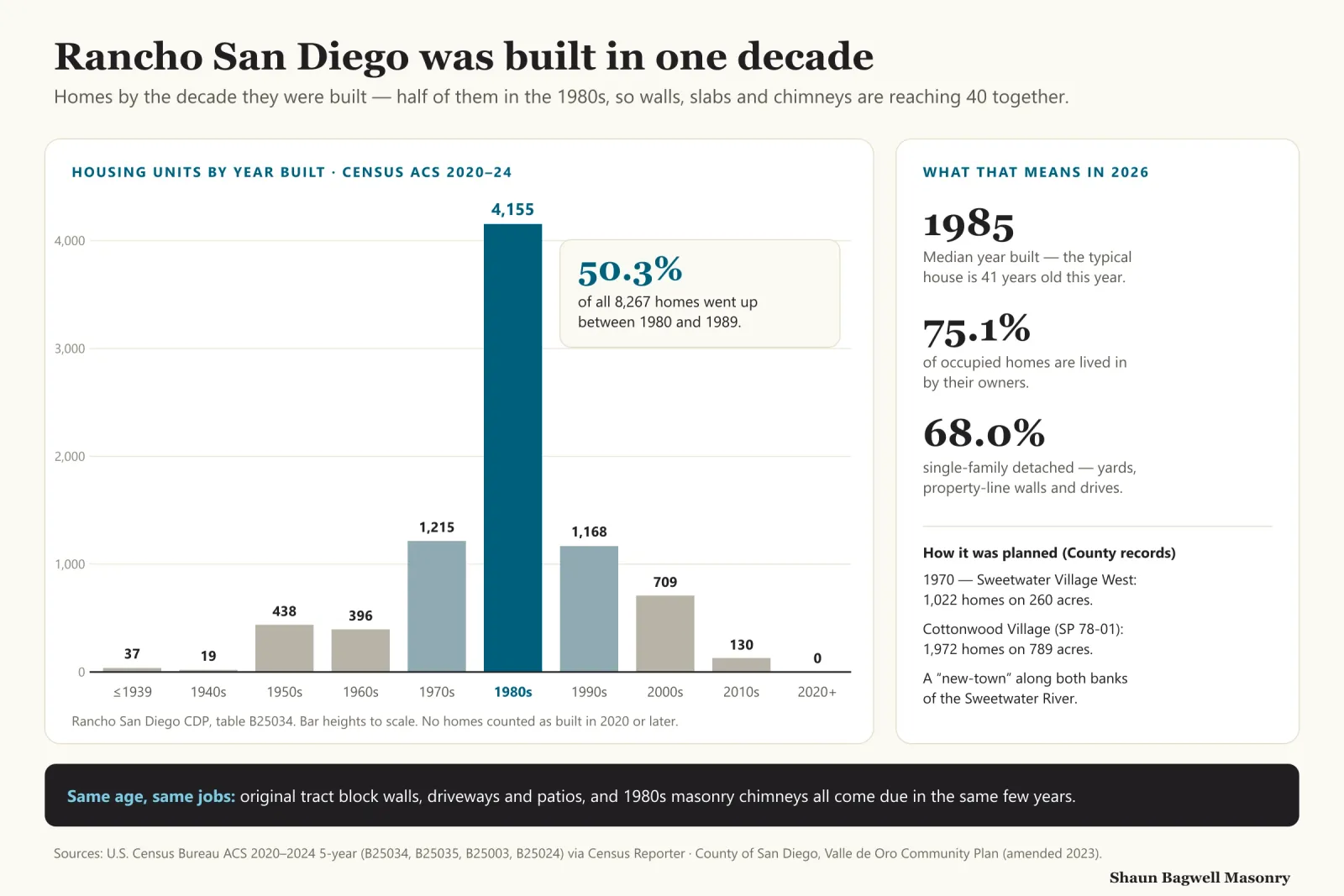
The building happened in a rush. Of 8,267 homes counted by the Census Bureau, 4,155 — 50.3% — were built between 1980 and 1989, and the median home dates to 1985. None were counted as built since 2020. Three in four occupied homes are owner-occupied and 68% are detached houses, so most of the masonry here belongs to the people living with it: property-line walls, backyard retaining walls, driveways, patios and fireplaces, all roughly the same age and all reaching the point where they need a decision.

Bar chart: Rancho San Diego homes by decade built, Census ACS 2020–2024. 1939 or earlier 37; 1940s 19; 1950s 438; 1960s 396; 1970s 1,215; 1980s 4,155, which is 50.3% of 8,267 homes; 1990s 1,168; 2000s 709; 2010s 130; 2020 or later 0. Side panel: median year built 1985, so the typical house is 41 years old in 2026; 75.1% of occupied homes are owner-occupied; 68.0% are single-family detached. County planning history: development began in 1970 with Sweetwater Village West, 1,022 homes on 260 acres; Cottonwood Village under specific plan SP 78-01, 1,972 homes on 789 acres; planned as a new-town along both banks of the Sweetwater River. Bottom line: original tract block walls, driveways, patios and 1980s chimneys all come due in the same few years.
One decade built half the community. That is why neighbours on the same street call about the same wall, the same cracked drive and the same chimney crown within a year or two of each other.Sources: Census ACS 2020–24 (B25034); Valle de Oro Community Plan.

Granite Ridges, a River Valley and Forty-Year-Old Tract Work

Six things shape a masonry job here. They come from two soils reports filed with the County, the Valle de Oro Community Plan, the fire and water districts that serve the community, and the Census — not a template written for somewhere else.

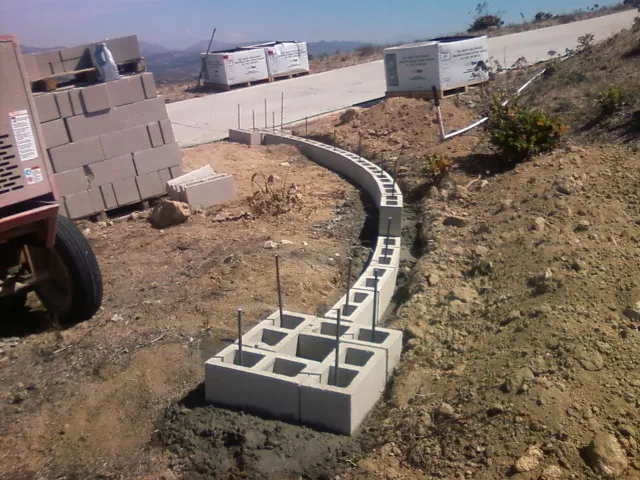
A concrete block wall core on a new footing along a hillside driveway, with dry slope above.

Hillside lots

Shallow granite that stops the digger

A 2021 soils investigation for a six-lot site on Sundale Road, west of Jamacha Road, found under a foot or so of silty sand a granitic bedrock that stopped every one of eight test pits at 3 to 12 feet, with boulders and loose “floaters” throughout; harder rock there needs rock-breaking equipment or blasting. The upside is firm bearing and very low swell — the topsoil tested at an expansion index of just 3. The cost is in the digging, which is why our retaining wall quotes here list excavation separately.
Lower ground

Pockets of swelling clay and seepage

Not every lot sits on clean granite. A soils study for a site on Jamacha Boulevard in neighbouring Spring Valley mapped the Sweetwater Formation there, whose bentonitic clays it describes as “typically highly expansive” with low shear strength, and noted that nearby development “has experienced groundwater issues due to seepage on rock fractures.” Where a Rancho San Diego yard shows that kind of ground — cracked slabs, a damp toe of slope — walls get free-draining backfill and a real drain, and slabs get a designed base.

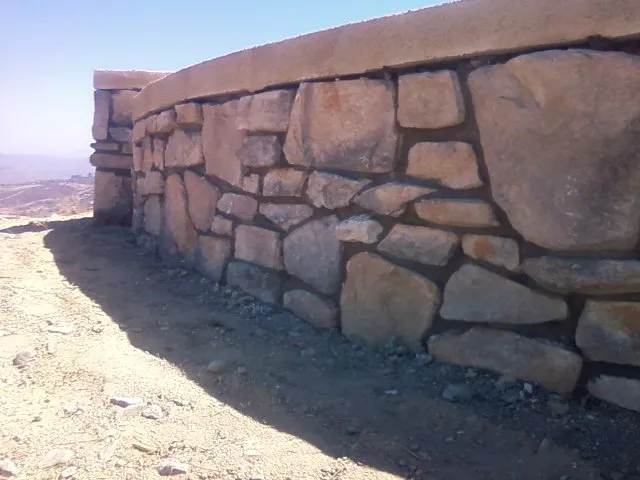
A natural rock retaining wall with a mortared cap curving along a dry, sunlit hillside.

Sweetwater River

A protected river through the middle

The County plan says the Sweetwater River is, “for the most part, in its natural state as it flows into Sweetwater Reservoir,” and lists the floodplain, Steele Canyon Creek, Jamacha Creek and Campo Creek as Resource Conservation Areas, alongside an 1,800-acre National Wildlife Refuge. If your lot backs onto one of those edges, we check drainage outlets and any grading with County PDS before design, so runoff from a new wall or patio goes where the plan allows.

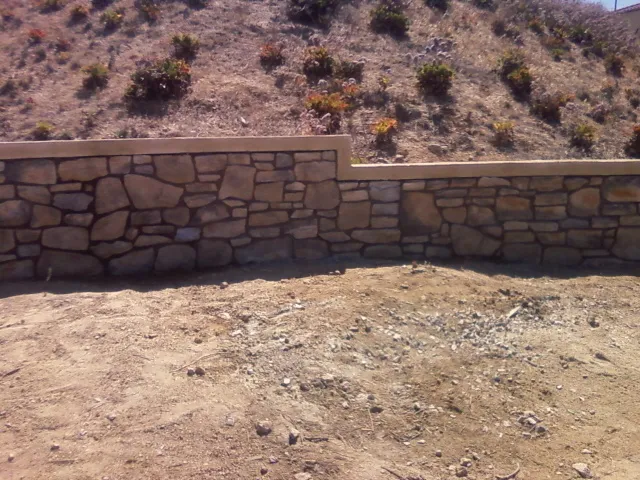
A finished stone veneer retaining wall with a mortar cap following the curve of a dry hillside.

Housing age

Tract walls built in one push

With half the homes finished in the 1980s, original block walls on many streets were laid by the same builders in the same years. When one starts to lean, crack along a mortar line or shed its cap, the run next door is usually the same age. We look at the footing, whether the cells were grouted and whether a retaining section has any drain before saying repair or rebuild — and we can price a shared property-line wall for both neighbours at once.

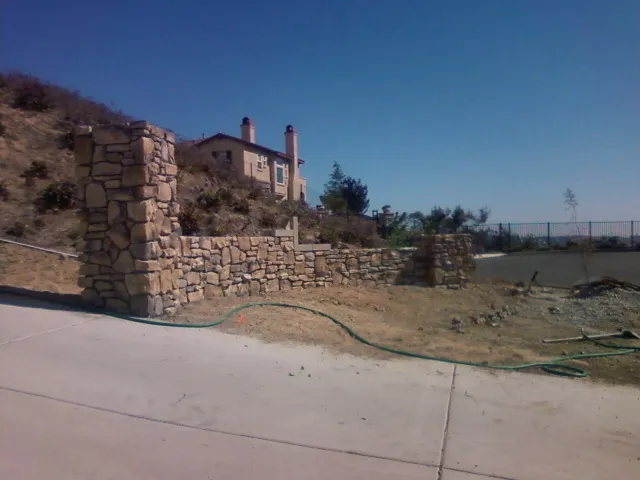
A fieldstone pillar and low stone wall at the edge of a concrete driveway entrance.

Fire

San Miguel Fire’s new hazard maps

San Miguel Fire & Rescue protects Rancho San Diego. The State sent its updated local fire hazard maps to the district on 24 March 2025, now showing moderate and high zones as well as very high, and the district must adopt them without lowering any rating. Look up your own address on the district’s map rather than relying on a neighbour’s. Whatever the rating, County rules already require any fence within 5 feet of a building to be noncombustible or approved fire-retardant — a job block and stone do well.

Water

Otay water and a demonstration garden next door

The Water Conservation Garden, started by the Helix and Otay water districts after the early-1990s drought, opened in 1999 on the Cuyamaca College campus and now covers about 6 acres. Most of Rancho San Diego buys its water from Otay, which passes on a turf-replacement rebate of at least $2 a square foot; as an unincorporated area the community also qualifies for the County’s Waterscape money. Both reward planting, not paving, so patio and paver conversions are laid out with that in mind.

County Permits, Even With an El Cajon Address

Rancho San Diego is unincorporated. Most homes carry an El Cajon mailing address in ZIP 92019, and parts use Spring Valley’s 91978 or La Mesa’s 91941, but the County of San Diego Planning & Development Services issues the permits and County zoning sets the wall heights. The City of El Cajon’s rules, which cover our El Cajon work, do not apply here.

Under County Code a retaining wall needs no building permit only when it holds back 3 feet of soil or less measured from the top of the footing, stands no more than 6 feet from the lowest grade, has level ground behind it, has no structure within 6 feet and carries no surcharge. Rancho San Diego’s hillside backyards often fail on the level-ground test. Freestanding block walls may go to 42 inches in a front or street-side yard and 72 inches at the rear and interior sides, exempt to 6 feet — except pool barriers. Discretionary projects are reviewed by the Valle de Oro Community Planning Group, whose area covers Rancho San Diego along with Casa de Oro, Mount Helix and Vista Grande Hills.

If your tract has a homeowners’ association, its architectural committee may want to see a wall or driveway before the County does; bring us the guidelines and we design to both. And because any job of $1,000 or more, or any job needing a permit, requires a licensed contractor in California, check the licence before you sign — ours is below.

Who decides in Rancho San Diego

  • County PDS — building and grading permits
  • County DPW — work in County roads
  • San Miguel Fire & Rescue — fire access and hazard maps
  • Valle de Oro Planning Group — discretionary projects

Not involved

  • City of El Cajon Building Division
  • City of La Mesa
  • Spring Valley’s own planning group
Retaining wall exemption
All 5 conditions
≤3 ft retained from the top of the footing, ≤6 ft total, level backfill, nothing within 6 ft, no surcharge.PDS 110
Freestanding block wall
42 in front · 72 in rear
No building permit up to 6 ft; pool barriers always need one.PDS 070
Fence within 5 ft of a building
Noncombustible
Or approved fire-retardant material meeting CBC 707A.PDS 070
Driveway apron in a County road
Encroachment · $217
$87 renewal; signed drawings; DigAlert 811 before digging.County DPW
Licensed contractor required
$1,000 or a permit
Unlicensed work only under $1,000 with no permit (AB 2622, 2025).CSLB

Masonry Work We Do in Rancho San Diego

What the community’s 1980s housing and hillside lots call for most. Each has its own page for Rancho San Diego with the local detail; every job is quoted in writing after a site visit.

Noncombustible returns and entries

Block or stone in the last 5 feet where a wood fence meets the house, plus stone-faced pilasters and mailbox columns at the drive.

Not sure which of these your property needs? Shaun will look at it with you — free, on site, no obligation.

(619) 581-2492

What Masonry Costs in Rancho San Diego

These are the 2026 ranges we quote across San Diego County. In Rancho San Diego the swing factors are rock in the excavation, demolition and haul-off of the old wall or slab, and whether a sloped backyard pushes a wall into County engineering.

What Masonry Costs in Rancho San Diego
ProjectTypical 2026 range
Retaining wall, CMU block, under 4 ft$35–$55 per sq. face ft.
Retaining wall, engineered, 4–8 ft$45–$120 per sq. face ft.
Natural stone retaining wall$80–$250 per sq. face ft.
Block wall, CMU with stucco or veneer$250–$400 per linear ft.
Patio or pavers$18–$40 per sq. ft.
Masonry chimney repair$1,500–$8,000+ by scope

Ranges are for comparison, not a quote. Removal of the existing wall or slab, rock excavation, engineering, County permit fees and any HOA submittal are shown as separate lines on the proposal.

Where We Work in and Around Rancho San Diego

Named from the County’s own planning record and the roads everyone uses. The community is one permit jurisdiction, but the ground and the jobs change from the river to the ridges.

  • Sweetwater Village WestWhere development began in 1970 — 1,022 homes on 260 acres, now the oldest tract stock in the community. Wall and flatwork replacement comes up first here.
  • Sweetwater Village East & Avocado VillageLater phases of the original plan, mixing homes with offices and shops. Property-line walls, driveway aprons and patio replacement.
  • Cottonwood VillageThe easterly 789 acres, built out under specific plan SP 78-01 with 1,972 homes. Backyard slopes, terrace walls and pool decks.
  • Jamacha Road & the SR-94 corridorSR-94 drops from freeway to highway at Via Mercado, turns south-east at the Jamacha Road–Campo Road intersection and crosses the Sweetwater River near the historic Steele Bridge. Hillside lots west of Jamacha, like the Sundale Road site, sit on shallow granite.
  • Cuyamaca College & the Water Conservation GardenThe 165-acre campus, opened in 1978 on part of the old Monte Vista Ranch, and the 6-acre demonstration garden — a good place to see drought-tolerant planting next to hardscape before you plan your own.
  • Sweetwater River, Steele Canyon & Campo creeksProtected floodplain and riparian edges named in the County plan. Lots backing onto them get their drainage outlets checked before anything is built.
  • Jamul, to the south-eastLarger parcels, clay over tonalite and long rural drives along SR-94 — see our Jamul page.
  • Spring Valley, Casa de Oro & El CajonNeighbours with different rules and housing: Spring Valley is older 1970s stock under the County; El Cajon is its own city with its own permits. Our base is in Alpine, further east.

Rancho San Diego Masonry Questions

Straight answers to what Rancho San Diego homeowners ask before they hire. Anything else — call, and Shaun answers it himself.

(619) 581-2492

Do I need a permit for a retaining wall in Rancho San Diego?

Often, yes. The County exempts a retaining wall only if it holds back no more than 3 feet of soil measured from the top of the footing, is no more than 6 feet tall overall, has level ground behind it, has no structure within 6 feet and carries no surcharge. On a sloping backyard the level-ground test is usually the one that fails. More detail on our Rancho San Diego retaining wall page.

My address says El Cajon. Whose rules apply?

The County of San Diego’s. Rancho San Diego is unincorporated, so County PDS issues permits and County zoning sets wall heights — 42 inches in a front yard, 72 inches at the rear — regardless of the El Cajon, Spring Valley or La Mesa mailing address.

Should I repair or replace my 1980s block wall?

It depends on the footing, whether the cells were grouted, and whether a retaining section has a drain. A cracked cap or a few open joints can be repaired; a wall that leans, has an empty core or has cracked at the footing is usually better rebuilt. We tell you which after looking — and if your neighbour’s side is the same age, we can price both.

Why does digging cost more on some Rancho San Diego lots?

Granite. A 2021 County-filed soils report for a site on Sundale Road hit refusal on granitic bedrock in all eight test pits at 3 to 12 feet, with boulders in the soil, and noted that harder rock needs rock-breaking equipment or blasting. Rock also bulks up when it comes out, so it fills more trucks. We price excavation and haul-off before we start.

Can I get a rebate for replacing my lawn with a patio?

For the planted part, yes; for the paving, no. Otay Water District passes on a turf rebate of at least $2 a square foot, and the County’s Waterscape program pays up to $5 in unincorporated areas like Rancho San Diego. Grouted or concrete paving is excluded, and you must be approved before you start. See our pavers page for how we lay out the split.

Is my home in a fire hazard zone?

Check your own address on San Miguel Fire & Rescue’s map — the State’s 2025 update added moderate and high zones to the very high ones, and ratings vary lot to lot. Whatever it says, County rules require fencing within 5 feet of a building to be noncombustible or fire-retardant, and block or stone meets that.

Does an HOA have to approve my wall or driveway?

If your tract has a homeowners’ association, often yes: its architectural committee may need to approve a wall, driveway or patio before the County permit. Check your CC&Rs and send us the guidelines with your photos, so the design meets both.

How do I check that you’re licensed?

Shaun Bagwell Masonry holds California C-29 Masonry licence #979389, issued 14 December 2012, with a $25,000 contractor bond. Look it up at cslb.ca.gov under “Check a License”.

Get Your Rancho San Diego Wall, Drive or Patio Priced

Call Shaun at (619) 581-2492 or send the form. He’ll look at the wall or slab, the ground and the slope behind it, tell you what the County and any HOA will want, and give you a written, itemised price — demolition and haul-off included.

(619) 581-2492

Call Now(619) 581-2492Estimate