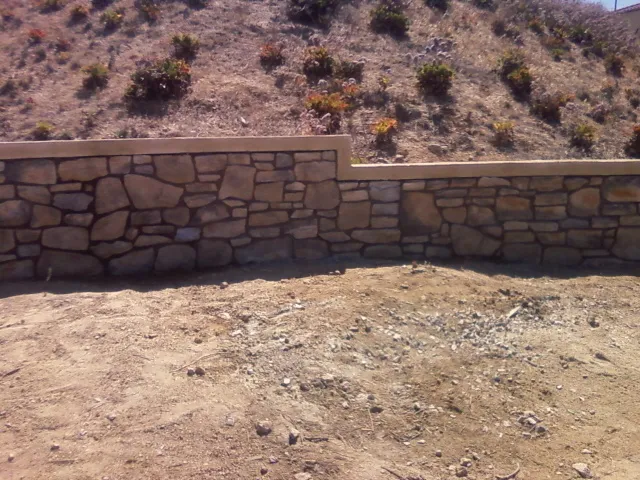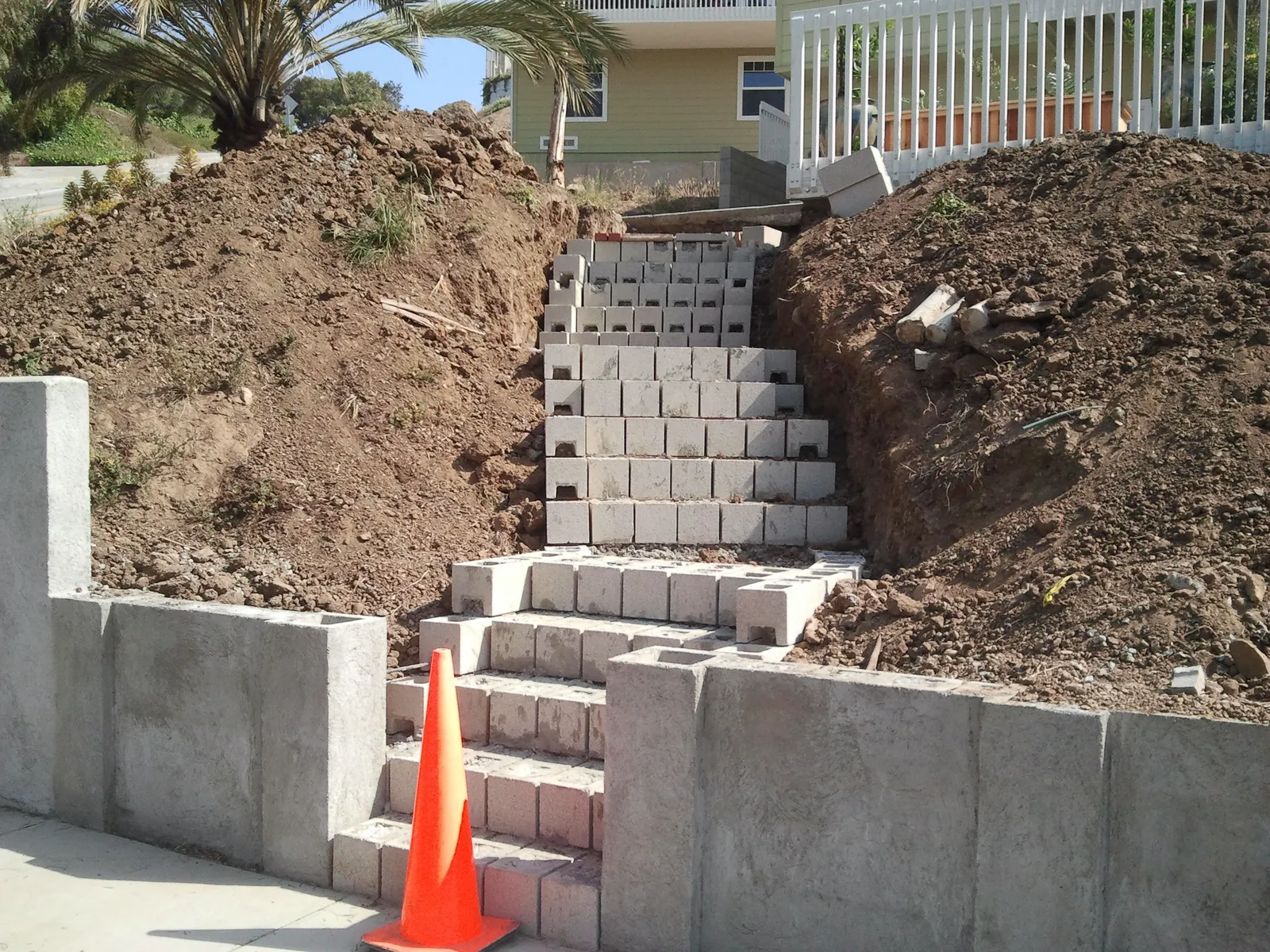
New concrete block retaining walls stepping up a freshly cut slope beside a block stairway.

Masonry Contractor for Pine Valley, Descanso, Guatay and Mount Laguna

Walls, steps, chimneys and hardscape built for snow, frost and fire season — not for the coast. Shaun works out of Alpine, just down the I-8, holds C-29 licence #979389 and permits every job through County PDS. Call for a free look at your property.

CSLB #979389 · C-29 Licensed · Bonded $25,000 · Free on-site estimates

The Central Mountain by the numbers

A Real Winter, and Wood Heat in One Home in Five

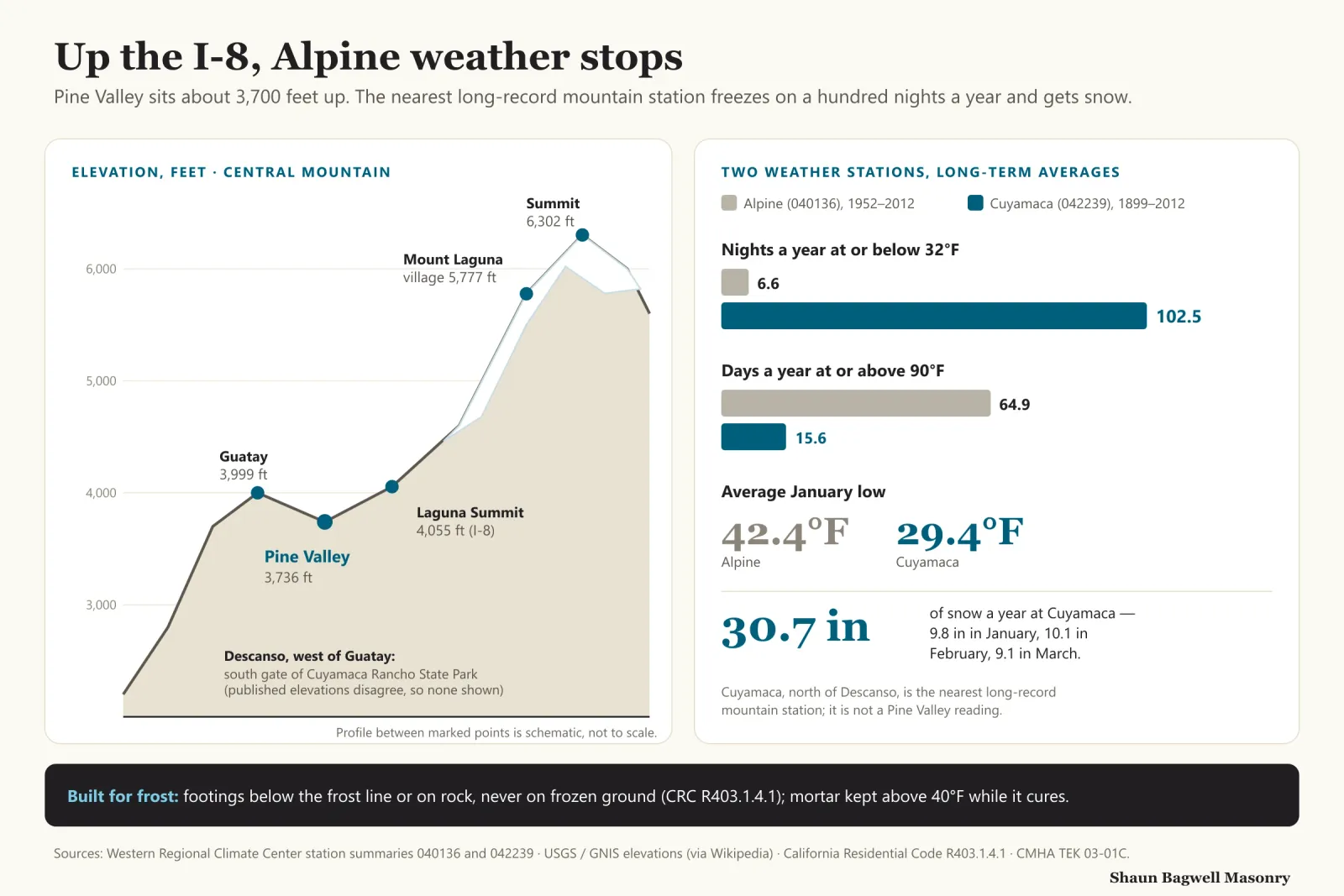
The Census Bureau counts the four communities together as the Laguna-Pine Valley division: about 5,640 people in 2,373 homes spread over 232.7 square miles of mountain. Eight in ten occupied homes are owner-lived, the median house dates from 1979, and 8.8% of all homes are held for seasonal or weekend use. Pine Valley itself sits at 3,736 feet, Guatay at 3,999 and the Mount Laguna village at 5,777.

Height changes the weather. Our own town, Alpine, averages 6.6 nights a year at or below freezing. Cuyamaca — the nearest mountain station with a long record — averages 102.5, with a January low of 29.4°F and 30.7 inches of snow a year. That is why one occupied home in five up here heats mainly with wood, against fewer than one in a hundred across the county, and why footings, mortar and chimney tops are built differently on this side of the grade.

Infographic. Left: a schematic elevation profile of the Central Mountain marking Guatay at 3,999 feet, Pine Valley at 3,736 feet, Laguna Summit on I-8 at 4,055 feet, the Mount Laguna village at 5,777 feet and the summit at 6,302 feet, with Descanso noted as the south gate of Cuyamaca Rancho State Park. Right: long-term averages from two weather stations. Nights at or below 32°F: Alpine 6.6, Cuyamaca 102.5. Days at or above 90°F: Alpine 64.9, Cuyamaca 15.6. Average January low: Alpine 42.4°F, Cuyamaca 29.4°F. Cuyamaca averages 30.7 inches of snow a year, mostly January to March. Footer: footings below the frost line or on rock and never on frozen ground under CRC R403.1.4.1, with mortar kept above 40°F while it cures.
Same county, different climate. Cuyamaca is the closest long-record mountain station, north of Descanso — not a Pine Valley reading, but the best measure of what winter does to masonry up here.Sources: WRCC Cuyamaca 042239; WRCC Alpine 040136; CRC R403.1.4.1; CMHA TEK 03-01C.

Frost, Forest, Rock and Fire

Six conditions decide how a wall, step or chimney should be built between Descanso and Mount Laguna. Each one is documented — by the weather service, the Census, CAL FIRE or the code — and each one is different from what a contractor working the coast would expect.

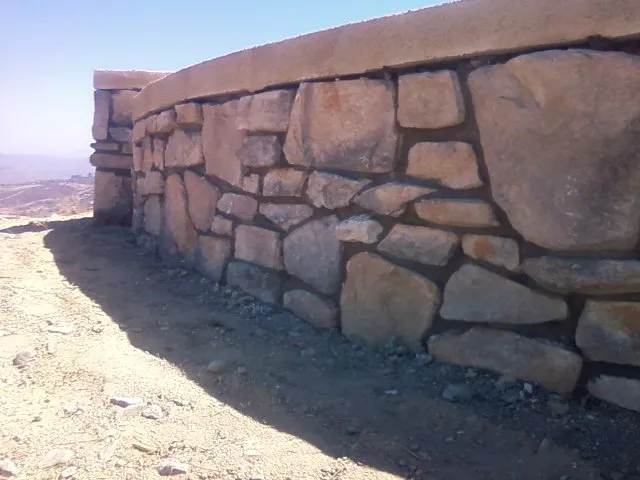
Hand-set natural rock wall with mortared joints.

Frost

Footings that never sit on frozen ground

The residential code sets every exterior footing at least 12 inches below undisturbed ground, and then adds a frost rule: foundations go below the frost line, onto solid rock, or into an insulated frost-protected design, and “shall not bear on frozen soil.” At 100-plus freezing nights a year that rule matters here in a way it rarely does in El Cajon. We dig to the County’s frost line for your elevation, or down to rock where the ground gives us rock, and we don’t pour on a morning when the trench is frozen.
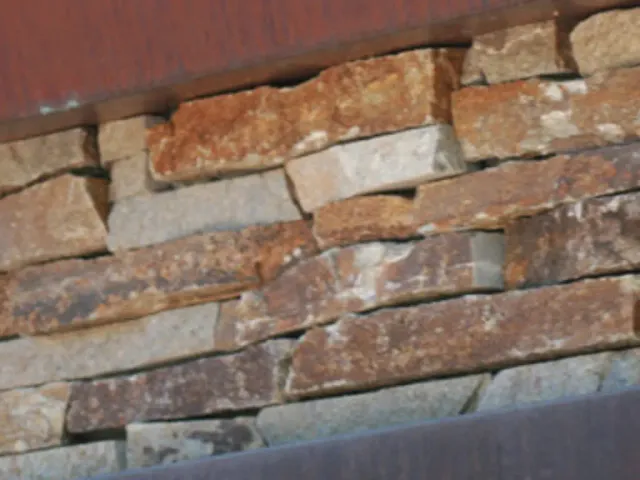
Close-up of dry-stacked ledger stone in rust, grey and tan tones.

Cold-weather work

Mortar and grout kept above 40°F

Cement only gains strength while it is warm enough to hydrate. The concrete-masonry industry’s cold-weather guide puts that line at about 40°F and calls for blankets, enclosures or heated materials when the low in the first day or two after laying drops below it. With a 29°F average January low at Cuyamaca, we schedule mountain jobs around the forecast, cover fresh block walls overnight and leave the cap course for a warm day.

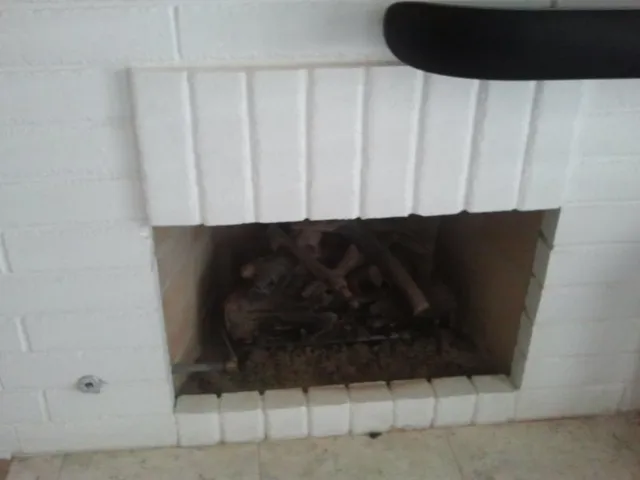
A brick fireplace refinished in white with a rebuilt hearth course.

Wood heat

Chimneys that work all winter

Census figures put wood as the main heat in 19.9% of the division’s occupied homes; in Descanso alone it is 31.8%. Tank propane heats another 41.5%, because there is very little piped gas this far up. A chimney here is a working appliance through a long, snowy season, which puts the crown, the flashing, the cricket on the uphill side and the spark arrestor under real load. The full story is on our Pine Valley chimney and fireplace page.

Finished stone-veneer wall with a mortar cap along a dry, brush-covered hillside.

Fire history

Cedar Fire country

The 2003 Cedar Fire burned 273,246 acres and destroyed 2,820 structures, and Cuyamaca Rancho State Park — whose south entrance is Descanso — was closed for months by the damage. In 2020 the Valley Fire started at Japatul and Carveacre roads and burned 16,390 acres between Alpine and Descanso. The County’s 2026 wildfire code now reserves the first five feet around a house for hardscape or noncombustible materials, and state law wants trees cut back 10 feet from any chimney outlet. Stone and block don’t burn; that is the case for them up here.

Wells

Hard-rock wells and private systems

Pine Valley has no reservoir and no imported water. KPBS reported in 2014 that its mutual water company draws from “hard rock wells” hundreds of feet down, fed mostly from Mount Laguna. Where a lot has its own well or septic system, the rule on site is simple: before we dig a footing or set a retaining wall, we find the wellhead, the tank and the leach lines, and we keep runoff from new paving heading away from them.

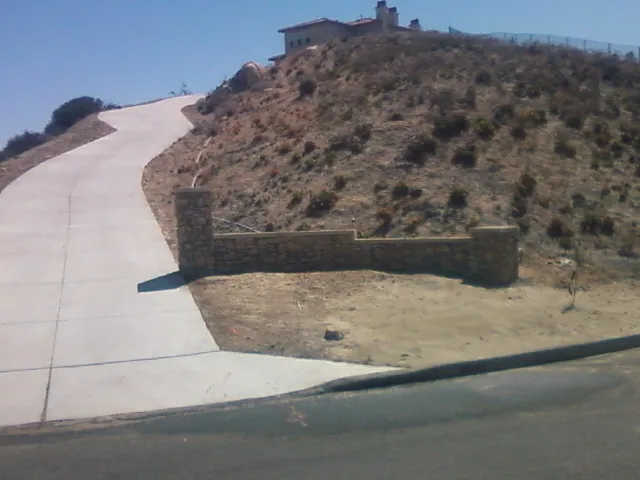
Finished stone wall and pillar at the foot of a long, dry hillside driveway.

National forest

Cabins under Forest Service rules

Mount Laguna sits on the eastern edge of the Cleveland National Forest. Many of its cabins are held under the Forest Service’s Recreation Residence Program, and the community’s association says every exterior improvement must be approved by the Forest Service and the State Historical Society, with cabins over 50 years old reviewed for their history. Chimney and stone work on those cabins starts with that approval, not with a County permit alone.

Permits: County PDS, County Fire and Sometimes the Forest Service

None of the four communities is a city, so walls, footings, fences and fireplaces are permitted by the County of San Diego Planning & Development Services, and fire rules come from County Fire, whose $8.2 million Station 44 in Pine Valley was planned to back up Descanso, Mount Laguna and Boulevard as well. Zoning lets a retaining wall be any height needed to hold a bank, but every retaining wall over 3 feet needs a building permit, and the 2026 exemption list only spares walls of 3 feet or less (measured from the top of the footing) with level backfill, no surcharge and nothing built within 6 feet.

A freestanding masonry wall up to 6 feet that meets zoning needs no building permit; solid walls stop at 42 inches in a front setback and 72 inches at the side and rear unless an Administrative Decision allows more. Any part of a fence within 5 feet of a house must be noncombustible or approved fire-retardant wood. On Forest Service land at Mount Laguna, add the Forest Service’s own sign-off first.

County of San Diego issues

  • Building and zoning permits (PDS)
  • Fire code and defensible space (County Fire)
  • Encroachment onto County roads (DPW)

Extra sign-off at Mount Laguna

  • Forest Service approval for cabin exteriors
  • Historical review for cabins over 50 years old
  • 100 ft defensible space around each cabin
Retaining wall
Over 3 ft = permit
Exempt only with level backfill, no surcharge and no structure within 6 ft, measured from the top of the footing.PDS-308 · PDS-110
Footing depth
12 in minimum + frost
Below the frost line, on solid rock or frost-protected; never on frozen soil (CRC R403.1.4.1).CRC R403
Freestanding masonry wall
Up to 6 ft — no permit
When it complies with zoning: 42 in in front setbacks, 72 in at side and rear.PDS-070
First 5 ft around a house
Hardscape only
Zone 0 under the 2026 County Wildland-Urban Interface Code; fences there must be noncombustible.2026 County WUI Code
Trees at the chimney
10 ft from the outlet
Plus 100 ft of defensible space around the house.PRC §4291

Masonry Work We Do in the Central Mountain

Each one quoted in writing after Shaun has walked the site and seen the ground, the slope and the access.

Stone repair on older buildings

Repointing and resetting of stone on older mountain buildings and cabins, matched to the original mortar and done only after any required approvals.

Not sure which of these your property needs? Shaun will look at it with you — free, on site, no obligation.

(619) 581-2492

What Masonry Costs Up the Grade

Our 2026 county-wide price bands, for planning. In the mountains the number moves with access on steep or forest lots, rock in the footing trench, cold-weather protection and whether a wall fits the County’s standard tables or needs an engineer.

What Masonry Costs Up the Grade
ProjectTypical 2026 range
Retaining wall, CMU or engineered$35–$120 per sq. face ft.
Block wall, CMU with stucco or veneer$250–$400 per linear ft.
Patio or pavers$18–$40 per sq. ft.
Masonry chimney repair$1,500–$8,000+ by scope

A guide only; your price comes after a site visit. County permit fees, engineering and any Forest Service requirements at Mount Laguna are listed separately on your written proposal.

The Four Communities We Cover

All four are unincorporated and permitted through the County. What changes from one to the next is height, forest cover and how the land is held. On the far side of the mountain, the Mountain Empire towns are covered on our Campo page; back down the grade is Alpine, where we’re based.

  • Pine Valley3,736 feet. West of town the I-8 crosses the 1974 Pine Valley Creek Bridge, 450 feet above the valley floor — the first U.S. bridge built by the segmental balanced-cantilever method. About 1,800 people; 93% of occupied homes are owner-lived and the median house dates from 1975.
  • DescansoThe south gate of Cuyamaca Rancho State Park, where Hulburd Grove was started in 1884, with a school and Town Hall founded in 1898. Nearly a third of occupied homes heat with wood, and the median house was built in 1974 — chimneys and older stone first.
  • Guatay3,999 feet, between Descanso and Pine Valley, once a stagecoach station on the San Antonio–San Diego Mail Line. A handful of homes on rock and slope: footings onto rock and short walls to hold driveways.
  • Mount Laguna5,777 feet in the Laguna Mountain Recreation Area, the highest of the four. Cabins under the Forest Service Recreation Residence Program; more than a quarter of homes are seasonal. Exterior work needs Forest Service approval.

Pine Valley & Descanso Masonry Questions

Straight answers to what Pine Valley & Descanso homeowners ask before they hire. Anything else — call, and Shaun answers it himself.

(619) 581-2492

Do you work in Pine Valley, Descanso and Mount Laguna?

Yes. We’re based in Alpine, so the four Central Mountain communities are a short run up the I-8. Shaun visits the property, takes measurements and gives you a written, itemised price.

How deep does a footing need to be in Pine Valley?

At least 12 inches below undisturbed ground under the California Residential Code, and deeper where frost requires it: the code calls for footings below the frost line, on solid rock or in a frost-protected design, and never on frozen soil. We confirm the depth for your elevation with County PDS before we dig.

Can you build in winter?

Often, yes, between storms. Mortar and grout need protecting when lows drop below about 40°F in the first day or two, so we watch the forecast, cover fresh work overnight and don’t pour on frozen ground. Snow days simply move the schedule.

Do I need a permit for a retaining wall in Descanso or Pine Valley?

For a wall over 3 feet, yes. These are unincorporated County areas, so County PDS issues the permit, and the 2026 exemption only covers walls retaining 3 feet or less from the top of the footing with level backfill, no surcharge and no structure within 6 feet.

What does the 2026 fire code change near my house?

The County’s Wildland-Urban Interface Code makes the first 5 feet around a building a hardscape or noncombustible zone, and a fence within 5 feet of the house has to be noncombustible. Pavers, concrete walks and a short masonry wall where a wood fence meets the house are the usual answers.

Can you work on a Forest Service cabin at Mount Laguna?

Yes, once the work is approved. The Mount Laguna Improvement Association says exterior improvements to recreation-residence cabins must be approved by the Forest Service and the State Historical Society. Get that approval first, then bring us its conditions and we build to them.

Will digging affect my well or septic system?

It shouldn’t, because we locate the wellhead, tank and leach lines before we lay anything out and keep footings and new drainage away from them. If you have a site plan from the County or your septic installer, it helps to have it ready.

How do I check your licence?

Shaun Bagwell Masonry holds California C-29 Masonry licence #979389, issued 14 December 2012, bonded and insured. Look it up at cslb.ca.gov under “Check a License”.

Sources for the figures on this page

  1. U.S. Census Bureau ACS 2020–2024 5-year, Laguna-Pine Valley CCD, tables B01003/B25001/B25003/B25004/B25035/B25040 (via Census Reporter)
  2. U.S. Census Bureau ACS 2020–2024 5-year, Pine Valley, Descanso and Mount Laguna CDPs (via Census Reporter)
  3. Census Reporter — Laguna-Pine Valley CCD profile (232.7 sq mi)
  4. Western Regional Climate Center — Cuyamaca (042239) temperature summary, 1899–2012
  5. Western Regional Climate Center — Cuyamaca (042239) monthly snowfall
  6. Western Regional Climate Center — Alpine (040136) temperature summary, 1952–2012
  7. Wikipedia — Pine Valley, California (USGS elevation, 2020 census)
  8. Wikipedia — Descanso, California (history, Cuyamaca Rancho State Park)
  9. Wikipedia — Guatay, California
  10. Wikipedia — Mount Laguna, California (GNIS elevation)
  11. Wikipedia — Pine Valley Creek Bridge (1974)
  12. Wikipedia — Cuyamaca Rancho State Park (2003 Cedar Fire closure)
  13. Mount Laguna Improvement Association — Our cabins (Forest Service Recreation Residence Program)
  14. KPBS — Mountain community in San Diego finds abundance of water (30 Jan 2014)
  15. CAL FIRE — Cedar Fire (2003)
  16. CAL FIRE — Valley Fire (2020), Japatul Road
  17. County News Center — New Pine Valley fire station construction set to begin (13 Dec 2017)
  18. California Residential Code §R403 Footings — R403.1.4 and R403.1.4.1 frost protection (gocodebook)
  19. CMHA TEK 03-01C — All-weather concrete masonry construction
  20. County of San Diego — 2026 Wildland-Urban Interface Code
  21. California Public Resources Code §4291 — defensible space and chimney clearance
  22. County of San Diego PDS-308 — Walls / retaining walls (zoning)
  23. County of San Diego PDS-070 — Fences (Rev. 01/01/2023)
  24. County of San Diego PDS-110 — Work exempt from a building permit (Rev. 01/01/2026)
  25. CSLB — Check a License (#979389)

Get Your Mountain Project Priced

Call Shaun at (619) 581-2492 or send the form. He’ll come up from Alpine, look at the ground, the slope and the chimney, tell you what the County, the frost and the fire code will ask for, and give you an itemised price in writing.

(619) 581-2492

Call Now(619) 581-2492Estimate