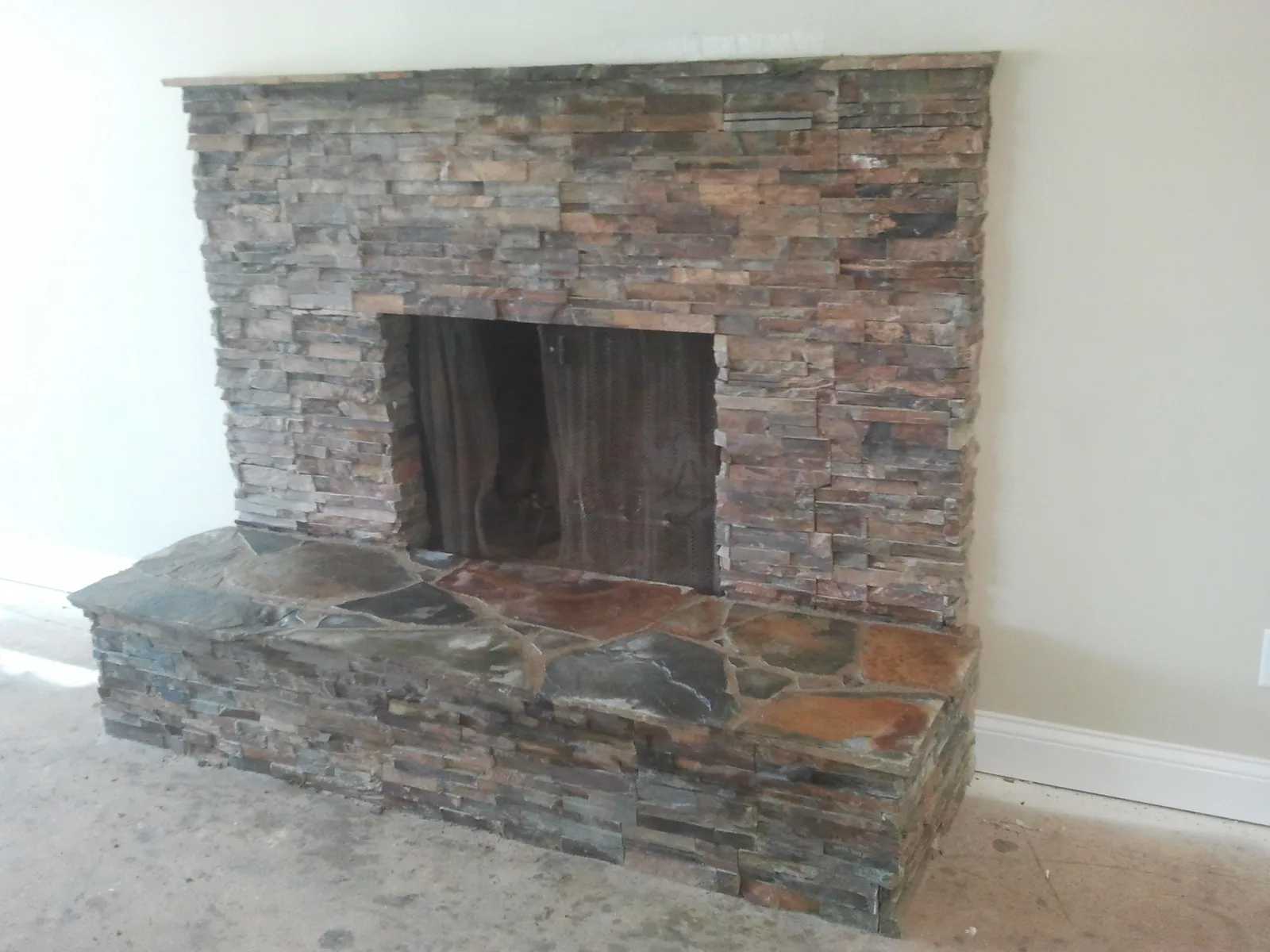
A finished floor-to-ceiling stacked-stone fireplace with a raised stone hearth.

Chimney Repair & Fireplaces in Pine Valley, Descanso and Mount Laguna

If your fireplace or stove heats the house through a snowy winter, the chimney has to be sound from the firebox to the cap. Shaun repairs crowns, flashing and frost-split joints, adds crickets and spark arrestors, rebuilds loose stacks and builds new stone fireplaces — from Alpine, just down the hill.

CSLB #979389 · C-29 Licensed · Bonded $25,000 · Free on-site estimates

Mountain chimneys by the numbers

Where the Fireplace Is the Furnace

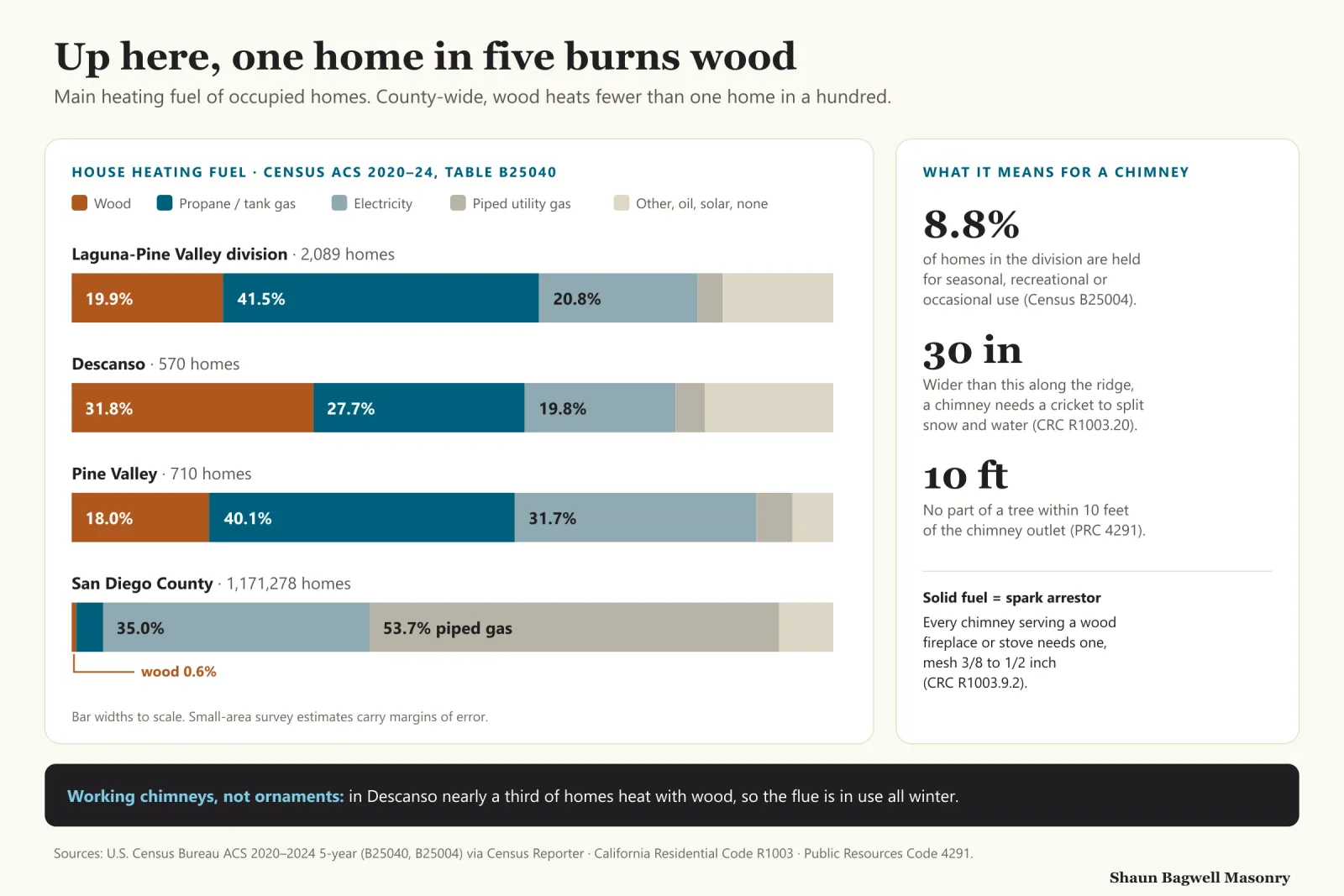
Across the Laguna-Pine Valley Census division, 415 of 2,089 occupied homes — 19.9% — name wood as their main heat. In Descanso it is 31.8%, and in Pine Valley 18.0%. County-wide the figure is 0.6%. Most of the rest of the division burns tank propane (41.5%), which is why so many of the chimneys we see up here are either working hard every winter or being converted to take an insert or stove.

Those chimneys also face weather the rest of the county doesn’t. Cuyamaca, the closest mountain station with a long record, averages 30.7 inches of snow a year, most of it from January to March, and a January low of 29.4°F. Snow piles up behind a wide chimney, meltwater finds every gap in the flashing, and water in a cracked crown freezes and splits it further. And because this is Cedar Fire country, every working flue needs a spark arrestor and a clear 10 feet around its outlet.

Infographic: stacked bars of main house-heating fuel from Census ACS 2020–2024. Laguna-Pine Valley division, 2,089 homes: wood 19.9%, propane or tank gas 41.5%, electricity 20.8%. Descanso, 570 homes: wood 31.8%, tank gas 27.7%, electricity 19.8%. Pine Valley, 710 homes: wood 18.0%, tank gas 40.1%, electricity 31.7%. San Diego County, 1,171,278 homes: piped gas 53.7%, electricity 35.0%, wood 0.6%. Side panel: 8.8% of homes in the division are held for seasonal, recreational or occasional use; a chimney wider than 30 inches along the ridge needs a cricket (CRC R1003.20); no part of a tree within 10 feet of the outlet (PRC 4291); every solid-fuel chimney needs a spark arrestor with 3/8 to 1/2 inch mesh (CRC R1003.9.2).
Wood is a main heat source up here, not a weekend luxury. In Descanso nearly one occupied home in three heats with it. Census survey estimates for small places carry margins of error.Sources: Census ACS B25040; Census ACS, CDPs; CRC §R1003; PRC §4291.

Chimney and Fireplace Work for Mountain Homes

From the cap down. The county-wide background is on our chimney repair and fireplace pages; this page is about what snow, frost and full-time wood heat do to them.

Repair

Crowns that shed water before it freezes

A flat or cracked mortar crown holds meltwater, and every freeze opens the crack wider. We replace it with a cap sloped to shed water, a drip edge that throws it clear of the brick, and a caulked bond break around the flue liner so the two can move without cracking.
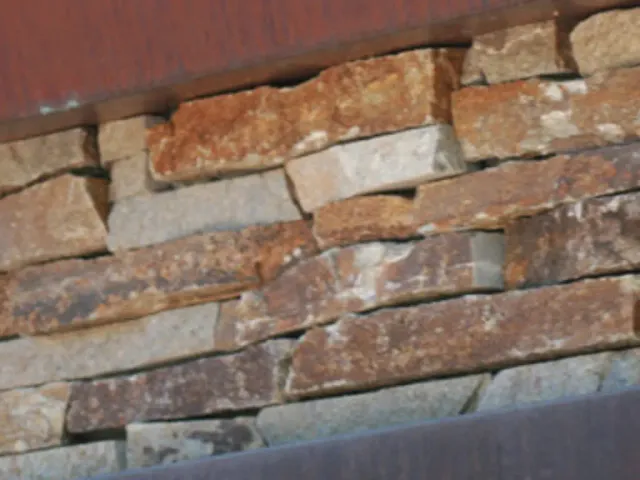
Close-up of dry-stacked ledger stone in rust, grey and tan tones.

Snow

Crickets and flashing on the uphill side

Snow and water stack up behind a chimney that faces up the roof. Where the chimney is more than 30 inches wide along the ridge and doesn’t sit on it, the code calls for a cricket to split the flow; we build or rebuild it, then re-set step and counter flashing into fresh joints.

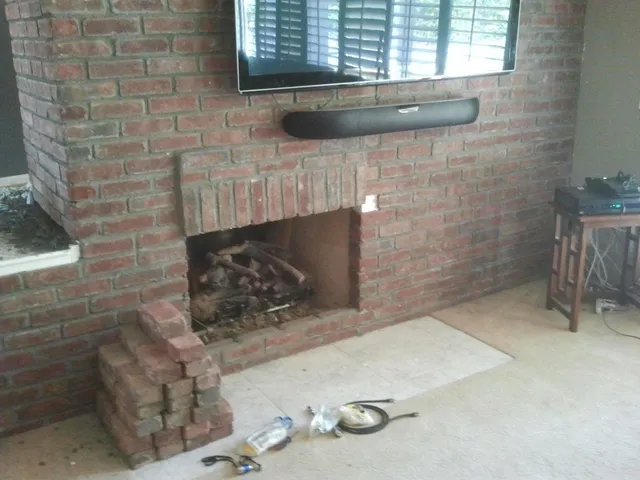
A brick fireplace wall partway through repair, with old hearth bricks stacked on the floor.

Repair

Repointing frost-split joints

Joints that have opened and crumbled are raked out and repointed with a mortar matched in strength to the brick or stone, so the joint — not the masonry unit — is what gives first. Spalled brick is cut out and replaced, and the work is protected from frost while it cures.

Seismic

Rebuilding a loose stack

When the masonry above the roof is loose or leaning, patching won’t hold through another winter. We take it down to sound work and rebuild it reinforced and strapped to the framing as the code requires in seismic regions, with a new cap and arrestor on top.

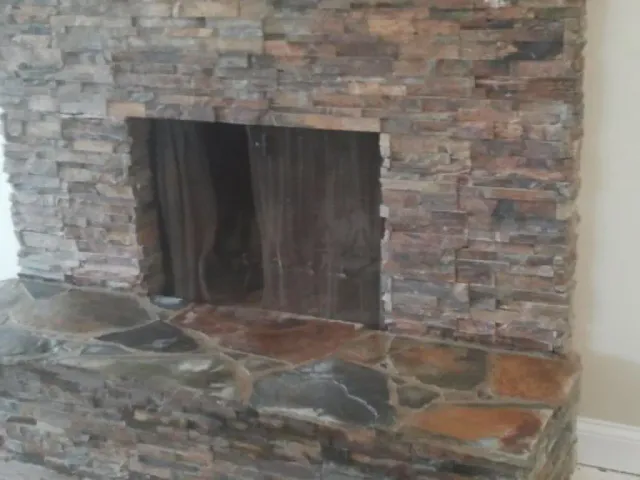
A stacked-stone fireplace with a flagstone hearth, the firebox opening still unfinished.

Heating

Ready for a stove or insert

Many owners up here are replacing an open fireplace or an old stove with a certified one. EPA figures show new wood heaters are held to 2.0 grams of smoke an hour against 15–30 for old uncertified stoves. Your stove dealer fits the appliance and liner; we make the masonry it connects to sound: hearth, firebox, smoke chamber and crown.

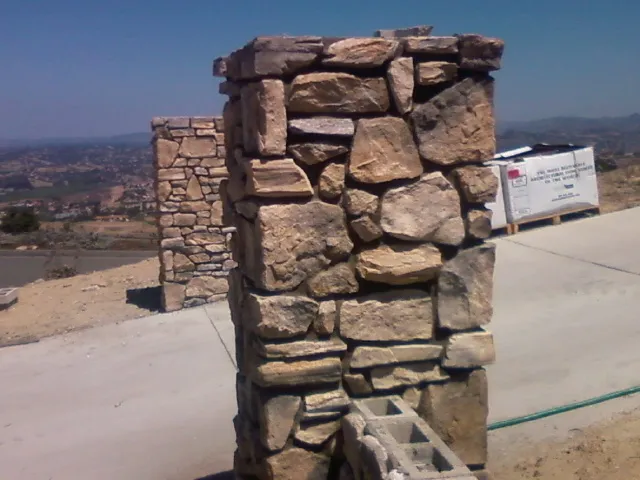
Close-up of a fieldstone pillar with a flat stone cap.

New builds

Stone fireplaces and outdoor fire

New site-built fireplaces on their own footing, below frost or on rock, with a firebox, hearth and chimney sized to code and finished in stone that suits a mountain house. Outdoor fireplaces and fire pits are sited first, at least 25 feet from structures and anything that burns.

The Code a Mountain Chimney Is Built To

California’s residential code asks the same things of every masonry chimney; up here they stop being paperwork. The chimney ends at least 3 feet above the roof and 2 feet above anything within 10 feet, so snow on the roof doesn’t bury the outlet. The cap is concrete, metal or stone, sloped, with a drip edge and a bond break. Walls are at least 4 inches of solid or grouted masonry, the flue is lined, and the chimney keeps 2 inches of air to framing where it runs inside the house.

On the roof side, any chimney wider than 30 inches parallel to the ridge gets a cricket. On top, every chimney serving a fireplace or appliance that burns solid fuel needs an approved spark arrestor, with mesh openings between 3/8 and 1/2 inch. Below, the fireplace sits on a footing at least 12 inches thick that extends 6 inches past it, carried below the frost line.

Cricket
Over 30 in wide
Where the chimney’s side parallel to the ridge exceeds 30 in and it isn’t at the ridge.CRC R1003.20
Spark arrestor
Required on solid fuel
Mesh 3/8–1/2 in; net free area at least 4× the flue outlet.CRC R1003.9.2
Termination
3 ft above the roof
Plus 2 ft higher than any roof or wall within 10 ft of it.CRC R1003.9
Clearance to framing
2 in inside · 1 in outside
Air space to combustibles for interior and fully exterior chimneys.CRC R1003.18
Fireplace footing
12 in thick, 6 in wider
Plus seismic steel and straps tying the chimney to the house.CRC R1001

Permits, Fire Rules and the Forest Service

All four communities are unincorporated, so a new masonry fireplace or a chimney rebuilt above the roofline is permitted through County of San Diego Planning & Development Services. State law adds the outdoor rules: a 100-foot defensible space around the house and no part of any tree within 10 feet of a chimney or stovepipe outlet. The County’s 2026 wildfire code keeps the first 5 feet around the house to hardscape and noncombustible materials, and sets firewood back 30 feet from buildings.

For a fire pit or outdoor fireplace, the state fire code the County adopts keeps recreational fires 25 feet from structures and combustible material and requires someone in attendance with a way to put the fire out. At Mount Laguna, a recreation-residence cabin needs Forest Service approval for exterior work before anything else.

Trees at the outlet
10 ft clear
No part of a tree within 10 ft of a chimney or stovepipe outlet.PRC §4291
Firewood stack
30 ft from buildings
Under the County’s 2026 fuel-modification zones.2026 County WUI Code
Recreational fire
25 ft from structures
Attended, with a hose or extinguisher at hand.CFC §307
Rebuild or new fireplace
County PDS permit
Like-for-like repairs usually need none; confirmed per job.
Mount Laguna cabins
Forest Service approval
Exterior improvements reviewed by the Forest Service and State Historical Society.MLIA

Repair, Rebuild, Convert or Build New?

How we sort a mountain chimney after looking at it from the roof and the hearth.

Repair, Rebuild, Convert or Build New?
RepairRebuild above the roofStove or insert prepNew fireplace
SignsCracked crown, open joints, leaks at flashingStack that moves, leans or is cracked right throughOpen fireplace you want to heat withNo fireplace, or one past saving
What we doSloped cap, cricket, repoint, re-flash, arrestorTake down, rebuild reinforced and strappedSound hearth, firebox, smoke chamber and crownFooting, firebox, chimney to code
PermitUsually noneCounty PDSDealer handles the appliance; masonry case by caseCounty PDS
Best seasonBefore the first snowDry spell, above 40°FSummer, ahead of burningSpring to autumn

Code points: CRC R1003 (caps, crickets, arrestors, clearances) and R1001 (fireplaces). Permits confirmed per job with County PDS.

How a Mountain Chimney Job Runs

  1. Roof first

    Cap, crown, arrestor, cricket and flashing, then the trees near the outlet — the places snow and fire find first.

  2. Then the hearth

    Firebox, damper area and hearth extension, and whether a stove or insert is planned.

  3. A straight answer

    Repair, rebuild or leave it, with the code reason for each item and a written price.

  4. Watch the weather

    Mortar work is scheduled for days that stay above 40°F, and covered overnight when they don’t.

  5. Build it

    Sloped cap with drip edge, cricket where needed, fresh flashing, code arrestor; reinforced rebuilds where the stack was loose.

  6. Before the first fire

    A walk-through and safe-use notes. The USFA recommends having chimneys inspected every year.

Planning one? Shaun will walk the site with you and tell you what it needs — free, no obligation.

(619) 581-2492

What Chimney and Fireplace Work Costs

Published national averages, shown so you have a yardstick — they are not our quote. Roof pitch, snow-season access and how much of the stack is sound move the number in the mountains.

What Chimney and Fireplace Work Costs
JobNational cost guide
Chimney crown replacement$1,000–$3,000
Tuckpointing (repointing)$500–$2,500
Partial or full chimney rebuild$500–$4,000+
Wood-burning fireplace, masonry or prefab$2,500–$30,000

Sources: Fixr chimney repair guide (Jan 2025) and Fixr fireplace installation guide (Jan 2026). Our own work is priced in writing after a free inspection; permit fees are separate.

Chimneys Across the Central Mountain

Four communities, four kinds of chimney work. The rest of what we build up here is on the Pine Valley & Descanso page.

  • DescansoZIP 91916The highest share of wood heat in the division and a median house from 1974 — older brick and stone stacks due for crowns, repointing and arrestors.
  • Pine ValleyZIP 9196293% owner-lived, median house from 1975, propane the most common heat and wood in 18% of homes. Insert and stove conversions and crickets on wide chimneys.
  • GuatayZIP 91931Homes at about 4,000 feet, between Descanso and Pine Valley. Cap and flashing work timed between storms.
  • Mount LagunaZIP 91948Cabins at 5,777 feet under Forest Service rules. Stone chimney repairs prepared for the approval the cabin program requires.

More Masonry in Pine Valley & Descanso

The Pine Valley & Descanso page covers the ground, permits and neighbourhoods across every kind of job. The county-wide pages go deeper on the build itself.

Pine Valley & Descanso Chimney & Fireplace Questions

Straight answers before you hire. Anything else — call, and Shaun answers it himself.

(619) 581-2492

Why does my chimney leak only after snow?

Snow sits on the uphill side of the chimney and melts slowly into any gap in the flashing or crown. A cricket on the uphill side, re-set flashing and a sloped cap with a drip edge usually fix it. The code requires a cricket on any chimney wider than 30 inches along the ridge that doesn’t sit on the ridge.

Do I need a spark arrestor if I only burn wood in winter?

Yes. California’s residential code requires an approved spark arrestor on every chimney connected to a fireplace or appliance that burns solid fuel, with mesh openings from 3/8 to 1/2 inch. It also keeps animals and debris out.

Can you get my fireplace ready for a wood stove insert?

We handle the masonry side: a sound hearth extension, firebox, smoke chamber and crown. The stove dealer supplies and installs the appliance and its liner. A newer certified stove is held to 2.0 grams of smoke an hour under EPA rules, far below older stoves.

Do trees near a mountain chimney have to be cut back?

State law requires removing any part of a tree within 10 feet of the outlet of a chimney or stovepipe. On wooded mountain lots that often means a branch or two that has grown in since the last inspection.

Can chimney work be done in winter?

Inspections and small repairs can, between storms. Mortar has to stay above about 40°F while it starts to cure, so rebuilds and crowns are best done from spring to autumn, before you need the fire.

Where can I stack firewood?

The County’s 2026 wildfire code sets firewood 30 feet from buildings and keeps the first 5 feet around the house free of anything combustible. A covered masonry or block log store out at that distance is a common request.

Are you licensed, and how far do you travel?

We’re based at 2351 Eltinge Dr, Alpine, and work throughout the Central Mountain. California C-29 masonry licence #979389, issued 2012, bonded and insured — check it at cslb.ca.gov.

Get Your Chimney Ready for Winter

Call Shaun at (619) 581-2492 or send the form. He’ll check the top of the chimney first, tell you what the code, the snow and the fire rules ask for, and give you a written, itemised price.

(619) 581-2492

Call Now(619) 581-2492Estimate