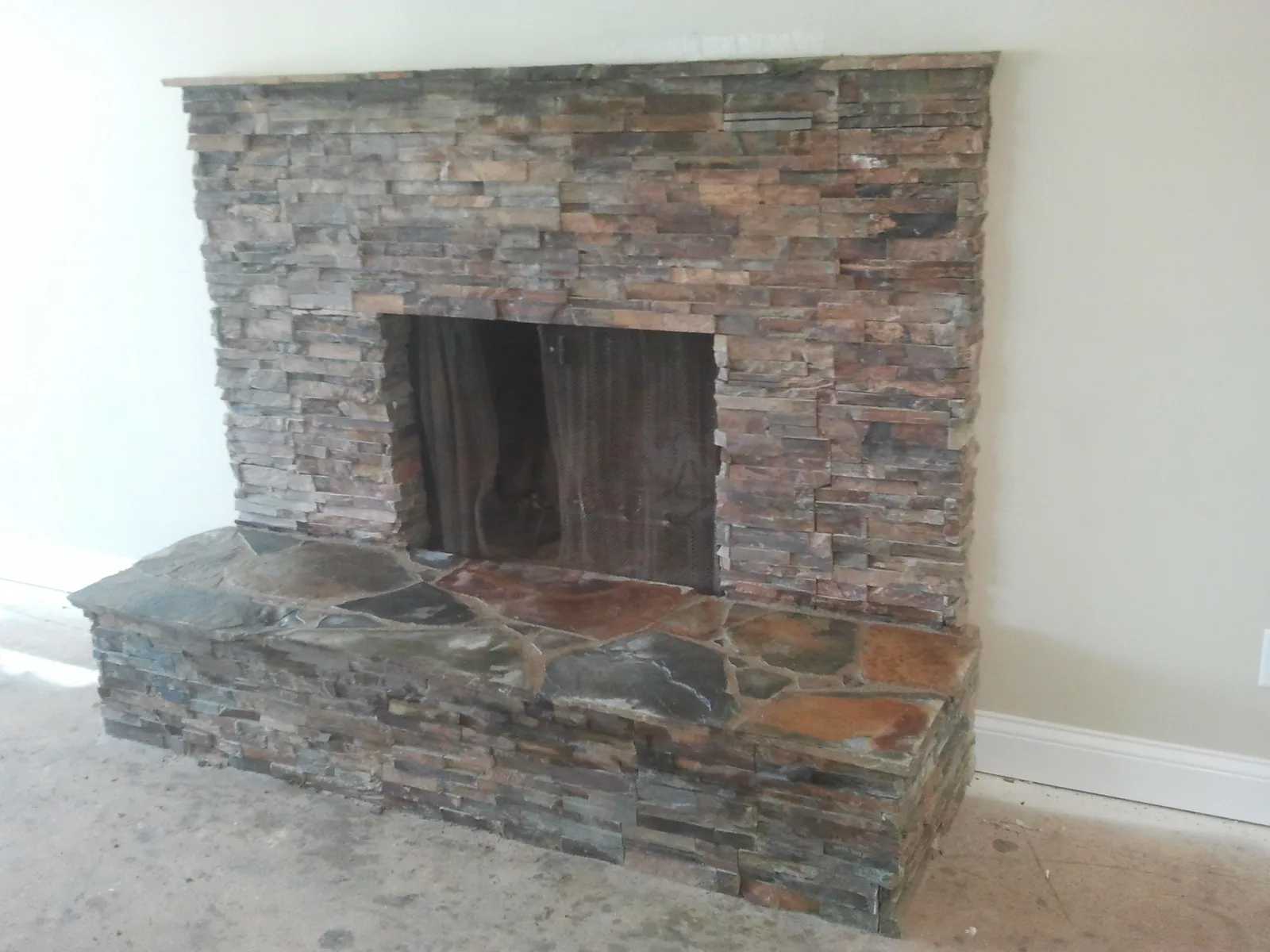
A finished floor-to-ceiling stacked-stone fireplace with a raised stone hearth.

Chimney Repair & Fireplaces in Crest, Dehesa & Harbison Canyon

If the fireplace heats your house, the chimney has to be right — and up here, so does everything around it. Shaun rebuilds crowns, fits spark arrestors, repoints and reinforces old chimneys, and builds stone fireplaces and fire pits placed where a stray ember has nowhere to go.

CSLB #979389 · C-29 Licensed · Bonded $25,000 · Free on-site estimates

Fireplaces in the planning area by the numbers

Where the Fireplace Is Still the Heater

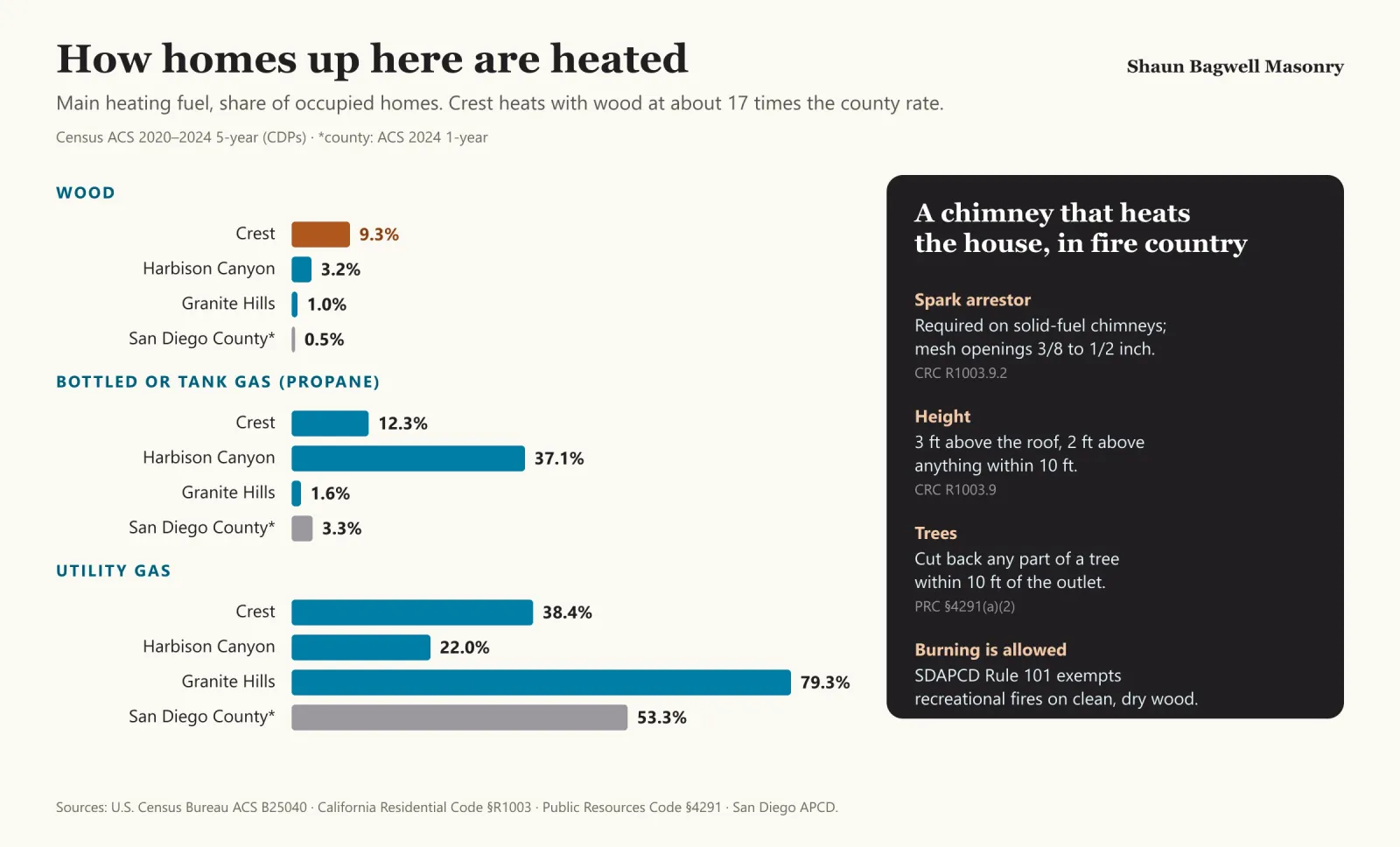
Across San Diego County, about one household in two hundred heats mainly with wood. In the Crest CDP it is 9.3% — nearly one in ten, and roughly 17 times the county rate. Harbison Canyon is different again: 37.1% of homes heat with bottled or tank propane, against 3.3% county-wide. In Granite Hills, closer to El Cajon, 79.3% are on utility gas and wood heat is down to 1%. Those numbers come straight from the Census, and they mean a lot of chimneys here work hard every winter.

They also sit in country with a long fire memory. The County’s community plan records more than 200 homes lost here to the 1970 Laguna Fire and more than 600 to the 2003 Cedar Fire, and as recently as July 2022 a fire burned about 37 acres along Harbison Canyon Road. A chimney that throws sparks, or a fire pit too close to brush, is the last thing anyone wants. California’s code requires a spark arrestor on every solid-fuel chimney, and state law wants any tree within 10 feet of the outlet cut back.

  • 9.3%Crest households heating mainly with wood (county: 0.5%)Census ACS
  • 37.1%Harbison Canyon homes heated with propane (county: 3.3%)Census ACS
  • 10 ftTree clearance required around a chimney outletPRC §4291
  • 25 ftRecreational fire to structures or combustible materialCFC §307.4.2
Infographic: horizontal bar chart of how homes are mainly heated, from the Census ACS 2020 to 2024. Wood: Crest 9.3 percent, 96 of 1,034 homes; Harbison Canyon 3.2 percent; Granite Hills 1.0 percent; San Diego County 0.5 percent in the 2024 one-year survey. Bottled or tank gas such as propane: Harbison Canyon 37.1 percent, Crest 12.3 percent, Granite Hills 1.6 percent, county 3.3 percent. Utility gas: Granite Hills 79.3 percent, Crest 38.4 percent, Harbison Canyon 22.0 percent, county 53.3 percent. A callout says Crest heats with wood at about 17 times the county rate, and lists the chimney rules that follow: spark arrestor with 3/8 to 1/2 inch mesh on solid-fuel chimneys, chimney 3 feet above the roof and 2 feet above anything within 10 feet, and trees cut back 10 feet from the outlet.
Crest’s chimneys aren’t ornamental. Nearly one home in ten heats mainly with wood — about 17 times the county rate — so caps, arrestors and clearances matter more here than almost anywhere in San Diego County.Sources: Census ACS 2020–24 (B25040); Census ACS 2024 1-yr (county); CRC §R1003; PRC §4291.

Chimney and Fireplace Work in the Crest–Dehesa Area

Repairs to working chimneys and new fireplaces built from the footing up. The county-wide detail is on our chimney repair and fireplace pages; here’s what matters on a wood-heated house in fire country.

Top of the chimney

Caps, crowns and spark arrestors

A cracked crown replaced with a sloped cap that sheds water, a drip edge and a bond break around the flue, and a code arrestor with mesh no coarser than half an inch. For a chimney you burn in all winter, this is the most important hour of work on the house.
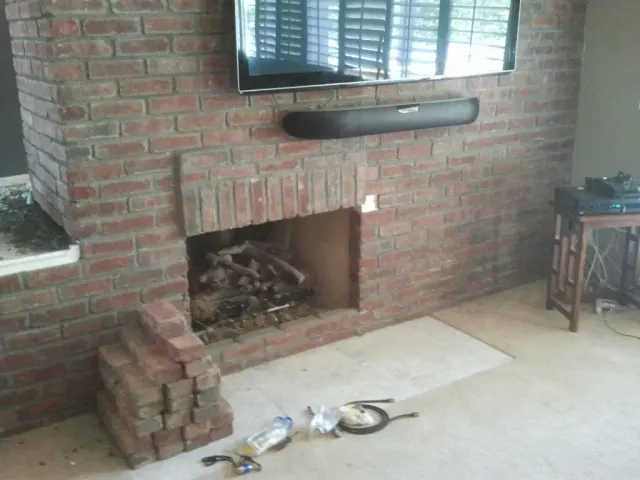
An older brick fireplace with a worn hearth, before repair.

Repair

Repointing and flashing

Joints raked and repointed, spalled brick replaced, and flashing reset where the chimney meets the roof — common on Granite Hills homes, nearly 80% of which were built before 1980.

Seismic

Rebuilds with steel and anchorage

A loose or leaning stack above the roof taken down and rebuilt reinforced, tied to the framing with straps as the residential code requires in seismic regions. Chimneys built before those rules usually lack the detail entirely.

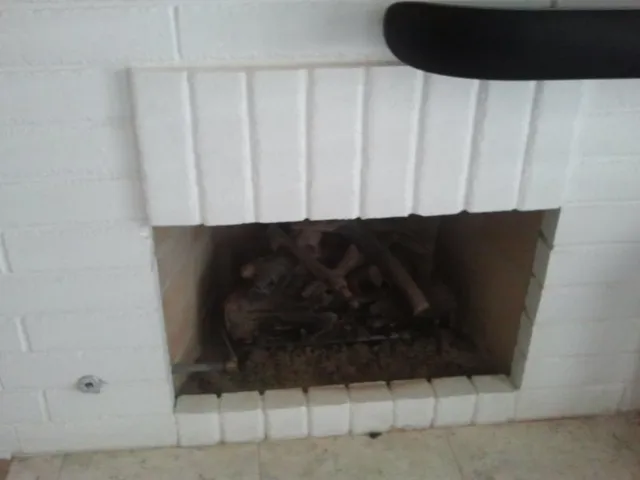
A brick fireplace refinished in white with a rebuilt hearth course.

Fireplaces

Refacing and hearths

Dated brick refaced in stacked stone, hearths rebuilt and extended — the stone and earth tones the community plan favours for Crest and Harbison Canyon homes.

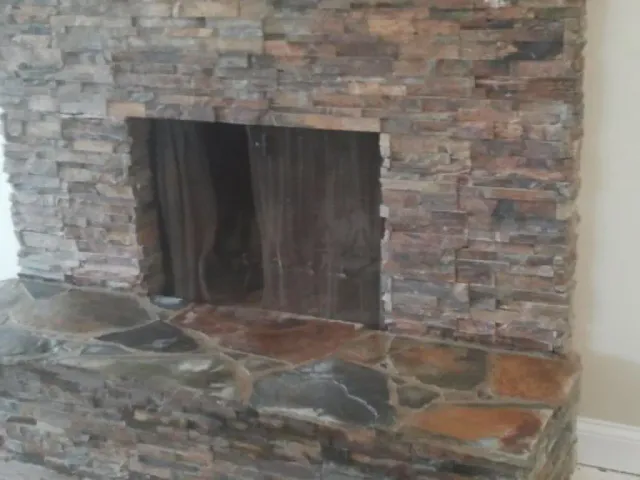
A stacked-stone fireplace with a flagstone hearth, the firebox opening still unfinished.

Fireplaces

New masonry fireplaces

Site-built fireboxes on a proper footing with a lined, reinforced chimney topped to code — for wood, or for gas where propane is already on the lot.

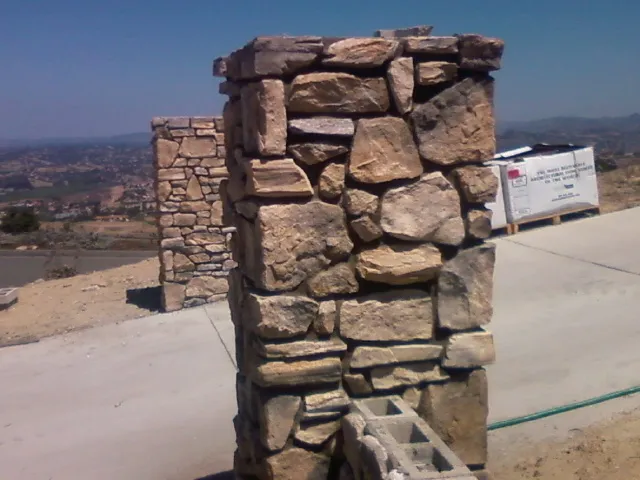
Close-up of a fieldstone pillar with a flat stone cap.

Outdoors

Outdoor fireplaces and fire pits

Placed first, built second: well away from the house, the brush and the trees, on a stone or paver pad, with gas as the safer choice on a tight canyon lot.

The Code at the Top of a Working Chimney

California’s residential code wants a masonry chimney to end at least 3 feet above the roof and 2 feet higher than any part of the building within 10 feet, and to be finished with a concrete, metal or stone cap sloped to shed water, with a drip edge and a bond break around the flue. Any chimney serving a solid-fuel fireplace or stove needs an approved spark arrestor: mesh openings between 3/8 and 1/2 inch and a net free area at least four times the flue outlet.

Down at the firebox, the code calls for a footing at least 12 inches thick extending 6 inches past the fireplace on each side, chimney walls of at least 4 inches of solid or grouted masonry, and — in seismic regions like ours — four No. 4 vertical bars with ties and straps to the house. When we rebuild a chimney in Crest, Dehesa or Harbison Canyon, that is the standard it goes back to.

Spark arrestor
Required on solid fuel
Openings 3/8–1/2 in; net free area ≥ 4× the flue outlet.CRC R1003.9.2
Termination
3 ft above the roof
And 2 ft above anything within 10 ft.CRC R1003.9
Cap
Sloped, drip edge, bond break
Concrete, metal or stone.CRC R1003.9.1
Seismic steel
Four No. 4 bars
With ties and straps anchoring the chimney to the framing.CRC R1001–R1003
Trees at the outlet
10 ft clear
Remove any part of a tree within 10 ft of the chimney outlet.PRC §4291(a)(2)

Permits, Air Rules and Fire Agencies

New masonry fireplaces and chimney rebuilds go through County of San Diego Planning & Development Services anywhere in Crest, Dehesa, Harbison Canyon and County Granite Hills. Fire service is split three ways — San Miguel Fire & Rescue from Station 18 in Crest, County Fire with CAL FIRE crews from Station 24 on Harbison Canyon Road, and the Sycuan Fire Department — so we check with the agency for your address before siting an outdoor fire feature.

Burning itself is allowed. The San Diego air district does not prohibit fires in fireplaces, fire pits or chimineas; its Rule 101 exempts recreational and cooking fires that burn clean, dry wood, charcoal, natural gas or propane, though heavy smoke can be treated as a public nuisance. The state fire code keeps a recreational fire 25 feet from structures and combustible material, attended, with a hose or extinguisher at hand.

Fireplace burning
Not prohibited
Rule 101 exempts recreational fires on clean, dry fuel; smoke can be a nuisance.SDAPCD
Recreational fire
25 ft from structures
And from combustible material; attended, with a hose or extinguisher.CFC §307.4.2
Defensible space
100 ft
Including an ember-resistant zone within 5 ft of the house.PRC §4291
Community plan
Fire-resistant exteriors
Fireproof roofing and walls; fire-resistant eaves (Policy S 1.1.2).Community plan
Fire agencies
Station 18 · Station 24 · Sycuan
San Miguel (Crest); County Fire / CAL FIRE (Harbison Canyon).Planning group minutes

Repair, Rebuild or Build New?

What a Crest–Dehesa chimney or fireplace needs depends on where the problem is. How we decide.

Repair, Rebuild or Build New?
RepairRebuild above the roofNew fireplace or fire pit
Typical signsCracked crown, open joints, no arrestorLoose or leaning stack, cracks through the masonryNo fireplace, or one past saving
What we doNew cap, arrestor, repointing, flashingTake down and rebuild reinforced and anchoredFooting, firebox and chimney, or a pit, built to code
PermitUsually none for like-for-like repairCounty PDSCounty PDS; fire agency for outdoor siting
National cost guide$250–$1,200 typical repair; crown $750–$3,000$500–$4,000 partial or full rebuildMasonry or prefab wood $2,500–$30,000; outdoor $1,500–$8,000

Sources: California Residential Code §R1001 and §R1003; Fixr chimney repair (Jan 2025) and fireplace installation (Jan 2026) cost guides, national. Permit needs confirmed per job with County PDS.

How We Handle a Chimney or Fireplace Here

  1. Start at the top

    Crown, cap, arrestor, flashing and the trees around the outlet — the fire-season risks — then the flue, firebox and hearth.

  2. Tell you straight

    Repair, rebuild or leave it, and what the code, the air district and your fire agency say about each.

  3. Permit where needed

    County PDS for rebuilds and new fireplaces; a call to your fire agency before any outdoor fire feature.

  4. Build it right

    Steel and anchorage on rebuilds, a sloped cap with a drip edge, a code arrestor, mortar suited to hot days and cold nights.

  5. Clear around it

    We point out any branch within 10 feet of the outlet so it’s cut before the first fire of the season.

  6. First fire

    Final check, safe-use notes and a written guarantee. The U.S. Fire Administration advises a chimney inspection every year.

Planning one? Shaun will walk the site with you and tell you what it needs — free, no obligation.

(619) 581-2492

What Chimney and Fireplace Work Costs

National cost guides give a starting point; roof pitch, access and how much of the stack has to come down set a Crest–Dehesa price. These are national cost-guide figures, not our prices.

What Chimney and Fireplace Work Costs
Job (national guide)Typical range
Chimney repair, average$750 (typical $250–$1,200)
Crown replacement$1,000–$3,000
Partial or full rebuild$500–$4,000
Outdoor fireplace$1,500–$8,000 (custom up to $50,000)

Sources: Fixr chimney repair (Jan 2025) and fireplace installation (Jan 2026) cost guides. You get an itemised written quote after a free visit.

Chimneys Across the Planning Area

How the house is heated, and how old it is, changes what we find at the top of the chimney.

  • Crest village and ridgeZIP 92021Wood-heated homes, from 1920s cabins to post-2003 rebuilds. Arrestors, caps and seismic rebuilds of older stacks are the usual work.
  • Harbison CanyonZIP 92019Propane is the main fuel for more than a third of homes, and oaks crowd many rooflines. Tree clearance at the outlet, and gas fireplaces and fire features.
  • Dehesa ValleyZIP 92019Farmhouses, estate homes and big outdoor areas. Outdoor fireplaces sited well clear of barns, hay and brush, often on gas.
  • Granite Hills, County sideZIP 92021Mostly 1950s and ’60s houses, four in five heated by utility gas. Where the original chimney survives, it’s usually due for repointing, a new crown or refacing.

Crest–Dehesa Chimney & Fireplace Questions

Straight answers before you hire. Anything else — call, and Shaun answers it himself.

(619) 581-2492

Do I need a spark arrestor on my chimney?

If it serves a wood-burning fireplace or stove, yes. California’s residential code requires an approved arrestor with openings no larger than 1/2 inch and no smaller than 3/8 inch. In Crest, where nearly one home in ten heats with wood, it’s the single most useful thing on the roof.

Is wood burning banned in San Diego County?

No. The air district does not prohibit burning in fireplaces, fire pits or chimineas, and its Rule 101 exempts recreational fires using clean, dry wood. Excessive smoke can still be a nuisance, so burn seasoned wood in a sound chimney.

How far from the house does a fire pit need to be?

The state fire code keeps a recreational fire at least 25 feet from structures and combustible material, attended, with a hose or extinguisher ready. Your fire agency — San Miguel, County Fire or Sycuan depending on your address — may add its own rules, so we check before we build.

Do trees near my chimney matter?

Yes. State law requires any part of a tree within 10 feet of a chimney or stovepipe outlet to be removed. On oak-shaded Harbison Canyon lots, that is often the first thing we flag.

My house was rebuilt after the Cedar Fire — does the chimney still need checking?

It’s twenty years old now. Caps, arrestors and flashing wear regardless of age, and anything added later — a new insert, a taller tree — can change things. An inspection every year is the U.S. Fire Administration’s advice.

Can you convert my fireplace to gas?

We build and rebuild the masonry; a gas line and insert are fitted by a licensed gas or fireplace specialist. Where propane is already on the lot, as in much of Harbison Canyon, an outdoor gas fire feature is often the simplest choice.

Are you local and licensed?

Yes — 2351 Eltinge Dr, Alpine, just up the road. California C-29 masonry licence #979389, bonded and insured. More about the area on our Crest–Dehesa page.

Get Your Chimney Checked Before Winter

Call Shaun at (619) 581-2492 or send the form. He’ll start at the top of the chimney, tell you what the code and your fire agency require, and give you a written, itemised price.

(619) 581-2492

Call Now(619) 581-2492Estimate