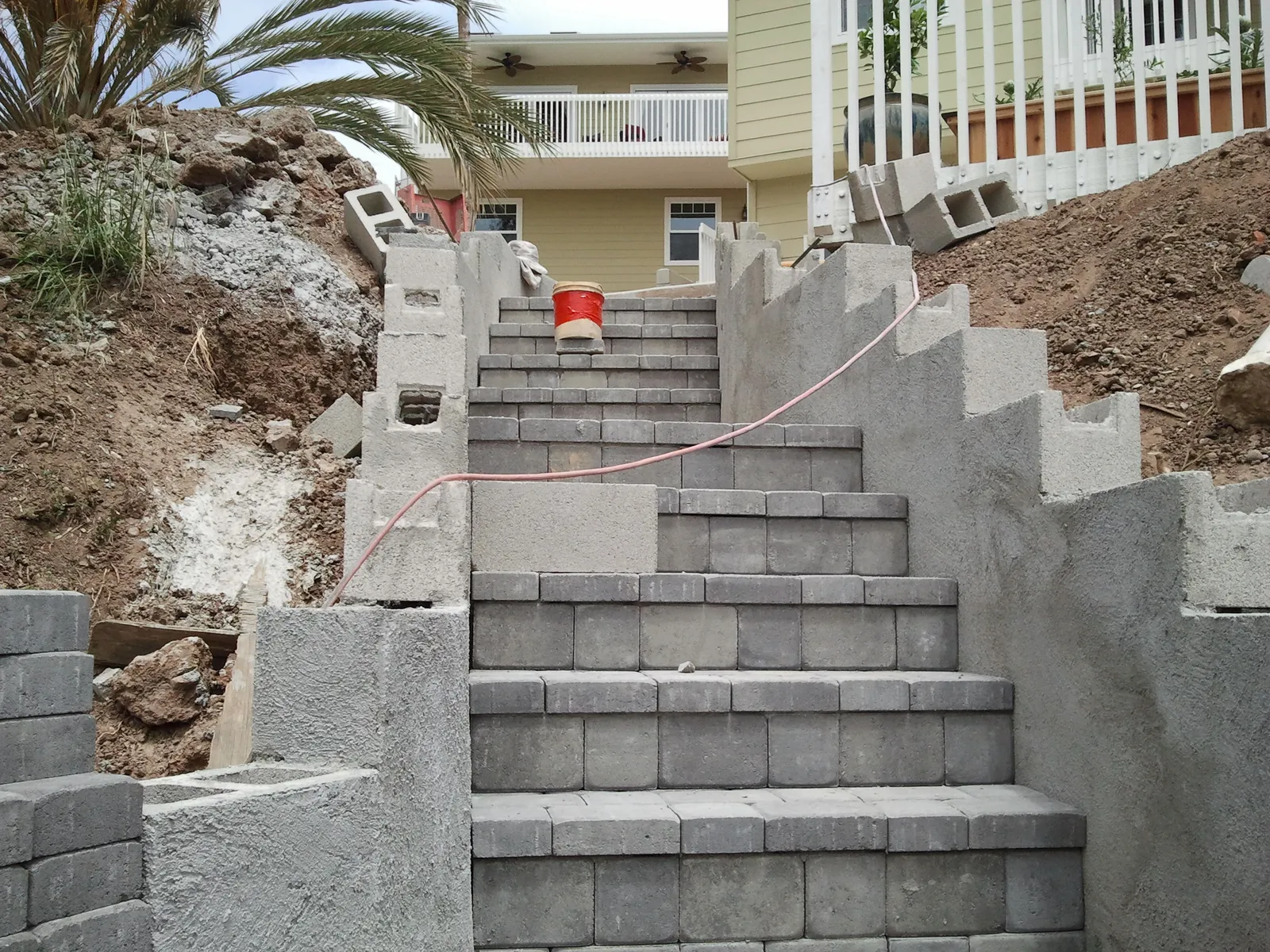
A paver stairway climbing between stepped, plastered concrete block walls on a sloped lot.

Masonry Contractor for Campo, Potrero, Boulevard and Jacumba

Block and stone walls, steps, chimneys and fire-safe hardscape for ranch and rural homes in the Mountain Empire — built for 90-degree afternoons, freezing nights and fire season. Licensed C-29 mason, based in Alpine. Call to have Shaun look at your property.

CSLB #979389 · C-29 Licensed · Bonded $25,000 · Free on-site estimates

The Mountain Empire by the numbers

Hot Days, Freezing Nights and a Wood Stove in One Home in Four

The Census Bureau groups the border communities of the county’s southeast corner as the Mountain Empire division: about 7,800 people in 2,876 homes across 450.6 square miles — roughly 17 people to the square mile. Nearly three in four occupied homes are owner-lived, and the median house was built in 1980, so a great many walls, slabs and chimneys out here are now in their forties.

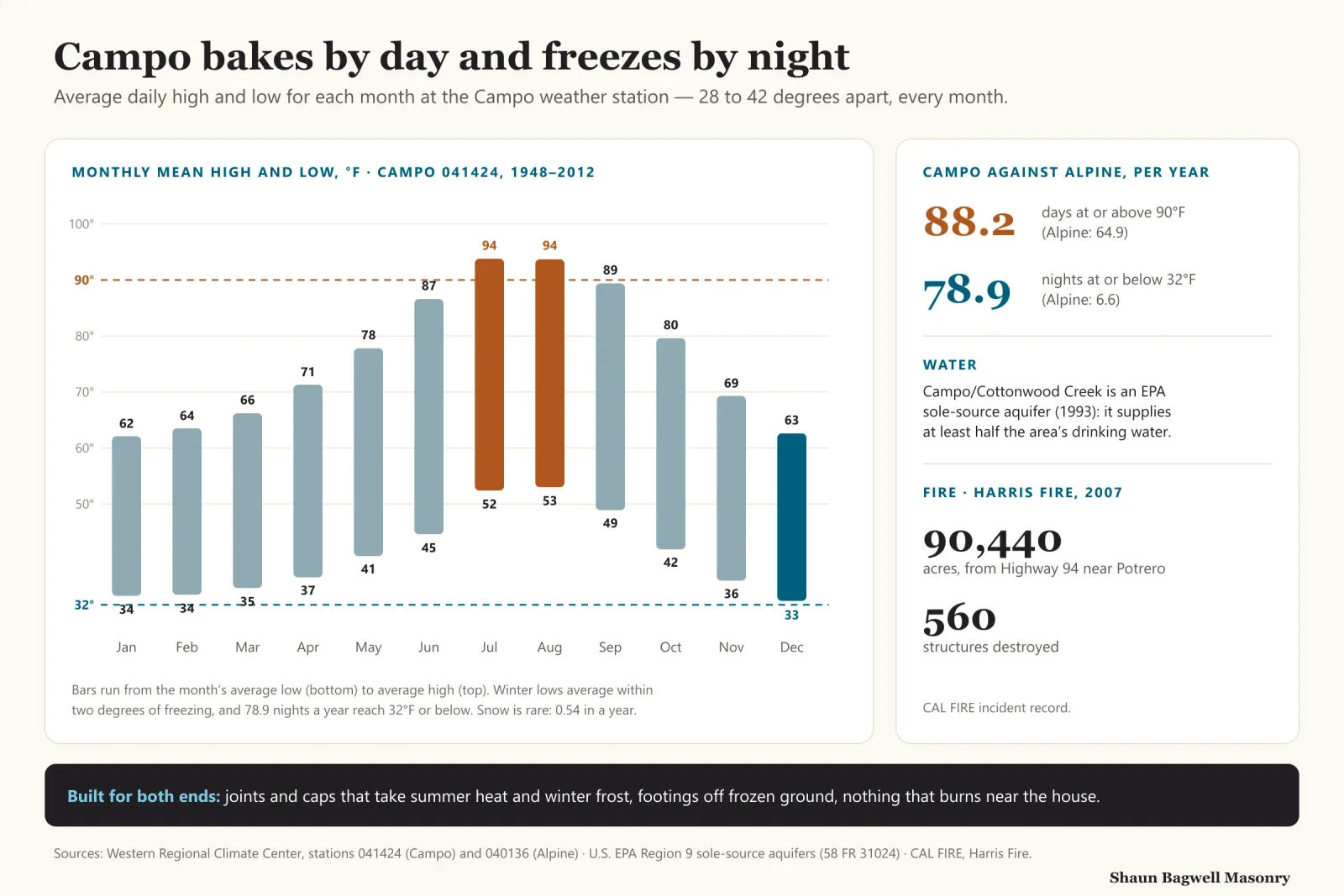
The weather is the hard part. The Campo station, with records back to 1948, averages 88.2 days a year at 90°F or above and 78.9 nights at or below freezing — compare Alpine’s 64.9 and 6.6. Average lows from December to February sit within two degrees of freezing, and from June to August the gap between afternoon and night is more than 40 degrees. Masonry here is heated and chilled every day, and in a region where wood heats 23.9% of homes, the chimney takes the worst of it.

Infographic: monthly average high and low temperatures at the Campo weather station, 1948–2012, drawn as bars against dashed lines at 90°F and 32°F. January 62 and 34, February 64 and 34, March 66 and 35, April 71 and 37, May 78 and 41, June 87 and 45, July 94 and 52, August 94 and 53, September 89 and 49, October 80 and 42, November 69 and 36, December 63 and 33. Campo averages 88.2 days a year at or above 90°F (Alpine 64.9) and 78.9 nights at or below 32°F (Alpine 6.6); snowfall averages 0.54 inch. Side panel: Campo/Cottonwood Creek is an EPA sole-source aquifer, designated 1993, supplying at least half the area’s drinking water. The 2007 Harris Fire started on Highway 94 near Potrero, burned 90,440 acres and destroyed 560 structures.
Two kinds of stress in one year. July afternoons average 94°F and December nights 33°F at the Campo station, so joints, caps and footings have to handle heat and frost — plus fire.Sources: WRCC Campo 041424; WRCC Alpine 040136; EPA sole-source aquifers; CAL FIRE Harris Fire.

Heat, Frost, Fire and Well Water

What makes building out here different from the coast — or even from Alpine — is all on the record: the weather station, the fire history, the EPA’s water designation and the County’s codes.

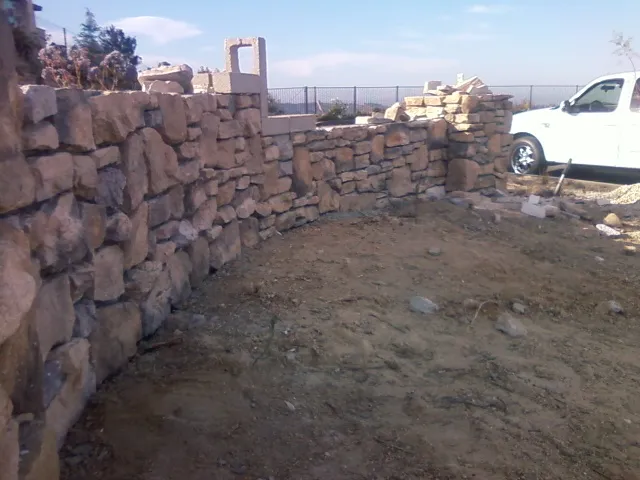
Natural stone veneer being set course by course onto a curved block wall.

Heat and frost

Joints that take a 40-degree swing

June averages 86.6°F by day and 44.6°F at night at the Campo station; December averages 62.6°F and 32.7°F. Brick, block, stone and mortar expand and shrink with every one of those swings, and water in a crack freezes on close to 80 nights a year. We use mortar matched to the masonry rather than the hardest mix on the truck, build in control joints on long block walls, and cap every wall so water runs off it rather than into it.
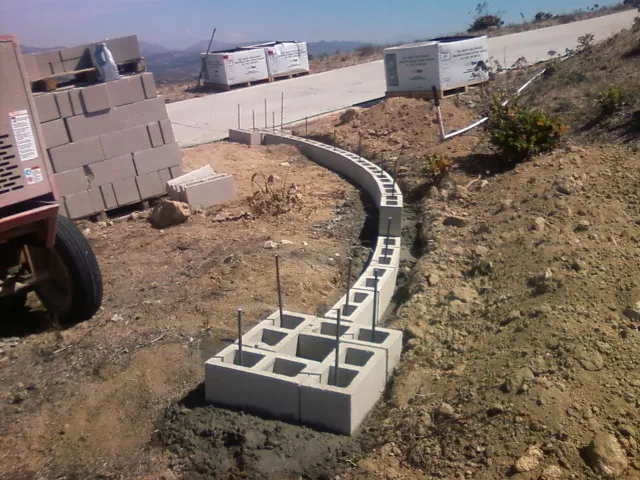
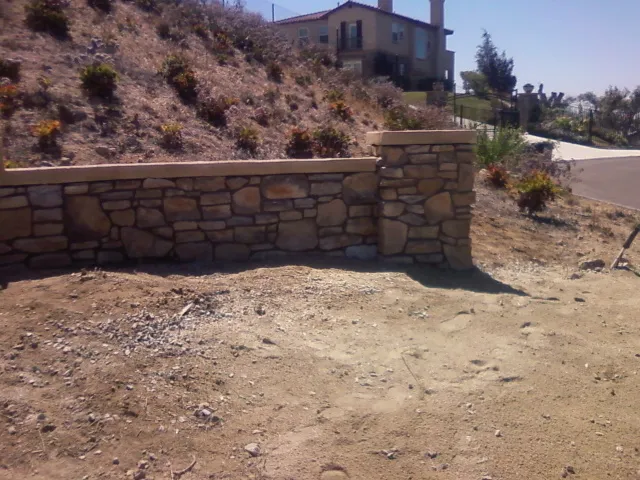
A concrete block wall core on a new footing along a hillside driveway, before facing.

Footings

Down past frost, or onto rock

The residential code sets exterior footings at least 12 inches below undisturbed ground and adds that they must be protected from frost — below the frost line, on solid rock or in a frost-protected design — and never placed on frozen soil. With freezing nights through most of the winter, we pour after the trench has thawed, protect fresh mortar when lows drop under 40°F, and take a footing down to rock wherever the dig finds it.

Finished stone-veneer wall and pillar with a mortared cap.

Fire

Harris Fire country

CAL FIRE records the 2007 Harris Fire starting at Highway 94 and Harris Ranch Road near Potrero; it burned 90,440 acres and destroyed 560 structures. The County’s 2026 wildfire code now keeps the first five feet around a house to hardscape and noncombustible materials, and its fence rules say anything within five feet of a building must be noncombustible. A stone or block wall where a wood fence meets the house, and pavers or concrete instead of bark against the walls, are the masonry answers.

Groundwater

An EPA sole-source aquifer

In 1993 the EPA designated the Campo/Cottonwood Creek aquifer a sole-source aquifer — its term for groundwater that supplies at least half the drinking water of the area above it, with no reasonable alternative if it were polluted. That is the water most homes here drink. On site we find the well and septic system before we lay out a footing, keep wash-out from concrete and mortar contained, and drain new hardscape away from the wellhead.

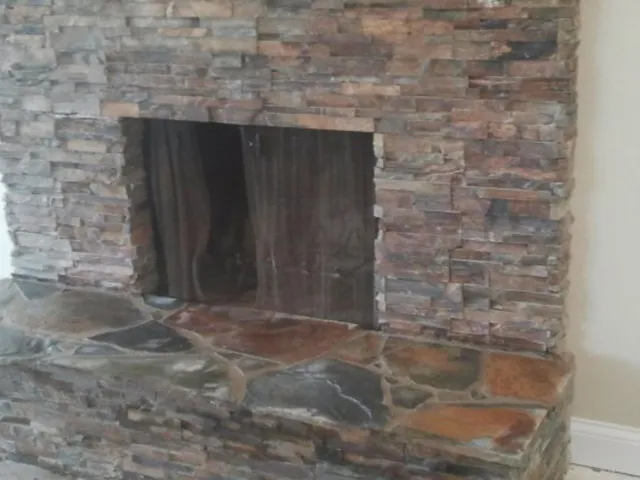
A stacked-stone fireplace surround with a flagstone hearth.

Wood and propane

Stoves, propane and almost no piped gas

Census figures show 23.9% of Mountain Empire homes heat mainly with wood — nearly 40 times the county rate — and 43.0% with tank propane; just 2.8% have piped gas. That makes the masonry chimney a working part of many houses, and the place where heat, frost and fire risk all meet. Our Campo chimney and fireplace page goes into it.

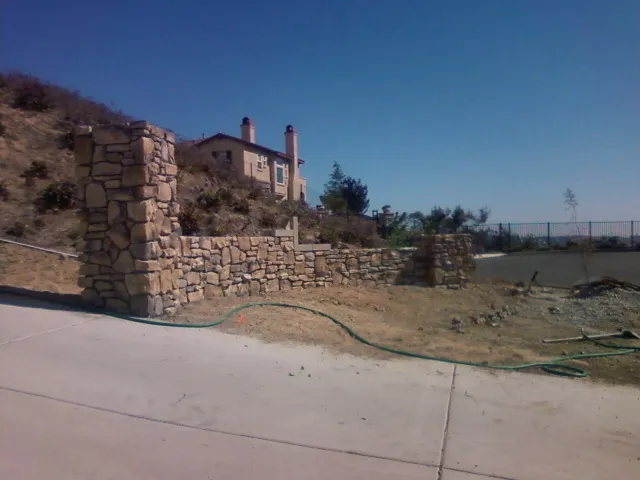
Stone pillar and low stone wall at the entrance of a concrete driveway.

Stone tradition

A stone-building district from the start

The Campo Stone Store, California Historical Landmark No. 411, is the “fort-like” stone building that replaced the Gaskill brothers’ frame store after border bandits raided it in December 1875; the County restored it as a museum between 1943 and 1948. In Jacumba, the stub of the burned Hotel Jacumba’s massive central fireplace still stands. Stone has a long history out here, and it still suits the climate and the fire risk better than anything that burns.

Permits Out Here: County PDS, Caltrans on the Highways

All four communities are unincorporated, so walls, footings and fireplaces are permitted by the County of San Diego Planning & Development Services. County zoning places no limit on the height of a retaining wall holding a bank, but every retaining wall over 3 feet needs a building permit; the 2026 exemption only covers walls retaining 3 feet or less from the top of the footing, with level backfill, no surcharge and no structure within 6 feet. On rural lots that is often not the case.

A freestanding masonry wall up to 6 feet that meets zoning needs no building permit, and the County publishes standard block-fence designs with a 24-inch-deep footing. Solid walls are capped at 42 inches in a front setback and 72 inches at the side and rear, but lots of an acre or more in the rural and agricultural zones can run open fencing — pipe corral, wrought iron, rail — to 72 inches out front, often hung between masonry pilasters. Where a driveway meets State Route 94 or another state highway, the apron needs a Caltrans encroachment permit; onto a County road, a DPW one.

County of San Diego issues

  • Building and zoning permits (PDS)
  • Fire code and defensible space (County Fire)
  • Encroachment onto County roads (DPW)

Not the County

  • Driveways onto SR-94 or other state highways (Caltrans)
  • Federally funded projects over the aquifer (EPA review)
Retaining wall
Over 3 ft = permit
The 2026 exemption needs all of: 3 ft or less from footing top, level backfill, no surcharge, nothing built within 6 ft.PDS-308 · PDS-110
Freestanding masonry wall
Up to 6 ft — no permit
When it meets zoning; County Table A block-fence design, footing 24 in below grade.PDS-070
Open fence, 1-acre+ rural lots
72 in in front yards
Pipe corral, wrought iron or rail in the A70, A72, RR and S8x/S9x zones.PDS-308
Fence within 5 ft of a building
Noncombustible
Or approved fire-retardant wood; Zone 0 kept to hardscape.PDS-070 · 2026 WUI Code
Footings
12 in + frost protection
Below the frost line or on rock; never on frozen soil.CRC R403.1.4.1

Masonry Work We Do in the Mountain Empire

For ranch houses, rural homes and older buildings — each priced in writing after a site visit.

Gate pilasters and ranch entries

Stone or block pilasters for gates and open corral or iron fencing, on footings sized for the gate’s weight and swing.

Repairs to older stone buildings

Repointing and resetting stone on older ranch and commercial buildings, with mortar matched to the original rather than hard modern cement.

Not sure which of these your property needs? Shaun will look at it with you — free, on site, no obligation.

(619) 581-2492

What Masonry Costs in the Mountain Empire

The 2026 ranges we quote county-wide. Out here the swing comes from distance and access, rock in the trench, long fence and wall runs, and whether a wall fits the County’s standard designs or needs engineering.

What Masonry Costs in the Mountain Empire
ProjectTypical 2026 range
Retaining wall, CMU or engineered$35–$120 per sq. face ft.
Block wall, CMU with stucco or veneer$250–$400 per linear ft.
Patio or pavers$18–$40 per sq. ft.
Masonry chimney repair$1,500–$8,000+ by scope

Use these to budget, not as a bid. Engineering and County or Caltrans permit fees are shown separately on your written proposal.

The Communities We Cover

Each is unincorporated and permitted through the County. Over the mountain, Pine Valley and Descanso have their own Central Mountain page; our yard is in Alpine.

  • Campo & Lake Morena2,802 feet; about 2,700 people, median house from 1985. Home of the 1940s Camp Lockett, the Campo Stone Store and the railway and motor-transport museums; Morena Village sits east of Morena Dam to the north. Ranch walls, pilasters and chimneys.
  • Potrero2,336 feet, near where CAL FIRE places the start of the 2007 Harris Fire, at Highway 94 and Harris Ranch Road. Fire-safe walls and Zone 0 hardscape first.
  • Boulevard3,638 feet, named for the old U.S. 80 that ran through it before I-8. Headquarters of the Manzanita Band of Diegueno Mission Indians; its planning group area covers about 86 square miles. Long property walls, gate pilasters and chimneys.
  • Jacumba Hot SpringsOn the border, around a warm spring recorded at 104°F; the Hotel Jacumba was open by 1925 and burned in 1983, and the stub of its fireplace still stands. Older stone and block repairs.

Campo & the Mountain Empire Masonry Questions

Straight answers to what Campo & the Mountain Empire homeowners ask before they hire. Anything else — call, and Shaun answers it himself.

(619) 581-2492

Do you come out to Campo, Boulevard and Jacumba?

Yes. We’re based in Alpine and cover the Mountain Empire along I-8 and Highway 94. Shaun visits the site before quoting and gives you the price in writing.

Why do block walls crack out here?

Mostly movement and water. The Campo station averages more than 40 degrees between day and night in summer and almost 80 freezing nights a year. Walls without control joints, solid grout where it’s needed, or a cap that sheds water crack sooner. We build all three in.

Do I need a permit for a retaining wall in Campo or Potrero?

For a wall over 3 feet, yes, from County PDS. The 2026 exemption only covers walls retaining 3 feet or less from the top of the footing with level backfill, no surcharge and no structure within 6 feet.

Can I build a 6-foot block wall without a permit?

A freestanding masonry wall up to 6 feet needs no building permit if it meets County zoning, which allows solid walls of 72 inches at the side and rear and 42 inches in a front setback. Larger rural lots can run 72-inch open fencing in front.

Does the sole-source aquifer affect my project?

The EPA designation mainly brings federally funded projects under EPA review. For a private wall or patio it doesn’t add a permit, but it is a good reason to keep concrete wash-out, mortar and runoff well away from your well — which we do on every job.

What does the County’s 2026 fire code mean for my yard?

The first 5 feet around a building has to be hardscape or noncombustible, and any fence within 5 feet of the house must be noncombustible. Pavers, concrete walks and a short block or stone section where a wood fence meets the house are the usual fixes.

My driveway meets Highway 94. Who issues the permit?

Work in a state highway right-of-way such as SR-94 needs a Caltrans encroachment permit; a driveway onto a County road needs one from County DPW. We tell you which applies before the price is final.

How do I check your licence?

Enter #979389 in the CSLB’s “Check a License” search at cslb.ca.gov. It is a C-29 Masonry licence issued to Shaun Bagwell Masonry on 14 December 2012, with the business bonded and insured.

Sources for the figures on this page

  1. U.S. Census Bureau ACS 2020–2024 5-year, Mountain Empire CCD, tables B01003/B25001/B25003/B25035/B25040 (via Census Reporter)
  2. U.S. Census Bureau ACS 2020–2024 5-year, Campo and Boulevard CDPs (via Census Reporter)
  3. Census Reporter — Mountain Empire CCD profile (450.6 sq mi)
  4. U.S. Census Bureau ACS 2020–2024 5-year, San Diego County, table B25040 (via Census Reporter)
  5. Western Regional Climate Center — Campo (041424) temperature summary, 1948–2012
  6. Western Regional Climate Center — Campo (041424) monthly precipitation
  7. Western Regional Climate Center — Alpine (040136) temperature summary
  8. U.S. EPA Region 9 — Sole source aquifers (Campo/Cottonwood Creek, 58 FR 31024, 1993)
  9. U.S. EPA — Overview of the drinking water sole source aquifer program
  10. CAL FIRE — Harris Fire (2007)
  11. California Office of Historic Preservation — Campo Stone Store, Landmark No. 411
  12. Wikipedia — Campo, California (Camp Lockett, museums, Morena Village)
  13. Wikipedia — Potrero, California
  14. Wikipedia — Boulevard, California
  15. Wikipedia — Jacumba Hot Springs, California
  16. California Residential Code §R403 Footings — frost protection (gocodebook)
  17. CMHA TEK 03-01C — All-weather concrete masonry construction
  18. County of San Diego — 2026 Wildland-Urban Interface Code
  19. County of San Diego PDS-308 — Walls / retaining walls (zoning)
  20. County of San Diego PDS-070 — Fences (Rev. 01/01/2023)
  21. County of San Diego PDS-110 — Work exempt from a building permit (Rev. 01/01/2026)
  22. Caltrans — Encroachment permits
  23. CSLB — Check a License (#979389)

Get Your Mountain Empire Project Priced

Call Shaun at (619) 581-2492 or send the form. He’ll drive out from Alpine, look at the ground, the slope and the chimney, explain what the County and the fire code ask for, and give you an itemised price in writing.

(619) 581-2492

Call Now(619) 581-2492Estimate