
San Diego Concrete Contractor for Slabs, Footings & Flatwork
Concrete is only as good as what's under it and the steel inside it. Shaun Bagwell pours slabs, footings, foundations and flatwork built for San Diego's expansive clay and Seismic Design Category D — not the "starting at $5 a foot" work you scrape off a driveway five years later. Owner-operated, licensed, and accountable from form to final cure.
CSLB #979389 · C-29 Licensed · Bonded $25,000 · Free on-site estimates
Structural Concrete, Done to Spec
Shaun handles the concrete that carries load and the flatwork you walk on every day:
Foundations & footings
the base under new masonry, room additions, walls and structures, tied into foundation repair when existing concrete has already failed.
Slabs on grade
garage floors, shed and equipment pads, ADU slabs, and interior slabs poured over a proper vapor barrier.
Flatwork
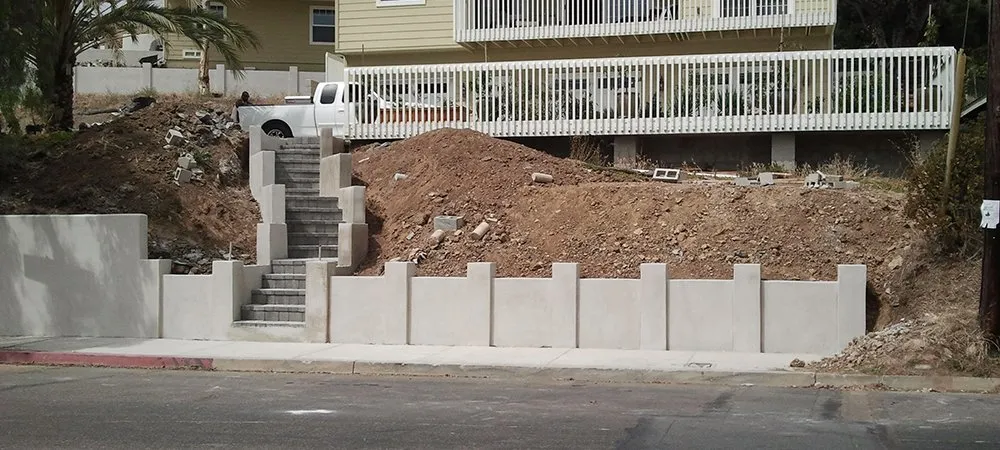
walkways, side yards, steps, landings, sidewalks and utility pads, finished broom, smooth-trowel or exposed-aggregate.
Driveways
engineered for vehicle loading, with the City permit handled where the apron is involved (full detail on the concrete driveway page).
Hardscape concrete
the base and surface behind patios, pool decks, pavers and retaining wall footings.
Because Shaun is a licensed masonry contractor, the concrete and the block wall or veneer that sits on it are built by the same hand, to the same standard — no coordination gap between trades.
Expansive Clay and Seismic Category D Change How Concrete Is Built
San Diego's climate is close to ideal for pouring — mild temperatures, low humidity, essentially no freeze-thaw. The hard part is the ground. Highly expansive clay soils sit across the coastal plains, marine terraces and uplands where most of the county's homes are built. That clay swells when it takes on water and shrinks through the dry season, and the cycle pushes and pulls on anything cast into it.
That's why a slab here isn't just a slab. Seismic Design Category D — one of California's highest — applies countywide, which means engineered footing designs and defined rebar schedules, not a guess. Foundations must meet Chapter 18 (Soils and Foundations) of the San Diego Building Code, including its expansive-soil and seismic load provisions. On poor or expansive subgrade, ACI 360R guidance is to step slab thickness up a size — 4 inches to 5, or 5 to 6 — and tighten reinforcement regardless of the load above. Shaun works to the local geotechnical recommendation on structural pours instead of pouring every job the same way.
The Specs That Decide Whether Concrete Cracks
Most slab failures trace back to what happened before the truck arrived. Shaun controls the parts that matter:
Base: 4–6 inches of compacted granular sub-base — site prep is 20–30% of a slab's cost and the biggest driver of how long it lasts.
Reinforcement: #3 rebar or 6×6 welded wire mesh for standard flatwork; #3–#4 bar at 12–18 inches on center each way for vehicle loads, tightened on expansive soil — chaired up into the slab, never lying on the dirt. ACI 318 caps slab reinforcement spacing at the lesser of three times the thickness or 18 inches, and calls for 3 inches of cover against earth.
Mix: 2,500–3,000 psi for light flatwork, 3,000–4,000 psi for driveways and garage slabs, at a controlled water-cement ratio so strength isn't watered down on site.
Vapor barrier: an ASTM E1745-compliant sheet (10–15 mil, 6-mil minimum) under interior and conditioned slabs, seams lapped and turned up at the edge, to stop ground moisture, efflorescence and coating failure.
Control joints: concrete shrinks about 1/16 inch per 10 feet as it cures, so joints are cut on a proper grid and at re-entrant corners to put the cracks where you can't see them.
Curing: walkable in 24–48 hours, drivable at about 7 days (roughly 70% strength — "70 in 7"), full design strength at 28 days. Rushing vehicles onto a fresh slab is how edges spall.
- 24–48 hrsWalkable
- ~7 daysDrivable · ~70% strength
- 28 daysFull design strength
What Needs a Permit — and What Doesn't
You shouldn't pay for a permit you don't need, or skip one you do. The lines in San Diego:
- Usually no permit
Most at-grade flatwork on private property is building-permit exempt under California code (CRC/CBC Section 105.2) and the City's exemption list (Information Bulletin 203, referencing SDMC §129.0203). A backyard slab or walkway usually doesn't need one.
- Building permit
Foundations and structural concrete do require a building permit, with engineered plans and a pre-pour (form) inspection before any concrete is ordered.
- Right-of-way permit
Anything touching the public right-of-way — the driveway apron, sidewalk, curb or gutter — needs a Minor Right-of-Way Permit (Information Bulletin 165) and often an Encroachment Maintenance & Removal Agreement (EMRA, SDMC §129.0715). New curb cuts and driveway widening trigger it, and curb outlets or underdrains add DS-560 stormwater review.
Shaun tells you which category your job falls in at the estimate and pulls the permit when it's required — so nothing gets red-tagged after the pour.
Call (619) 581-2492San Diego Concrete Pricing — Published, Not Hidden
Every job varies with access, grading, thickness and finish, but here are honest 2026 San Diego ranges to plan around — reinforced, graded and finished to last, not the lowball ads.
| Concrete Work | Typical San Diego Range (2026) |
|---|---|
| Standard slab / flatwork (reinforced, 4") | $7 – $13 per sq. ft. |
| Unreinforced pad | $6 – $12 per sq. ft. |
| Foundation slab | $6 – $14 per sq. ft. |
| Driveway (standard finish) | $8 – $15 per sq. ft. |
| Stamped / colored / decorative | $11 – $23+ per sq. ft. |
| Pool deck | $15 – $30 per sq. ft. |
| Concrete demolition & removal | $1.30 – $2.10 per sq. ft. |
Site access and grading move these more than anything — a tight backyard costs more to reach than an open lot. You get a written, itemized proposal before work starts, with no change-order surprises.
Request Your Free EstimateSan Diego Concrete — Straight Answers
How thick should my concrete slab be?
Four inches handles most residential flatwork, patios and shed pads. Driveways, garage floors and anything on expansive San Diego clay usually step up to 5–6 inches with tighter rebar. Your soil decides — that's part of what the on-site estimate is for.
How long before I can use it?
Foot traffic after 24–48 hours, vehicles after about 7 days (roughly 70% strength), and full design strength at 28 days. Parking on a slab too early is a common way to crack the edges.
Do I need a permit for a concrete slab in San Diego?
Most at-grade flatwork on your own property is building-permit exempt under CBC/CRC Section 105.2 and City Information Bulletin 203. Foundations, structural slabs, and any work touching the sidewalk, curb or driveway apron do require permits — Shaun handles those.
Why is my quote higher than a "$5 a foot" ad?
Those numbers leave out grading, base compaction, steel and proper finishing — the parts that keep a slab from failing. Done right, concrete lasts 40-plus years with almost no maintenance, which is the cheaper number over time.
Are you licensed and insured?
Yes — Shaun holds an active California C-29 masonry contractor license (CSLB #979389), a $25,000 bond, and liability insurance. Verify it at cslb.ca.gov.
Get a Concrete Quote That Holds Up
From a garage slab to an engineered foundation, Shaun Bagwell pours it to code and stands behind it with a workmanship guarantee. Free on-site estimate, a written proposal, and one accountable owner from start to finish.