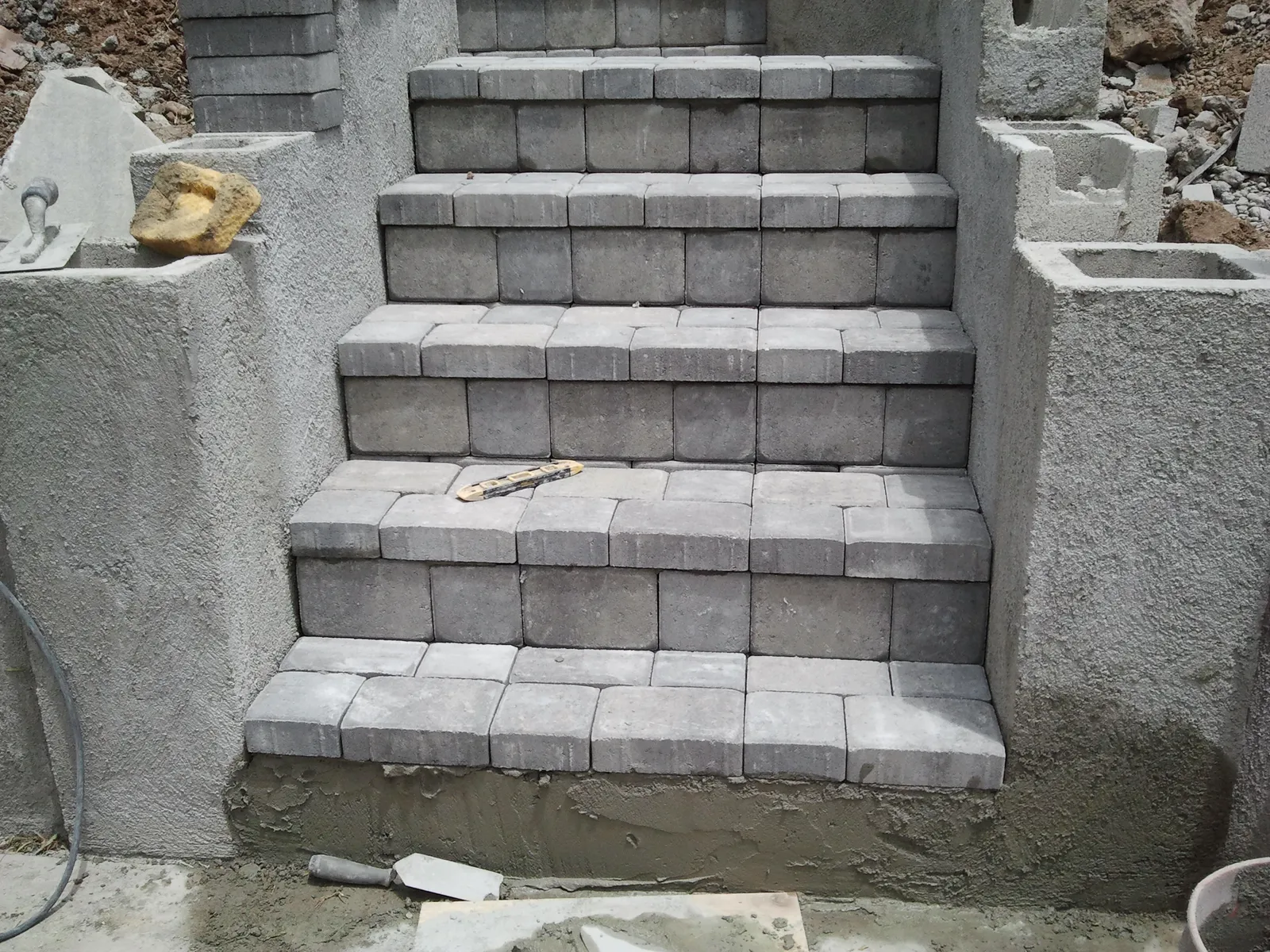
Close-up of paver stair treads set level between plastered block stringer walls on a San Diego hillside job.

San Diego Paver Installation — Driveways, Walkways & Stone Pavers Built to Last

Pavers are the one hardscape surface that flexes with San Diego's clay instead of cracking against it — but only when the base beneath them is built right. Most paver failures aren't the pavers; they're the two inches of shortcut underneath that nobody can see. Shaun Bagwell sets pavers to full ICPI standard on a base that holds, with more than 25 years of masonry behind the work.

CSLB #979389 · C-29 Licensed · Bonded $25,000 · Free on-site estimates

The Interlock Is Why Pavers Outlast a Slab in San Diego

The single best reason to choose pavers over a poured slab has everything to do with San Diego's ground. A concrete slab is rigid — it's one solid piece, so when the expansive clay beneath it swells and shrinks through the seasons, the slab has no way to move with it and eventually cracks. Pavers solve that by being the opposite of rigid. Each unit is a separate piece locked to its neighbors through an interlocking pattern and jointing sand, so the whole surface behaves as a flexible system. When the ground moves, the pavers flex and settle together instead of splitting, which is exactly why a paver driveway still looks right after a decade when the concrete one next door is mapped with cracks.

The pavers themselves are also simply stronger. Interlocking concrete pavers are manufactured to ASTM C936, which requires a minimum compressive strength of 8,000 psi — more than double the roughly 3,000–4,000 psi of a typical residential concrete slab. They come out of the plant fully cured, so there's no week of waiting to drive or walk on them, and when something does go wrong — a utility trench, an oil stain, a single cracked unit — you lift and replace individual pavers invisibly, rather than patching a slab in a shade of gray that never matches. Higher strength, movement tolerance, and repairability are why pavers cost more up front and usually less over the life of the surface.

Driveways, Walkways and Every Surface In Between

Pavers work anywhere concrete would, and Shaun sets them across the property — but the driveway is where the engineering matters most.

Driveways

A paver driveway carries thousands of pounds of vehicle load every day, so it's built to a different standard than a walkway — thicker 80mm units, a deeper compacted base, and a herringbone laying pattern that mechanically resists the sideways creep tires create. Done right, it's the most durable driveway surface you can buy and the easiest to repair. It's also the paver application most worth doing in interlocking or stone paver rather than poured concrete, precisely because a driveway takes the most abuse and shows cracks the most.

Walkways, paths and steps

Front walks, side-yard paths, garden steps and entry landings are where pavers add the most character for the least cost, in any pattern or border you like. Thinner 60mm pedestrian units on a properly compacted base give you a surface that stays flat and level for decades.

Patios and pool decks

Pavers are a leading choice for both, but those are projects with their own considerations, so they each have a dedicated page: see patio contractors for outdoor-living patios in every material, and pool decks for slip-resistant, cool-underfoot poolside paving and coping. This page is about the paver material and method that can be used across all of them.

Why Paver Failures Are Almost Always Base Failures

When a paver surface shifts, dips, or grows weeds through spreading joints, the pavers didn't fail — the installation did. A paver system is only as good as the layers underneath it, and those layers are where a cut-rate crew saves a few hundred dollars that turns into thousands of dollars of settling within two or three years. Built to the Interlocking Concrete Pavement Institute (ICPI) standard, the way Shaun builds it, a paver surface is an engineered assembly.

It starts with excavation to the right depth and a compacted aggregate base — typically four inches of Class II road base for pedestrian areas and deeper for driveways — compacted to at least 95% standard Proctor density (ASTM D698), the vehicular version compacted harder still. A shallow or loosely compacted base is the number-one cause of paver failure in San Diego, full stop. On top of that goes a screeded bedding layer of coarse concrete sand — ASTM C33, not bagged play sand or beach sand, because evenly graded sand doesn't lock together and won't hold the pavers in place. The pavers are then laid in pattern, with herringbone used for driveways because its interlocking geometry resists the lateral forces of vehicle traffic far better than a running bond.

The detail that separates a lasting installation from a spreading one is the edge restraint. Set around the perimeter and spiked into the compacted base, it's what stops the whole field of pavers from creeping outward and opening joints over time — the single most-skipped component on cheap jobs. Finally the joints are filled and locked, typically with polymeric sand that hardens to resist weeds, ants and washout. None of this shows in the finished surface, which is exactly why it's where discipline matters — and where a masonry contractor who builds structural bases every week has the advantage over a crew that treats the base as an afterthought.

Choosing the Right Paver Material

The structure underneath is the same; the material on top changes the look, the maintenance and the feel underfoot.

  • Interlocking concrete pavers are the workhorse — strongest value, widest range of shapes and colors, from manufacturers like Belgard, Angelus and Acker-Stone. They're the default for driveways and high-traffic areas.

  • Porcelain pavers are the modern premium option: completely non-porous, so they never stain and need essentially zero maintenance, in large-format tile looks that suit contemporary homes.

  • Travertine is the coastal and poolside favorite — a natural limestone that stays noticeably cooler underfoot in San Diego's summer sun and offers natural slip resistance, though its porous surface needs periodic sealing.

  • Natural stone — flagstone, slate, granite — gives the most organic, high-end look, each piece unique, ideal for estate landscapes.

  • Clay brick pavers bring a classic, warm-toned permanence that never fades because the color runs through the whole unit.

Shaun helps you match the material to the application, your home's style and your budget — and, being a mason, ties the paver work cleanly into any adjacent stone or block so it reads as one project, not two trades that didn't talk.

Where Pavers Solve a Regulatory Problem, Not Just a Design One

San Diego takes stormwater seriously, and pavers have a real advantage here that concrete can't match. The City requires a Storm Water Requirements Applicability Checklist (DS-560) for most hardscape projects, and when you're adding significant impervious surface — a new driveway, a large patio — you may be required to manage that runoff on site rather than sending it to the street. Permeable pavers (permeable interlocking concrete pavement, or PICP) do exactly that: instead of shedding water, they let it infiltrate straight through open-graded joints into a stone reservoir base and back into the ground. At the surface they look like high-end standard pavers; underneath, the open-graded aggregate stores and releases water over 24 to 48 hours. On San Diego's slower-draining clay soils, the design uses a deeper reservoir and sometimes an underdrain to a lawful outlet — engineering that has to be done to the BMP manual's criteria, not guessed at.

Then there's the driveway apron. The section of a driveway that sits in the public right-of-way is City property, so altering it for a new paver driveway typically requires a Minor Right-of-Way permit and an Encroachment agreement — paperwork Shaun handles rather than leaving you to discover it after the fact. Coastal properties in areas like Del Mar and La Jolla can also fall in the Coastal Overlay Zone, which adds permit review time. Most on-property paver patios and walkways, by contrast, need no building permit at all. Shaun sorts which category your project falls in at the estimate.

  • Driveway apronMinor Right-of-Way permit and an Encroachment agreement
  • Most hardscapeStorm Water Requirements Applicability Checklist (DS-560)
  • Coastal Overlay ZoneAdds permit review time in areas like Del Mar and La Jolla
  • Patios & walkwaysOn-property work needs no building permit at all

San Diego Paver Costs

Pavers are priced per square foot installed, and the surface material plus the base requirements drive the range. These are typical 2026 San Diego figures, including base prep and jointing; coastal neighborhoods run 15–25% above inland.

Typical installed San Diego paver costs per square foot, 2026
Application / TypeTypical Installed Cost (per sq. ft.)
Walkways & paths$18 – $28
Patio pavers (concrete)$15 – $30
Driveway pavers (standard)$18 – $40
Driveway pavers (porcelain / premium)$40 – $75
Pool deck pavers$28 – $52
Permeable pavers (patio)$26 – $45
Permeable pavers (driveway)$32 – $50

Material tier is the biggest swing on the surface: standard concrete pavers run about $3.25–$5.25 per square foot in material, porcelain and travertine $6–$15, and natural stone $8–$25 before installation. Beyond the surface, the things that move your total are site access (moving pallets by wheelbarrow through a side gate instead of backing a truck in adds $1–$3 per square foot), demolition of an existing slab, added drainage, and decorative borders or curves. Every project comes with a written, itemized proposal.

San Diego Pavers — Straight Answers

Are pavers better than concrete?

For most San Diego applications, yes. Pavers flex with expansive clay instead of cracking, they're rated to 8,000+ psi versus about 3,000–4,000 for a slab, they're usable immediately with no cure time, and a damaged one can be lifted and replaced invisibly. Concrete is cheaper up front; pavers usually win over the life of the surface.

Why do some paver jobs sink or shift?

Almost always a base failure — too shallow, poorly compacted, or missing edge restraints. The pavers are fine; the two inches under them were rushed. Built to ICPI standard with a properly compacted base and spiked edge restraint, they stay put.

Do I need a permit for pavers?

On-property patios and walkways usually don't. A new driveway that alters the apron in the public right-of-way needs a Minor Right-of-Way permit, and most hardscape triggers San Diego's DS-560 stormwater checklist. Shaun handles the permitting when your project needs it.

Which paver is best around a pool?

Travertine is the poolside favorite because it stays cool underfoot and offers natural slip resistance. See the pool deck page for the full breakdown — that's its own project.

Are you licensed and insured?

Yes — active California C-29 masonry contractor license (CSLB #979389), which explicitly covers paving, plus a $25,000 bond and full insurance. Verify at cslb.ca.gov.

Get Pavers That Stay Put

Whether it's a driveway that has to carry daily traffic, a walkway that should still be level in fifteen years, or stone that ties your whole yard together, Shaun Bagwell sets it on a base built to last — and backs it with a workmanship guarantee. Free on-site estimate and a written proposal.

(619) 581-2492

Call Now(619) 581-2492Estimate