
Footings
Footings and foundations
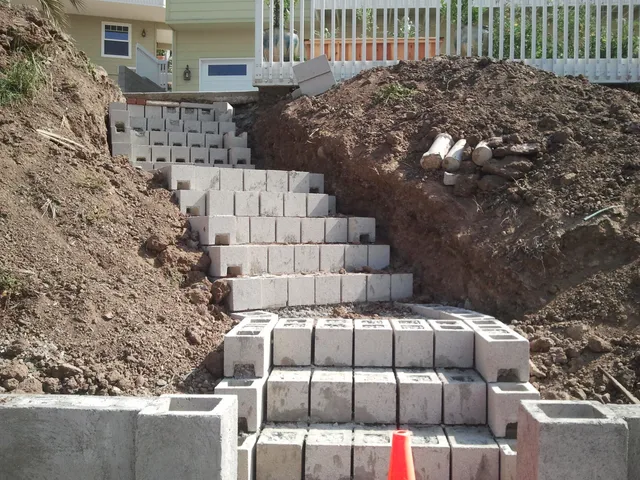
Wall footings, stem walls and foundations for additions, ADUs and garages, dug to sound bearing — through the valley loam or down to rock on a hillside — and inspected by the County before the pour.
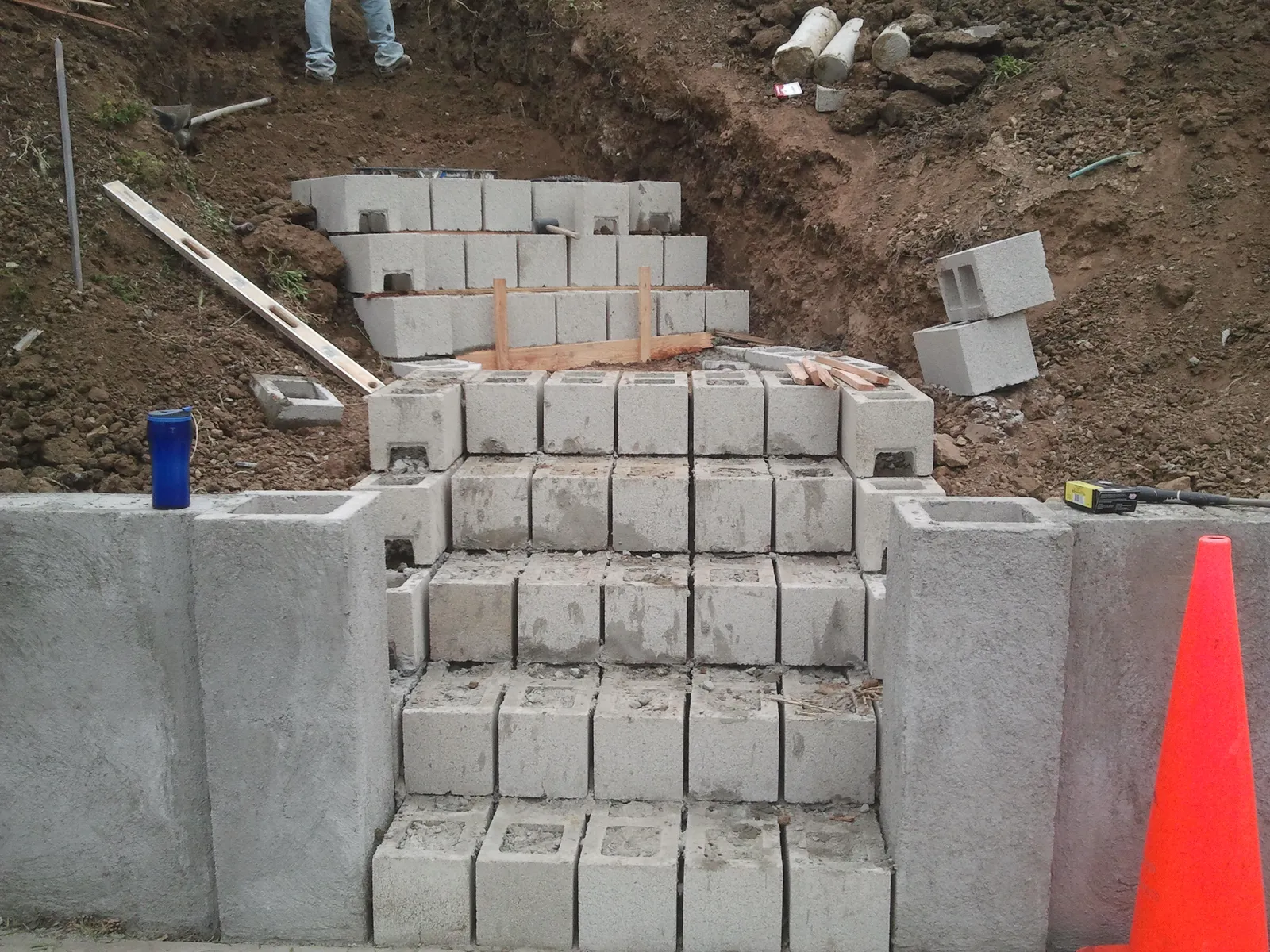
Footings for a wall or an ADU, a barn or garage slab, a long drive out to the road, or new walks and steps — poured on a prepared base, cured properly and protected on Ramona’s frosty nights. One licensed contractor, from forms to final finish, with a written price after a free site visit.
CSLB #979389 · C-29 Licensed · Bonded $25,000 · Free on-site estimates
Concrete in Ramona, by the numbers
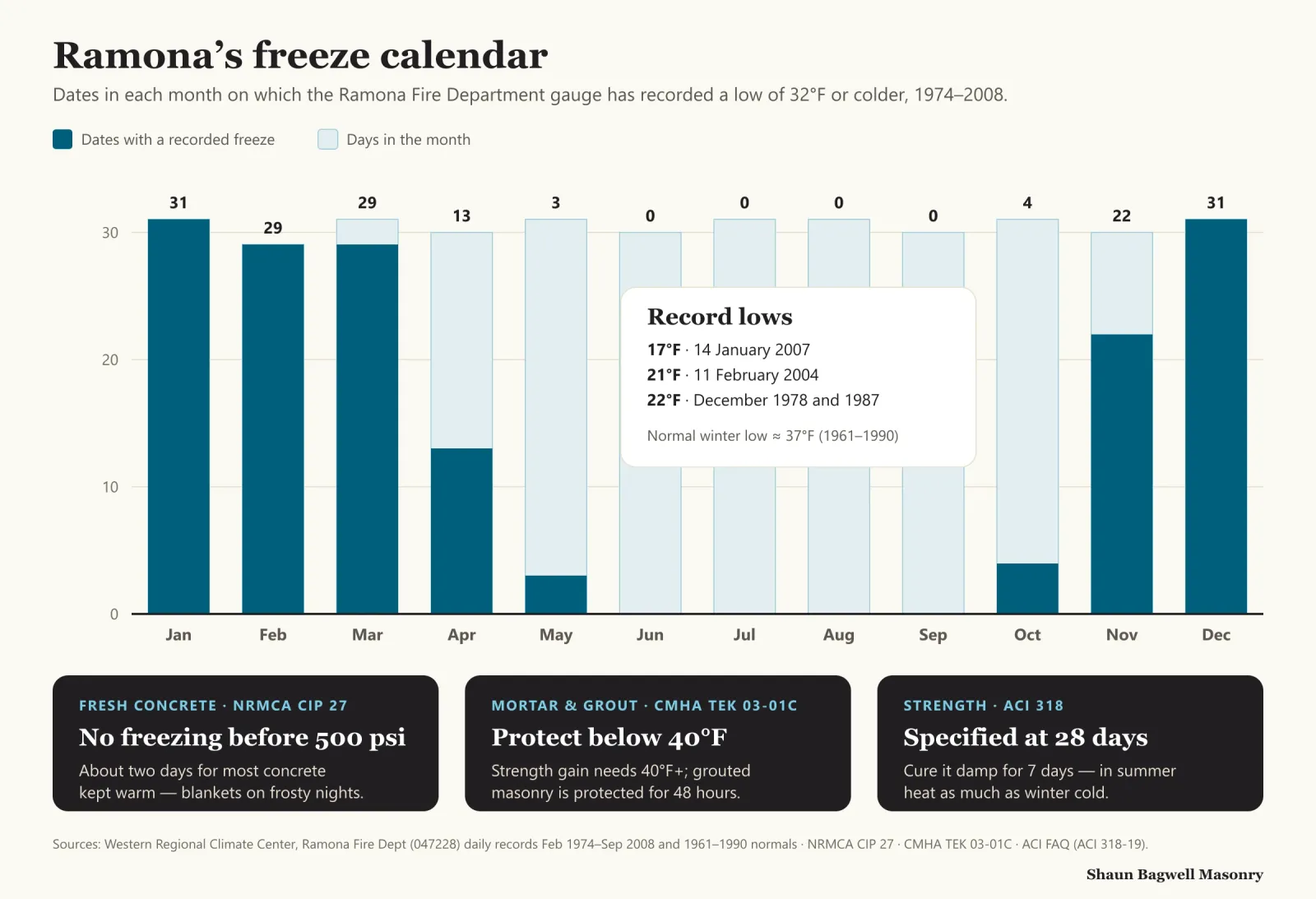
Ramona sits in an inland valley the federal wine-region ruling credits with “up to 320 frost-free days” — which leaves the rest of the year open to frost. The Western Regional Climate Center’s gauge at the Ramona Fire Department recorded a freezing low on 162 different calendar dates between 1974 and 2008, including every date from December through February, and a record 17°F on 14 January 2007. Even a normal winter night there bottoms out around 37°F.
That matters on pour day. Industry guidance is to keep new concrete from freezing until it reaches about 500 psi — roughly two days — and its specified strength is only measured at 28 days. Below 40°F, mortar and grout barely gain strength at all. Winter work in Ramona gets scheduled around the forecast and covered at night; summer work gets the opposite treatment, shaded and kept damp so it doesn’t dry out too fast.
Structural and flat work alike, usually alongside the masonry it supports. The County-wide detail is on our concrete services page.
Footings
Wall footings, stem walls and foundations for additions, ADUs and garages, dug to sound bearing — through the valley loam or down to rock on a hillside — and inspected by the County before the pour.
Driveways
Driveways from the house to the road, turnarounds and aprons, on a compacted base and thick enough for trucks and trailers. Where the apron meets a County road or Main Street, the right encroachment permit comes first.
Slabs
Reinforced slabs for barns, workshops, RV pads and equipment, with joints laid out before the pour and a vapour barrier where something sits on top.
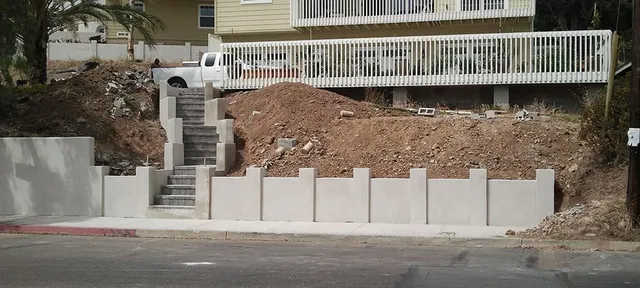
Flatwork
Broom, exposed-aggregate and stamped walks, steps and patios — including the continuous hardscape ring the County’s wildfire code calls for in the first 5 feet around a house.
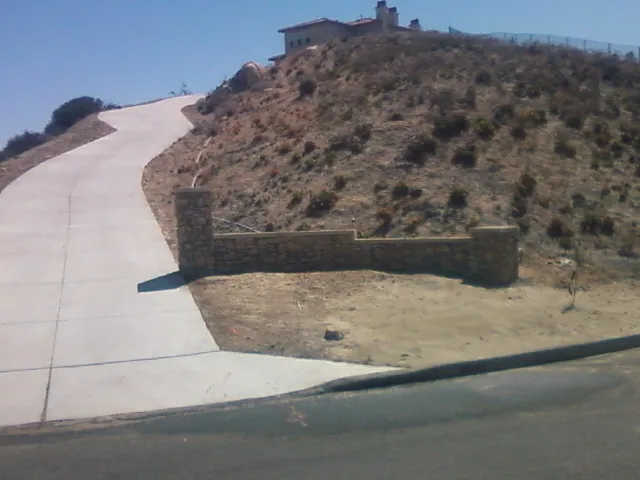
Repair
Broken panels saw-cut out, the wet or soft base underneath corrected, and the section re-poured and doweled to the old slab.
With masonry
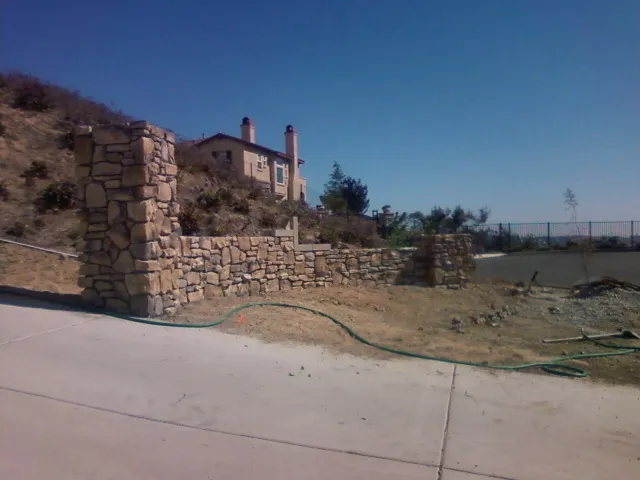
The concrete under our block walls, retaining walls and gate pilasters — sized to the County’s fence tables or the engineer’s drawings.
Ramona’s valley soils are loams; the Ramona series that the federal wine-region ruling names among them has a subsoil of 18–27% clay with moderately slow permeability (NRCS). Water lingers under a slab on that kind of ground, and wet ground under a slab is what freezes and heaves. So the base is compacted crushed rock, the grade falls away from the house, and downspouts don’t empty onto the edge of the concrete.
Then the slab is built to crack where we choose. Control joints go in at roughly 24 to 36 times the slab thickness — about 8 to 12 feet apart on a 4-inch slab, never more than 15 feet — cut to a quarter of the slab’s depth. Curing runs a default 7 days. In the cold months we pour in the morning, use blankets overnight and keep the concrete above freezing until it reaches 500 psi.
Flat work on your own land usually needs no building permit: the County exempts walks, platforms and driveways up to 30 inches above grade and not over a basement (PDS-110). Footings, foundations and structural slabs are different — they go through County Planning & Development Services with the building they carry, and the County inspects them before the pour.
The road is where Ramona gets specific. A driveway apron in a County road right-of-way needs a County Department of Public Works encroachment permit before any work there. Main Street isn’t a County road at all: it carries State Route 67, which ends at SR-78 in town, and Caltrans requires an encroachment permit for driveway work in a state highway right-of-way. We find out which agency owns your frontage before we quote the apron.
Both are fire-safe and both handle trucks when built on the right base. They differ in cost, repair and rebates.
| Poured concrete | Interlocking pavers | |
|---|---|---|
| Upfront cost | Lower (national guides: $6–$12 per sq ft for plain to coloured) | Higher (national guides: $8–$25 per sq ft overall) |
| Frost and ground movement | Cracks at control joints; base and drainage decide how much | Units flex; heaved areas are lifted and re-laid |
| Repairs | Saw-cut and re-pour a panel; colour rarely matches | Replace individual pavers |
| Rebates (unincorporated County) | Pervious concrete only | Permeable pavers can qualify for the County pavement rebate |
See our Ramona pavers page for permeable driveways and rebate details.
Measure, check drainage and fall, and find out who owns the road frontage — County or Caltrans.
County building permit for structural work; DPW or Caltrans encroachment for an apron.
Excavate, compact crushed rock in lifts, set forms and grade stakes.
Rebar or mesh on chairs; County inspection for footings and foundations.
Poured on a forecast-checked day, finished, and jointed on the layout we planned.
Kept damp for a week; blanketed on frosty nights until it’s safe from freezing.
Planning one? Shaun will walk the site with you and tell you what it needs — free, no obligation.
Call (619) 581-2492National cost-guide figures for comparison only — not our price. Ramona jobs vary with distance, access for the truck, base depth and any encroachment permit.
| Project (installed) | National cost guide |
|---|---|
| Concrete driveway, 24 × 24 ft, 5 in, broom | $3,460–$6,910 (avg $5,184) |
| Driveway, plain finish | $6–$8 per sq. ft. |
| Driveway, broom, coloured or exposed aggregate | $8–$12 per sq. ft. |
| Driveway, stamped | $12–$18 per sq. ft. |
| Poured concrete patio | $6–$17 per sq. ft. (2022) |
Sources: Fixr concrete driveway guide (Jan 2025) and Fixr patio guide (2022). San Diego County labour generally runs above national averages. You get an itemised written proposal after a free site visit.
Same County rules everywhere, different jobs from place to place.
The Ramona page covers the ground, permits and neighbourhoods across every kind of job. The county-wide pages go deeper on the build itself.
Straight answers before you hire. Anything else — call, and Shaun answers it himself.
Call (619) 581-2492Not for the part on your property — the County exempts driveways up to 30 inches above grade (PDS-110). The apron is different: work in a County road needs a County DPW encroachment permit, and a driveway onto Main Street (State Route 67/78) needs a Caltrans encroachment permit.
Yes, with care. Ramona’s fire-station gauge has recorded freezes on every date from December to February (WRCC), so we pour on mornings with a good forecast, use blankets overnight and keep the concrete from freezing until it reaches about 500 psi — roughly two days.
Usually water in the base, missing or widely spaced joints, or a slab too thin for the trucks on it. Valley loams like the Ramona series drain slowly (NRCS), and wet ground under a slab moves when it freezes or dries. Joints at 24–36 times the thickness put the cracks where they belong.
Four inches is a common minimum for cars; heavier vehicles call for 5 inches or more, with steel and a deeper compacted base. On a ranch drive we size the slab to what actually uses it.
Yes. The County’s 2026 wildfire code requires the first 5 feet around a building to be continuous hardscape or noncombustible material (§604.12.1), and concrete is hardscape. It won’t earn a turf rebate, though — impermeable surfaces are disqualified.
National cost guides put a 24 × 24 ft broom-finish driveway at $3,460–$6,910 (Fixr, 2025). Ramona prices depend on access, base depth and any encroachment permit. You get an itemised written proposal after a free site visit.
Shaun Bagwell Masonry holds California C-29 licence #979389, bonded and insured. Check it at cslb.ca.gov.
Call Shaun at (619) 581-2492 or send the form. He’ll look at the ground and the road frontage, plan the pour around the season, and give you a written price.