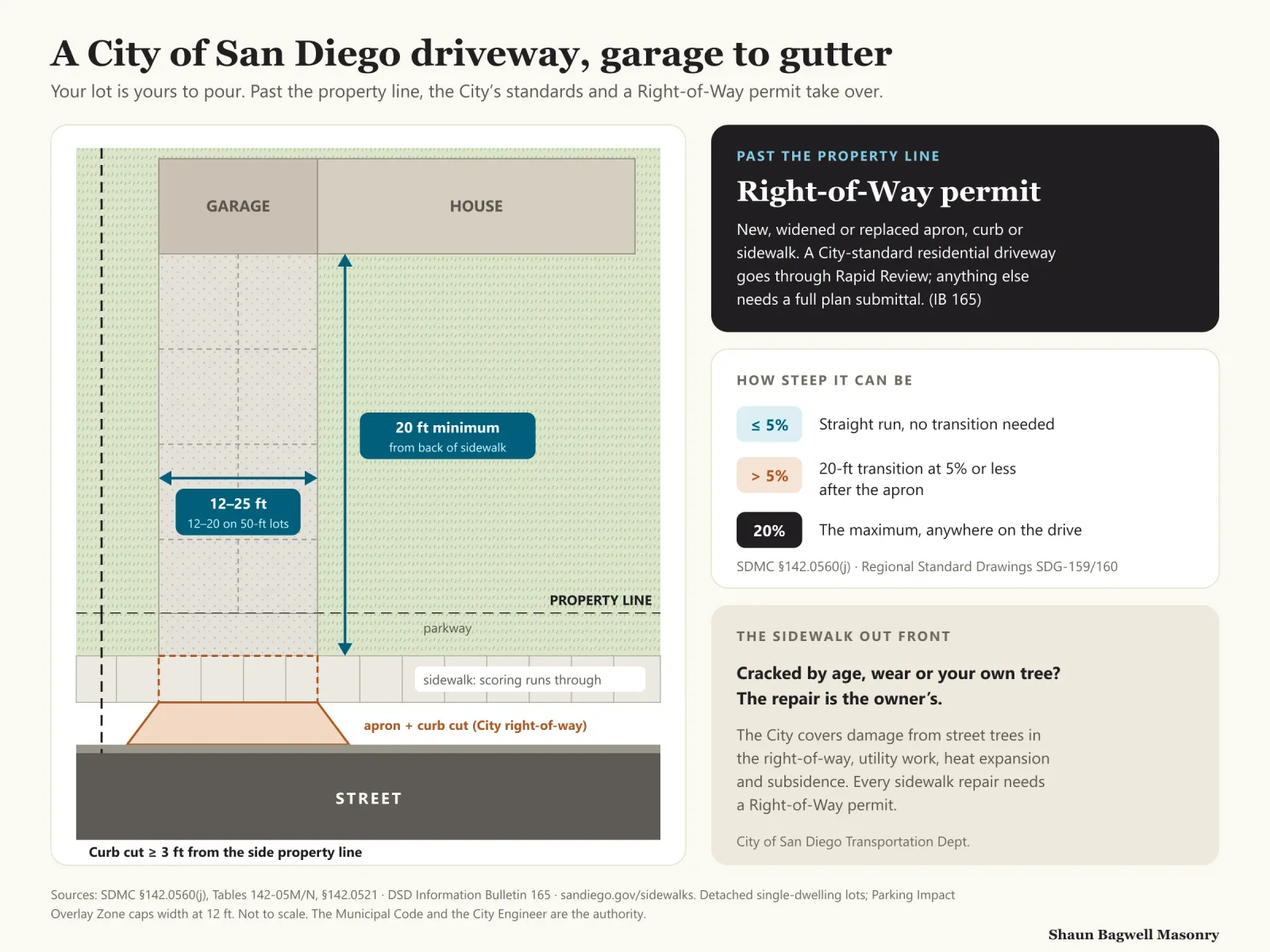
Finished stucco block retaining walls and a stair on a corner lot above the City sidewalk and curb at Gardena Avenue and Illion Street in Bay Park, San Diego.

Concrete Driveways, Slabs & Sidewalks in the City of San Diego

A new driveway and apron, a sidewalk the City says is yours to fix, or footings and a slab on difficult ground — poured to the City’s standards, with the Right-of-Way permit handled for you. Free on-site estimate, quoted by the owner.

CSLB #979389 · C-29 Licensed · Bonded $25,000 · Free on-site estimates

City concrete by the numbers

Your Lot, Your Rules — the Sidewalk and Curb Are the City’s

On your own lot, a driveway, walk or patio slab 30 inches or less above grade needs no City building permit (SDMC §129.0203). The moment the work crosses the property line — a new or wider apron, a curb cut, a replaced sidewalk panel — it is public right-of-way, and “all improvements in the Right-of-Way require review and approval” (Information Bulletin 165).

The City also puts the sidewalk out front on you: normal wear, age and damage from your own trees are the owner’s to repair, and a Right-of-Way permit is required for every sidewalk repair. Get the driveway’s geometry right while you’re at it — at least 20 feet long from the back of the sidewalk, 12 to 25 feet wide on a lot over 50 feet, and never steeper than 20%.

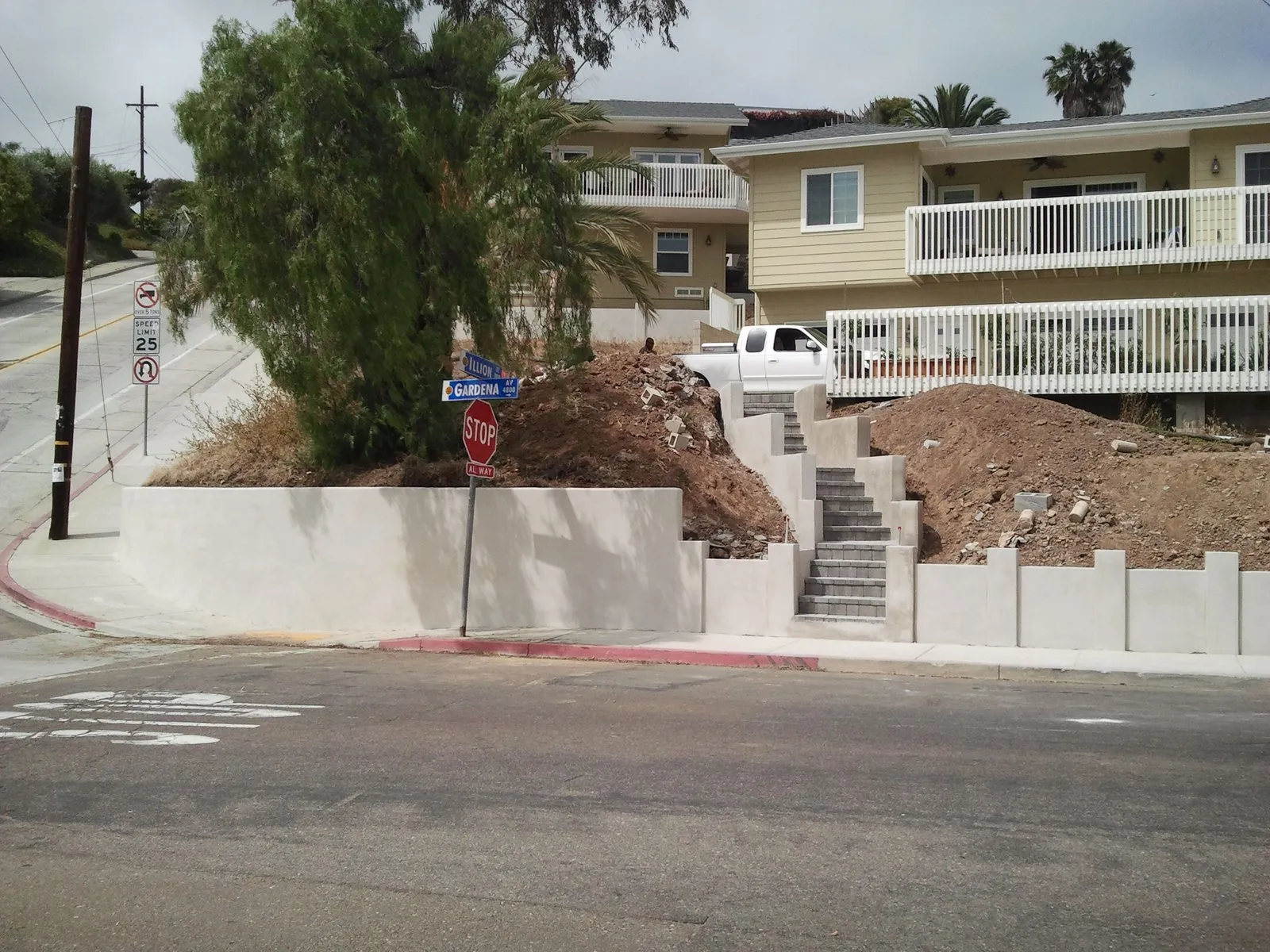
Infographic titled A City of San Diego driveway, garage to gutter. A plan view shows a garage and house, a driveway 12 to 25 feet wide (12 to 20 on 50-foot lots) and at least 20 feet long from the back of the sidewalk, the property line, a parkway, the sidewalk whose scoring runs through the driveway, and the apron and curb cut in the City right-of-way, with the curb cut at least 3 feet from the side property line. Panels explain that past the property line a Right-of-Way permit is needed, with Rapid Review for a City-standard residential driveway; that a driveway may run straight up to 5 percent, needs a 20-foot transition at 5 percent or less when steeper, and may never exceed 20 percent; and that sidewalk damage from age, wear or your own tree is the owner’s to repair, while the City covers street-tree, utility, heat-expansion and subsidence damage, with a Right-of-Way permit required for every sidewalk repair.
Everything from the property line to the gutter belongs to the City — its standard drawings, its permit, its inspection. Inside the line the slab is yours, and the soil decides how it’s built.Sources: SDMC §142.0560, §142.0521; IB 165; City sidewalk page.

Concrete We Pour Inside City Limits

Footings, slabs and flatwork mixed, reinforced, jointed and cured for the ground they sit on. County-wide detail is on our concrete page.

Driveways

Driveways and aprons

Tear-out and replacement, widening and new curb cuts — the slab on your lot thickened where cars turn, the apron built to the City’s standard drawings under a Right-of-Way permit, with Rapid Review where the design is City-standard.

Sidewalks

Sidewalk repair out front

Lifted or cracked panels the City has flagged as the owner’s responsibility, replaced under a Right-of-Way permit with the existing scoring and colour matched.

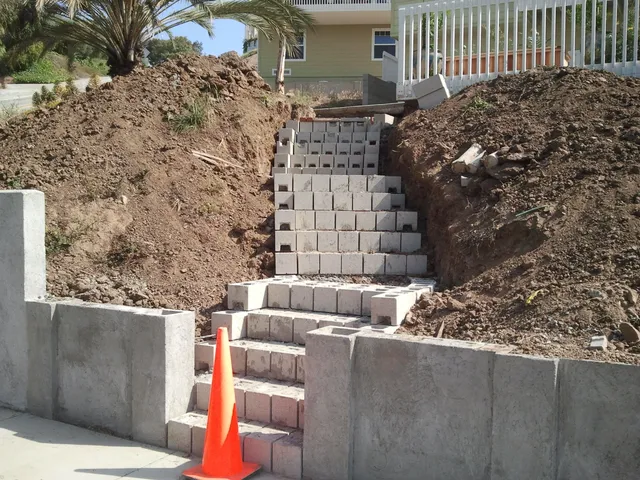
A concrete-block stair rising up a cut slope on new footings between block walls at the Bay Park job.

Footings

Footings and foundations

Footings for walls, additions, fireplaces and posts, excavated to firm soil and inspected before the pour. Structural work always needs a permit — we handle it.

Slabs

Patio slabs, pads and walks

Patio and equipment slabs, side-yard walks and steps, broom, exposed-aggregate or stamped, with control joints cut at the right spacing so the cracks go where we put them.

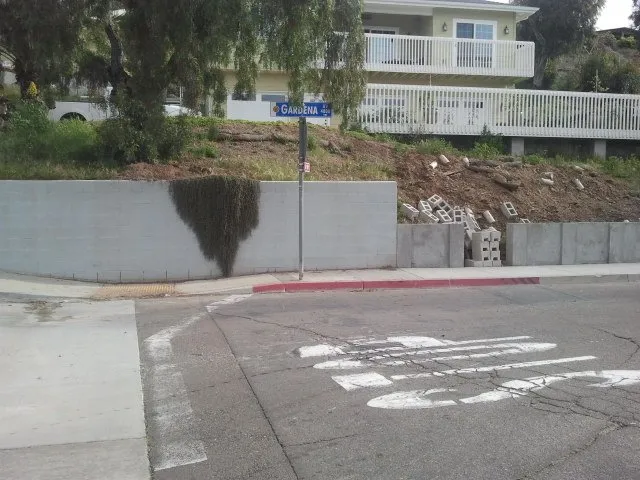
A street-front corner before the work at the Bay Park job: an old block wall at the sidewalk with new block staged on the lot.

Tear-out

Replacing tired 1960s–70s concrete

San Carlos, Pacific Beach and Point Loma driveways and walks poured fifty or more years ago, broken out and replaced on a proper base instead of overlaid.

Steps

Steps and stair landings

Poured or block-cored steps on hillside entries, with uniform risers and a landing at the sidewalk that drains to the street, not the house.

How the Slab Is Built, Not Just Poured

Concrete is specified by its 28-day compressive strength; early tests only track progress. It reaches that strength only if it stays moist — the ACI default is 7 days of curing, or until it reaches 70% of design strength — which is why we cure every pour instead of walking away from it. Joints go in at roughly 24 to 36 times the slab thickness, cut a quarter of the way through.

The ground under a City slab ranges from Point Loma sandstone to Mission Valley river alluvium the City’s own geotechnical review calls unsuitable for improvements in its current state, and the Rose Canyon fault — capable of an M6.9 in the USGS scenario — runs through the middle. Footings for walls and structures follow City standards such as the 3,000-psi footing concrete in IB 221, and on poor ground an engineer’s design.

Design strength
Measured at 28 days
3- and 7-day breaks track progress, not acceptance.ACI
Curing
7 days or 70% f′c
The ACI 308.1 default, above 50°F.FHWA / ACI 308.1
Control joints
24–36 × thickness
About 8–12 ft apart on a 4-in slab; ¼ of the depth.NRMCA CIP 6
Driveway slab
4 in minimum
Thicker, with edges thickened, where vehicles load it.ConcreteNetwork
Sunlight reflected
30–50% (new concrete)
Versus about 5% for new asphalt — a cooler driveway.LBNL

City of San Diego Right-of-Way and Driveway Rules

IB 165 covers curb, gutter and sidewalk replacement, new sidewalk, residential and commercial driveways and curb ramps. A City-standard residential driveway (remove and replace, or new) and up to 150 linear feet of curb, gutter and sidewalk replacement qualify for Rapid Review; a non-standard design needs a full plan submittal, and work tied to a building permit isn’t eligible. Plans show the curb-to-property-line distance, the sidewalk and utilities, and a Traffic Control Permit may also be needed.

The driveway itself is set by SDMC §142.0560(j): openings follow the Regional Standard Drawings, the curb cut stays at least 3 feet from the side property line, there’s one driveway per lot without alley access, and two driveways serving the same lot need 45 feet of full-height curb between them. Inside the Parking Impact Overlay Zone a single-dwelling driveway is capped at 12 feet wide.

Apron, curb, sidewalk
Right-of-Way permit
Rapid Review for City-standard residential driveways.IB 165
On-lot flatwork
Exempt to 30 in
Above grade, not over a story, not an accessible route.SDMC §129.0203(a)(7)
Curb cut to side property line
3 ft minimum
So a standard apron fits; drive aisle 10–25 ft wide.SDMC §142.0521
Gradient
5% straight · 20% max
Steeper than 5% needs a 20-ft transition at 5% or less.SDMC §142.0560(j)
Sidewalk repair
Owner’s duty
For wear, age and private-tree damage; permit for every repair.City of San Diego

Concrete or Pavers for a City Driveway?

Both work on a San Diego lot. Here’s how they differ once the City’s rules and the ground come into it.

Concrete or Pavers for a City Driveway?
Poured concretePavers
On your lotExempt to 30 in above gradeExempt to 30 in above grade
Apron at the curbBuilt to the City’s standard drawingsApron still follows the City standard
After a utility digSaw-cut and patch — the patch showsLift and relay the same pavers
National installed cost$5–$8/sq ft plain; $14–$21 stamped$8–$25/sq ft
HeatReflects 30–50% of sunlight newDepends on colour and finish

Costs: ConcreteNetwork (Jan 2026) and Fixr (Aug 2025), national. See our San Diego pavers page for the paver side.

How a City Concrete Job Runs

  1. Measure and photograph

    Lot width, curb-to-property-line distance, slope, existing joints and utilities — the facts the City’s plan form asks for.

  2. Permit path

    On-lot work exempt or not; Rapid Review or a full submittal for the right-of-way; traffic control if the street is involved.

  3. Break out and haul

    Old concrete removed to clean, firm soil; soft spots dug out and replaced with compacted base.

  4. Form, base and steel

    Forms set to grade and fall, base compacted, reinforcement placed and chaired; right-of-way forms inspected before the pour.

  5. Pour, finish, joint

    Placed and finished to the specified texture, joints tooled or saw-cut at the right spacing, and the sidewalk scoring carried across the drive.

  6. Cure and hand over

    Cured, not left to dry; you’re told when to walk and when to drive on it.

Planning one? Shaun will walk the site with you and tell you what it needs — free, no obligation.

(619) 581-2492

What Concrete Costs in San Diego

Demolition, access and the right-of-way work drive City jobs more than the yardage does. Published national figures to start from — not our quote:

What Concrete Costs in San Diego
ItemPublished range
Plain gray driveway (ConcreteNetwork, 2026)$5–$8 per sq ft
Broom, coloured or exposed aggregate (ConcreteNetwork)$8–$14 per sq ft
Stamped, two or more colours (ConcreteNetwork)$14–$21 per sq ft
Typical two-car driveway, national (ConcreteNetwork)$3,200–$13,000
24 × 24 ft, 5-in broom-finish driveway (Fixr, 2025)$3,460–$6,910

National cost guides; San Diego labour and tear-out usually sit toward the top. Right-of-Way permit fees are set by the City and quoted separately.

What’s Under the Slab, Neighbourhood by Neighbourhood

The rules are citywide; the ground isn’t. ZIP figures are Census ACS 2020–2024 estimates.

  • Mission ValleyZIP 92108San Diego River alluvium and fill with liquefaction risk, per the City’s 2019 geotechnical review — structural slabs and footings here usually start with a soils report.
  • Pacific BeachZIP 92109About 97% built out, so concrete work is replacement on tight lots, with the Rose Canyon fault trace along I-5 and pockets of liquefaction potential noted in the community plan.
  • Point LomaZIP 92106The oldest stock of these areas — median home built 1958, a fifth from before 1940 — on the peninsula’s sandstone. Historical screening applies whenever the work needs a permit.
  • San Carlos & Del CerroZIP 92119Almost half the homes went up in the 1960s, on lots that climb toward Cowles Mountain — steep drives where the 5% and 20% gradient rules matter.
  • TierrasantaZIP 921241970s and ’80s tracts on canyon rims; side-yard walks and pads on slopes need a footing or edge that won’t creep downhill.
  • Bay Park & ClairemontZIP 92110Hillside streets above Mission Bay — the corner lot in our photos at Gardena Avenue and Illion Street meets the City sidewalk right at the wall line.

Concrete Questions

Straight answers before you hire. Anything else — call, and Shaun answers it himself.

(619) 581-2492

Do I need a permit to replace my driveway in San Diego?

The part on your lot is exempt if it’s 30 inches or less above grade (SDMC §129.0203). The apron, curb cut and any sidewalk you touch are City right-of-way and need a Right-of-Way permit (IB 165); a City-standard residential driveway goes through Rapid Review.

How wide can my driveway be?

For a detached single-dwelling lot over 50 feet wide, 12 to 25 feet; on a lot 50 feet or narrower, 12 to 20 feet; and 12 feet maximum inside the Parking Impact Overlay Zone (SDMC Tables 142-05M and 142-05N). The curb cut stays at least 3 feet from the side property line.

Who pays to fix the sidewalk in front of my house?

In the City of San Diego, normal wear, age and damage from trees on your own property are the owner’s responsibility. The City covers damage from street trees in the right-of-way, City utility work, heat expansion and subsidence. Every sidewalk repair needs a Right-of-Way permit.

How steep can a driveway be?

Up to 5% with no transition. Steeper than that, the City requires a 20-foot transition at 5% or less after the apron, and no part of the driveway may exceed 20% (SDMC §142.0560(j)). On San Carlos and Point Loma hillsides that often shapes the whole design.

How long before I can drive on new concrete?

Walk on it after about 24 hours and drive on it after about 7 days (ConcreteNetwork). The ACI default is 7 days of curing, or until the concrete reaches 70% of its design strength — and the design strength itself is measured at 28 days, so keep heavy trucks off for the first month.

Can you match my old sidewalk scoring?

Yes — and where a driveway crosses the sidewalk, the City requires the sidewalk’s scoring pattern and colour to continue across it.

Are you licensed for concrete work?

Shaun holds California contractor licence #979389 (C-29), verifiable at cslb.ca.gov, and pulls the City permits on the jobs that need them.

Price Your City of San Diego Driveway or Sidewalk

One visit covers the measurements the City asks for, the permit path and the price. Call Shaun directly.

(619) 581-2492

Call Now(619) 581-2492Estimate